


Key takeaways
- "Supports" is structure/function wording. It tells you how an ingredient helps the body's normal work. U.S. law allows this kind of statement on a supplement label.
- The small asterisk after a claim points to a required FDA notice. The company must have evidence for the claim, and it must tell FDA about it within 30 days of using it.
- Your liver, kidneys and gut do your body's detox work every day. On a label, "detox support" describes a helping role in that work.
- In daily life, support can mean nutrients and fiber, a steady routine and plants with a long history of traditional use.
- You can read any label the same way. Look for a normal function, the asterisk and the FDA notice, and nothing that points to a disease.
A small star with a big job
Pick up almost any supplement bottle and turn it around. Somewhere on the label, a short sentence ends with a tiny asterisk. Follow that star and it leads to a notice in bold type, often set inside a box.
The rules for that notice are precise. Federal rules spell out its exact words. They even require bold letters at least one-sixteenth of an inch tall.[1] That little star is how you can tell a "support" statement apart from other kinds of claims.
"Detox support" is one of the most common phrases in this part of the store. This guide explains what "support" means on a label and what your body's own detox work involves. It also shows what support can look like in your day. It ends with a word-by-word reading of one common label phrase.
What "support" means on a supplement label
In 1994, Congress passed a law called the Dietary Supplement Health and Education Act, or DSHEA. It lets supplements carry statements about how a nutrient or ingredient affects the body's normal structure or function.[2]
These are called structure/function claims. FDA's own example is plain: calcium builds strong bones.[3] A claim like this describes a healthy body doing its usual work. Verbs such as "supports," "maintains" and "helps" fit right in.
A support claim names a body system and a normal job, which makes it easy to read. A phrase like "supports cardiovascular health" points to the heart and blood vessels. "Supports healthy digestion" points to the gut's everyday work. Neither one mentions a disease or a symptom.
The law allows two related kinds of statements. A general well-being claim says how a nutrient or ingredient adds to how you feel overall. A nutrient shortfall claim ties a benefit to a classic deficiency. It must also say how common that deficiency is in the United States.[2][3]
Each structure/function claim comes with three duties for the company:
- It must have evidence that the claim is true and not misleading.[2]
- It must tell FDA about the claim within 30 days after the product first goes on sale with it.[1]
- It must print the standard FDA notice. The notice sits right beside the claim or is linked to it by a symbol such as an asterisk.[1]
FDA does not approve these claims before they appear.[3] The company is responsible for backing them up.
Ads have a second referee, too. The Federal Trade Commission expects health claims in ads to rest on sound science. The FDA notice doesn't change that.[4] Our guide to what DSHEA means for you at the shelf covers the law in more depth.
Where support ends and disease claims begin
Supplements have to stay on one side of a clear line. A claim crosses it when it says or hints that a product affects a disease or its typical signs.[1]
FDA defines a disease as damage to an organ, part, structure or system of the body that keeps it from working properly.[1] The test covers hints as well as plain words. A product name, a picture or a nod to research about a disease can turn an ordinary sentence into a disease claim.[1]
That's why careful labels stick to normal function. A phrase like "helps maintain healthy bones" describes the body doing its everyday job. It stays on the structure/function side of the line.
| Type of statement | What it describes | Example wording |
|---|---|---|
| Structure/function | A nutrient or ingredient's role in normal body function | "Calcium builds strong bones," FDA's own example [3] |
| General well-being | Overall wellbeing from a nutrient or ingredient | "Supports overall wellness" |
| Disease claim | Any effect on a disease or its typical signs | Not allowed on a dietary supplement [1] |
Your body's detox work, in one minute
Detoxification is a normal job your body does every day. Over a lifetime, you may meet 1 to 3 million different foreign compounds.[5] They include medicines, pollution, cosmetics and food additives. Your body also clears leftovers from its own chemistry.
Most of the chemical work happens in the liver, in two steps. First, enzymes change a compound so a tag can attach. Then the liver adds a water-friendly tag, so the compound can dissolve in water and leave.[5] Our guide to what detox means inside the body explains these two stages in more detail.
Your kidneys filter about 150 quarts of blood a day. Only 1 to 2 quarts leave as urine.[6] Bile carries other compounds into the gut, and they leave in stool. Breath and sweat play small parts.[5]
Our guide to how your body's natural detoxification processes work every day walks through each organ. One point matters most here. These systems run every day, so "support" describes a helper's role in work your body already does.
What support can mean in daily life
If your body does the work, support means caring for what that work runs on. Three kinds of support come up most often.
The first is supplying raw materials. Some of the tags your liver attaches are amino acids, such as glycine.[5] Your body gets amino acids from the protein you eat. Vitamins, minerals and fiber come from food, too.
Fiber is the clearest gap for most people. National surveys suggest only about 5% of Americans get the recommended amount.[7] Fiber adds bulk and holds water on the last stretch out. Our guide to your daily fiber number shows how big the gap is.
In a small study of 15 healthy adults, adding psyllium husk to a set diet for a week made stools heavier and moister.[8] The researchers traced this to a part of psyllium that forms a gel and that gut bacteria don't break down. In their tests, the gel acted like a lubricant.
The second is keeping a steady rhythm. Your detox systems work every day, so daily habits suit them. In one study of everyday habits, a new daily action took about 66 days on average to feel automatic.[9] Missing a single day didn't undo the progress.[9]
Linking a new step to one you already do, like breakfast, makes it easier.[9] Our guide to anchor habits shows how. Water, movement and sleep belong in the same daily rhythm. Your kidneys need fluid to do their work, and our guide to how much fluid you need has the numbers.
The third is plants with a long history. Turmeric has a place in Ayurvedic and traditional Chinese practice.[10] Dandelion has a history in Mexican and other North American traditions.[11] Ginger has long been used in folk practice,[12] and milk thistle has a long record in herbal tradition as well.[13]
These plants have traveled far. Turmeric belongs to the ginger family and is grown in Southeast Asia and India. Its underground stem is the part used, in cooking and in traditional practice.[10] Milk thistle, a tall plant with large purple flowers, is native to Europe and came to North America with early colonists.[13] Taken by mouth, milk thistle appears to be well tolerated.[13]
Traditional use tells you how people have used a plant over many generations, in foods, teas and home preparations. Researchers today continue to explore several of these plants in modern studies.
Reading "supports your body's natural detoxification processes"
A phrase like this one shows up on detox-style labels, usually followed by a small asterisk. Here is what each part of it tells you, asterisk included.
| Words | What they tell you | Why it matters |
|---|---|---|
| "Supports" | A helping role, in structure/function language | Your body does the work |
| "Your body's" | The subject is you, not the capsule | Matches how detox works inside you |
| "Natural" or "normal" | Everyday processes in a healthy body | No disease is named or hinted at |
| "Detoxification processes" | The liver, kidney and gut work described above | A real function, in general terms |
| The asterisk | A link to the FDA notice | Marks a structure/function claim |
Some labels use "normal" in place of "natural." Both words point to everyday function in a healthy body.
Read this way, the phrase is modest and specific. It describes a helping role in the work your liver, kidneys and gut do every day. It sets no deadline and doesn't name a single substance to be removed. Wording like this stays on the structure/function side of the line described above.
You can use the same reading on any label. First, check that the claim names a normal function, and look for the asterisk and the FDA notice. Then scan the rest of the label, including the product name and any pictures. None of it should point to a disease.[1] Our guide to choosing a detox supplement has more checks.
Where a support formula fits in your day
A support claim tells you what a formula is meant for. The directions tell you where it belongs in your day, so read the two together.
A formula built on fiber, such as psyllium husk, should ask for plenty of water, since fiber soaks up fluid. It fits easily around a meal, when a full glass is already on the table. Botanical formulas vary more. One with green tea extract or guarana can bring natural caffeine with it, which places it in the morning. An evening formula built around botanicals traditionally taken at night is written for the quiet stretch before bed. Other products are a short routine with a clear start and finish, such as a set number of days after a trip.
Picture where the bottle would actually live: beside the coffee maker with a glass waiting next to it, on the nightstand by the book you're halfway through, or in a week circled on the calendar after the holidays. Our guide to where you keep the bottle has practical tips.
Whichever style appeals to you, the label reading stays the same. Read the claim and its asterisk, the FDA notice, the directions and any cautions. Each style sits alongside meals with protein and fiber, enough water, regular movement and steady sleep. None of them should ask you to fast or replace meals.
Before you start
- Read the full label and follow the directions. If a label sets a time limit, such as 7 days, keep to it.
- Psyllium swells as it soaks up water. Take each dose with a full 8 ounces of liquid.[14] When you add fiber from food, add it gradually over a few weeks.[15]
- Psyllium shouldn't be taken at the same time as some medicines. Ask your pharmacist how far apart to space them.[16]
- Green tea extract and guarana can both supply caffeine. If you're sensitive to caffeine, count them along with your coffee and tea, and keep them to the morning.
- Milk thistle is a relative of ragweed, marigolds and daisies. If you're allergic to those plants, ask your pharmacist before trying it.[13]
- If you take a water pill (diuretic) or another daily medicine, ask your pharmacist before adding dandelion.[11]
- Some evening formulas contain valerian or 5-HTP. 5-HTP affects serotonin, and formulas with it are for adults only. Ask your doctor first if you take an antidepressant, a sedative or a sleep aid. Take an evening formula at bedtime as the label directs, and don't drive if you feel drowsy.
- Some formulas include oyster or other shellfish extracts. Check the allergen information if you are allergic to shellfish.
- Check with your doctor or pharmacist first if you take prescription medicine, are pregnant or nursing, or have a health condition.
When to see a clinician
Some changes deserve a professional's eyes. Talk with a health care professional promptly if you notice:
- yellowing of the skin or the whites of the eyes, or dark urine
- blood in your stool
- a lasting change in bowel habits
- belly pain that won't go away, or vomiting
- trouble swallowing or chest discomfort after taking a fiber product
- any new symptom that started after a new medicine or supplement
Frequently asked questions
Does "detox support" mean a product removes toxins by itself?
No. Your liver, kidneys and gut do that work. A support claim describes a product's role alongside them, such as supplying fiber or plants with a long traditional history.
Why does the label say FDA hasn't evaluated the statement?
FDA doesn't review structure/function claims before they appear. That's why the law requires the notice beside or linked to each one. The company still needs evidence for the claim, and it must tell FDA within 30 days of using it.[1][2]
Is a phrase like "helps maintain healthy bones" a medical claim?
No. It describes a healthy part of the body doing its usual work, which is structure/function wording. A statement about a condition or its symptoms would be a disease claim, and supplements can't make those.[1]
Is detox support the same as a cleanse?
The two words often appear side by side on labels. Some cleanse plans are built around juice or fasting. Support wording describes a helping role in work your body does every day, and it fits alongside regular meals, whether your routine is daily or a defined week. Our guide to daily detox support versus a 7 day wellness reset compares the two.
Can food alone support these processes?
Food is the foundation. Protein, fruits, vegetables, whole grains and beans supply much of what these systems use, and a supplement is meant to add to that base. The NIH Office of Dietary Supplements notes that supplements can help you get enough of some nutrients. It adds that they can't take the place of a varied diet.[17]
The short version
"Detox support" is structure/function language. "Supports" describes a helping role in the body's normal work. The asterisk links the claim to a required FDA notice. The company must have evidence for the claim and must tell FDA within 30 days of using it. Your liver, kidneys and gut handle detox every day. Support can mean nutrients and fiber, a steady routine and plants with a long traditional history. Read word by word, a phrase like "supports your body's natural detoxification processes" puts your body first and gives the formula a helping role.
This article is for general education. It is not medical advice, and nothing here is intended to diagnose, treat, cure or prevent any disease. If you take prescription medicines, are pregnant or breastfeeding, or have a medical condition, talk with your doctor or pharmacist before starting any supplement, and never stop or change a prescribed medicine on the basis of general information.
Sources
- Code of Federal Regulations. 21 CFR 101.93, Certain types of statements for dietary supplements. eCFR. https://www.ecfr.gov/current/title-21/chapter-I/subchapter-B/part-101/subpart-F/section-101.93
- Federal Food, Drug, and Cosmetic Act, section 403(r)(6), 21 U.S.C. 343(r)(6). U.S. Code via GovInfo. https://www.govinfo.gov/content/pkg/USCODE-2023-title21/html/USCODE-2023-title21-chap9-subchapIV-sec343.htm
- U.S. Food and Drug Administration. Label Claims for Conventional Foods and Dietary Supplements. https://www.fda.gov/food/nutrition-food-labeling-and-critical-foods/label-claims-conventional-foods-and-dietary-supplements
- Federal Trade Commission. Health Products Compliance Guidance. December 2022. https://www.ftc.gov/business-guidance/resources/health-products-compliance-guidance
- Esteves F, Rueff J, Kranendonk M. The central role of cytochrome P450 in xenobiotic metabolism: a brief review on a fascinating enzyme family. J Xenobiot. 2021;11(3):94-114. https://pmc.ncbi.nlm.nih.gov/articles/PMC8293344/
- National Institute of Diabetes and Digestive and Kidney Diseases. Your Kidneys & How They Work. https://www.niddk.nih.gov/health-information/kidney-disease/kidneys-how-they-work
- Quagliani D, Felt-Gunderson P. Closing America's fiber intake gap: communication strategies from a Food and Fiber Summit. Am J Lifestyle Med. 2017;11(1):80-85. https://pmc.ncbi.nlm.nih.gov/articles/PMC6124841/
- Marlett JA, Kajs TM, Fischer MH. An unfermented gel component of psyllium seed husk promotes laxation as a lubricant in humans. Am J Clin Nutr. 2000;72(3):784-789. https://pubmed.ncbi.nlm.nih.gov/10966900/
- Gardner B, Lally P, Wardle J. Making health habitual: the psychology of 'habit-formation' and general practice. Br J Gen Pract. 2012;62(605):664-666. https://pmc.ncbi.nlm.nih.gov/articles/PMC3505409/
- National Center for Complementary and Integrative Health. Turmeric. https://www.nccih.nih.gov/health/turmeric
- National Center for Complementary and Integrative Health. Dandelion. https://www.nccih.nih.gov/health/dandelion
- National Center for Complementary and Integrative Health. Ginger. https://www.nccih.nih.gov/health/ginger
- National Center for Complementary and Integrative Health. Milk Thistle. https://www.nccih.nih.gov/health/milk-thistle
- Code of Federal Regulations. 21 CFR 201.319, Water-soluble gums, hydrophilic gums, and hydrophilic mucilloids (including psyllium): warnings and directions. eCFR. https://www.ecfr.gov/current/title-21/chapter-I/subchapter-C/part-201/subpart-G/section-201.319
- MedlinePlus Medical Encyclopedia. Fiber. U.S. National Library of Medicine. https://medlineplus.gov/ency/article/002470.htm
- MedlinePlus. Psyllium. U.S. National Library of Medicine. https://medlineplus.gov/druginfo/meds/a601104.html
- NIH Office of Dietary Supplements. Dietary Supplements: What You Need to Know. https://ods.od.nih.gov/factsheets/WYNTK-Consumer/
Product information
Facts from the product pages. Before using any supplement, read the full label, directions and cautions on the product page, and check with your doctor or pharmacist if you take medicines, are pregnant or nursing, or have a health condition.
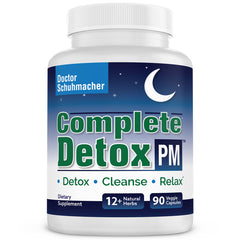
Longevity Complete Detox PM
- Size
- 90 capsules · 30 night supply
- Directions
- 3 capsules once daily, preferably about 30 minutes before sleep
- Ingredients
- Contains botanical extracts together with GABA and 5-HTP.
- Routine
- Designed as an evening supplement routine.
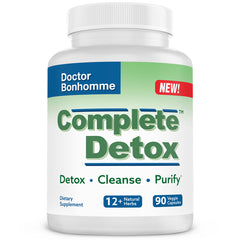
Longevity Complete Detox (Day Formula)
- Size
- 90 capsules · 30 servings
- Directions
- 3 capsules once daily
- Ingredients
- A botanical and fiber based formula containing ingredients including psyllium husk, green tea extract, dandelion extract and acai.
- Routine
- Designed for a simple daytime wellness routine.


