


Key takeaways
- Many ingredients in detox-style formulas are familiar plant parts. Think seed husks, roots, leaves, berries and a dried citrus peel.
- Each ingredient has its own story. Psyllium supplies fiber, herbs like milk thistle carry long traditions, and fruits like acai bring plant compounds.
- Researchers study these plants from many angles. Psyllium is among the best-studied fibers, and scientists continue to explore dandelion, acai and many others.
- The plant part matters. Aloe inner leaf gel and aloe latex come from the same leaf but act very differently in the body.
- A few habits help. Take psyllium with a full glass of water and follow each label's directions. If you take prescription medicine, ask a pharmacist first.
Reading an ingredient list like a map
Turn a detox supplement around and the ingredient list reads like a map. One fruit grows on palm trees in the Brazilian Amazon.[1] A citrus peel is dried and stored for three years or more in China before it's considered ready.[2] One root was already in use in ancient Greece and Rome.[3]
Some names will be familiar from your spice rack, like turmeric and ginger. Others, like Job's tears and wild jujube, are better known in East Asian kitchens and herbal traditions.[4][5]
This guide covers ingredients that often turn up in detox-style formulas, one at a time. Each gets its plant part, its traditional use, the research and one good-to-know note.
Why a formula mixes different ingredients
A blend makes more sense when you sort it by role. The ingredients in this guide fall into four groups.
- Fiber comes from psyllium husk.
- Traditional botanicals include milk thistle, dandelion, turmeric, ginger, aloe and Job's tears.
- Plants studied for their antioxidant compounds include green tea, acai, tangerine peel and goji.
- Evening ingredients include wild jujube and valerian, plus GABA and 5-HTP.
Each ingredient brings its own history and its own line of research. So the clearest way to understand a formula is ingredient by ingredient.
Fiber
Psyllium husk
Psyllium husk is the thin outer coat of the psyllium seed. Stir it into water and it swells into a soft gel. That gel makes psyllium one of the most studied fibers for regularity. A 2017 review of controlled studies explains that the gel holds on to water in the large intestine, so stool stays soft and easy to pass. Fibers that gut bacteria break down quickly don't do this.[6]
Good to know: drink at least 8 ounces of liquid with each dose, and raise fiber from food slowly. Some medicines shouldn't be taken within 3 hours of psyllium, so ask your pharmacist about timing.[7] Our guide to psyllium and digestive regularity goes deeper.
Traditional botanicals
Milk thistle
Milk thistle is a tall plant with large purple flowers, native to Europe. Its best-known compounds form a mix called silymarin. Herbal tradition has long used milk thistle for the liver and for nursing mothers.[8]
Good to know: milk thistle appears well tolerated, though some people notice mild stomach upset. People allergic to ragweed, daisies, marigolds or chrysanthemums may react to it.[8] See our guide to milk thistle and normal liver function.
Dandelion
Yes, this is the yellow flower in your lawn. It is native to Europe and now grows across much of the Northern Hemisphere. Its flowers, leaves and root have been used in traditional medicine in Mexico and elsewhere in North America.[9]
Researchers are exploring its plant compounds, including their antioxidant activity, in lab studies.[9]
Good to know: if you take a water pill, a blood thinner or a medicine for blood sugar, ask your pharmacist before adding dandelion.[9] Labels may name the root, the leaf or both. Our guide to dandelion's traditional use and modern research has more.
Turmeric
Turmeric is the underground stem, or rhizome, of a plant in the ginger family. It has a long history in Indian (Ayurvedic) medicine, including for digestion. Its yellow color comes from compounds often called curcumin. They make up about 1% to 6% of whole turmeric extract by dry weight.[10]
Turmeric is grown commercially in Southeast Asia and India. It also has a place in Chinese, Islamic and Thai traditional medicine, and researchers have run many human studies of turmeric and curcumin.[11]
Good to know: LiverTox describes rare liver reactions, mostly with forms of curcumin made to absorb better.[10] See our guide to turmeric and antioxidant research.
Ginger
The part used is the rhizome, the knobby root in the produce aisle. Folk medicine has long used ginger for an upset or unsettled stomach.[12]
Ginger is native to the warm parts of Asia. Many human studies have looked at ginger and the stomach in specific situations, such as pregnancy or travel.[12]
Good to know: ginger can cause heartburn or stomach discomfort in some people. NCCIH suggests asking your health care provider first if you take any medicine.[12] Our guide to ginger and digestive wellness covers more.
Aloe vera
Aloe has a long history. It was used in ancient Greece, Rome, Babylonia and China, mostly for the skin. An aloe leaf has distinct parts. The clear gel comes from the inner leaf. The latex comes from the leaf's outer layer, and whole leaf products contain both.[13]
These parts act very differently in the body. The latex is the part that was once sold in over-the-counter laxatives. Inner leaf gel is a different material.[13]
Good to know: labels may say "inner leaf" or "gel," which tells you the part used. NCCIH notes liver reactions in some people who took aloe leaf extracts by mouth, so tell your clinician if you take aloe.[13]
Job's tears
Job's tears is a grass whose seeds are eaten as a grain. It has a long history in Asian cooking and traditional health practice.[4]
A 2026 review calls it a nutrient-dense grain with a wide mix of natural plant compounds. It also looks at the grain's growing use in new foods.[4]
Good to know: adlay and coix seed are other names for the same species.[4]
Plants studied for antioxidant compounds
Green tea extract
Green tea comes from the leaves of the tea plant, the same plant used for black and oolong tea. For green tea, the leaves are steamed and dried without fermenting. An extract packs in plant compounds called catechins.[14]
There are many human studies of green tea and its extracts.[14] Our guide to green tea extract, acai and botanical antioxidant compounds covers the research.
Good to know: green tea contains caffeine, so extracts do too unless they're decaffeinated.[14] A 2020 USP safety review of liver reports with concentrated extracts recommended that labels advise taking green tea extract with food and not using it if you have a liver problem.[15]
Acai
Acai is a dark purple fruit from a palm that grows in Central and South America. It has long been a food for Indigenous peoples of the Amazon.[1]
Lab studies have looked at its antioxidant activity, and human studies of acai pulp have measured the body's own antioxidant defenses.[1]
Good to know: acai might affect MRI images of the gut, so mention it if you have a scan coming up.[1]
Tangerine peel
This is the dried peel of the ripe tangerine, known in China as chenpi. It has been part of traditional Chinese medicine for thousands of years. Cooks add it to savory dishes, sweet soups and teas.[2]
Its best-known compounds are citrus flavonoids such as hesperidin. Researchers study the peel and its flavonoids for their antioxidant activity, among other properties.[2]
Good to know: dried peel has to stay dry. Damp peel can grow mold, so careful producers store it well and test for it.[2]
Goji
Goji berries are the small fruit of a shrub in the nightshade family. Chinese tradition has long used goji as a tonic herb.[16]
In one study, 16 healthy adults drank goji juice daily for 14 days, and 18 others drank a placebo. Everyone rated how they felt on a questionnaire.[17]
Good to know: one case report describes a woman on the blood thinner warfarin. Her clotting test rose after she drank strong goji tea.[16] If you take warfarin, check with your pharmacist first.
Evening ingredients
Wild jujube
Wild jujube is a close relative of the jujube fruit tree. Herbal practice mostly uses the seed, called suanzaoren in Chinese and commonly taken for sleep.[5]
The seed has been used for centuries in Asia. A 2023 review gathered randomized trials of the seed and herb blends built on it, in which people rated their sleep quality.[5]
Good to know: as with any evening herb, follow the timing on your label, and don't drive if you feel drowsy.
Valerian
Valerian is a flowering plant native to Europe and Asia, and its roots are dried for teas, tinctures and capsules. Hippocrates described its uses, and the physician Galen recommended it for sleep in the second century.[3]
The root has a distinctive smell that many people find unpleasant. People in England turned to it during the air raids of World War II. Today, researchers study several groups of compounds in the root, including valerenic acid from its oil.[3]
Good to know: side effects in studies were few and similar to placebo, though one study linked a higher dose to morning sleepiness. Ask your doctor before pairing it with alcohol or sedatives.[3] Don't drive if you feel drowsy.
GABA
GABA (gamma-aminobutyric acid) is one of the brain's main chemical messengers for quieting nerve activity. It isn't a botanical, but it occurs in foods such as tea, tomatoes, soybeans and fermented foods. Supplement GABA is often made by fermentation.[18]
A 2020 review gathered 14 placebo-controlled human studies of GABA taken by mouth, which measured stress and sleep.[18]
Good to know: GABA is also found in the nerves of the gut. Researchers are exploring the gut-brain axis, the two-way link between the gut and the brain, as one way GABA taken by mouth may act.[18]
5-HTP
Your body makes 5-HTP (5-hydroxytryptophan) from tryptophan, an amino acid in protein foods. It then turns 5-HTP into serotonin, a chemical messenger, and later into melatonin, the hormone that helps time sleep. Supplement 5-HTP comes mostly from the seeds of an African plant called griffonia.[19]
Griffonia is the main source, but 5-HTP also turns up in other plants and in some mushrooms. Human research on it goes back decades.[19]
Good to know: 5-HTP feeds the body's serotonin supply. Don't combine it with antidepressants or other serotonin-affecting products unless your doctor agrees. Higher doses can upset the stomach.[19]
Also on the labels
A few more ingredients turn up on detox-style labels. Guarana comes from the seeds of an Amazonian plant and is valued mostly for its natural caffeine.[20] Some formulas list asparagus extract or oyster extract, which comes from shellfish. Astragalus root appears in some blends too.
The field guide at a glance
| Ingredient (plant part) | Traditional use | Good to know |
|---|---|---|
| Psyllium (seed husk) | Bulk fiber | Take with plenty of water. |
| Milk thistle (seed) | The liver | Ragweed family allergy possible. |
| Dandelion (root, leaf or flower) | Digestion | May interact with water pills. |
| Turmeric (rhizome) | Ayurvedic digestive use | In the ginger family. |
| Ginger (rhizome) | Unsettled stomach | Heartburn possible. |
| Aloe vera (inner leaf gel) | Skin care | Gel and latex differ. |
| Job's tears (seed) | Asian cooking | Also called adlay. |
| Green tea extract (leaf) | Tea | Natural caffeine source. |
| Acai (fruit) | Amazonian food | May affect gut MRI images. |
| Tangerine peel (dried peel) | Chinese cooking and herbal practice | Must be stored dry. |
| Goji (fruit) | Chinese tonic herb | Ask first if you take warfarin. |
| Wild jujube (usually the seed) | Sleep, in Chinese practice | Used in Asia for centuries. |
| Valerian (root) | Sleep, since Roman times | Morning sleepiness possible. |
| GABA (not a plant) | Found in some foods | Often made by fermentation. |
| 5-HTP (seed of an African plant) | Also made by the body | Not with antidepressants. |
How formulas combine these ingredients
A formula can borrow from several of the groups above, and the mix often follows the time of day it is meant for.
- A morning formula, taken around breakfast, often leans on fiber or tea-based botanicals. The glass of water at the breakfast table suits psyllium well.
- An evening formula tends to center on botanicals traditionally taken at night, such as valerian or wild jujube.
- A short routine with a clear start and finish, often a week long, may gather fiber, roots and fruit extracts into one blend.
Picture where each would live in your home. The breakfast bottle sits by the kettle and the fruit bowl. The evening one waits on the nightstand beside a paperback and a glass of water. The short routine is a week circled on the kitchen calendar after a long trip.
Whatever the style, the label shows how the formula is built. You may see each ingredient's plant part and Latin name. Amounts may be listed one by one, or as one total for a blend of ingredients. Our guide to reading a supplement label explains that second case. Any formula sits beside the basics: meals with fiber and protein, water through the day, movement and sleep.
Before you start
- Read the full label and follow its directions and cautions.
- Take psyllium with a full glass of water, and ask your pharmacist how to space it from prescription medicine.[7]
- Green tea extract and guarana are both natural sources of caffeine.[14][20]
- 5-HTP affects serotonin. If a formula contains 5-HTP or valerian, ask your doctor first if you take an antidepressant, a sedative or a sleep aid, and don't drive if you feel drowsy.[3][19]
- Oyster extract comes from shellfish. Skip formulas that contain it if you are allergic to shellfish.
- Milk thistle and dandelion are related to ragweed and daisies. If those plants give you allergies, ask before starting.[8][9]
- Talk with your doctor or pharmacist first if you are pregnant or nursing, take prescription medicine or have a health condition.
When to see a clinician
Some changes deserve a professional's eyes. Contact a health care professional promptly if you notice:
- yellowing of the skin or eyes, or dark urine
- belly pain that won't go away
- a lasting change in bowel habits, or blood in your stool
- trouble swallowing
- a rash, hives or swelling after starting anything new
- sleep trouble that lasts more than a few weeks
Frequently asked questions
Is the turmeric in a capsule the same as the turmeric in my spice jar?
It comes from the same plant. A supplement often uses an extract, though, which concentrates certain compounds. Our guide to standardized extracts and whole herb powders explains the difference.
Which of these ingredients has the most human research?
Green tea, turmeric and ginger each have many human studies. Among fibers, psyllium stands out. A 2017 review of controlled studies explains how its gel holds water as it moves through the gut.[6] Dandelion, acai and goji bring long traditions as foods and herbs, and researchers continue to study them.
Can botanical ingredients interact with medicines?
Some can. Psyllium can affect the timing of certain medicines. Goji was linked to a change in warfarin's effect in one case report. 5-HTP shouldn't be combined with antidepressants without a doctor's advice. A pharmacist can check your list in a few minutes.
How can I tell which part of the plant is in my capsule?
Check the Supplement Facts panel and the ingredient list. You may see the plant part named there, such as root, leaf or seed. Our guide to Latin names on supplement labels shows how to read them.
The short version
A detox formula's ingredient list is a set of plant parts, each with its own history. There's a seed husk that turns to gel in water, roots from herbal tradition and fruits rich in plant compounds. A few evening ingredients are studied for relaxation. Psyllium is among the best-studied fibers. Dandelion, Job's tears and acai have long traditions as foods and herbs. Learn the plant part, the traditional use and a few good-to-know notes, and you can read any formula with confidence.
This article is for general education. It is not medical advice, and nothing here is intended to diagnose, treat, cure or prevent any disease. If you take prescription medicines, are pregnant or breastfeeding, or have a medical condition, talk with your doctor or pharmacist before starting any supplement, and never stop or change a prescribed medicine on the basis of general information.
Sources
- National Center for Complementary and Integrative Health. Acai: Usefulness and Safety. Updated November 2024. https://www.nccih.nih.gov/health/acai
- Shi M, Guo Q, Xiao Z, Sarengaowa, Xiao Y, Feng K. Recent advances in the health benefits and application of tangerine peel (Citri Reticulatae Pericarpium): a review. Foods. 2024;13(13):1978. https://pmc.ncbi.nlm.nih.gov/articles/PMC11241192/
- NIH Office of Dietary Supplements. Valerian: Fact Sheet for Health Professionals. https://ods.od.nih.gov/factsheets/Valerian-HealthProfessional/
- Wu-Chen RA, Liu X, Wang C, et al. The nutritional composition, functional properties, and food application of adlay (Coix lacryma-jobi L.): a comprehensive review. Compr Rev Food Sci Food Saf. 2026;25(1):e70358. https://pubmed.ncbi.nlm.nih.gov/41392849/
- Yang M, Wang H, Zhang YL, et al. The herbal medicine Suanzaoren (Ziziphi Spinosae Semen) for sleep quality improvements: a systematic review and meta-analysis. Integr Cancer Ther. 2023;22:15347354231162080. https://pmc.ncbi.nlm.nih.gov/articles/PMC10084578/
- McRorie JW, McKeown NM. Understanding the physics of functional fibers in the gastrointestinal tract: an evidence-based approach to resolving enduring misconceptions about insoluble and soluble fiber. J Acad Nutr Diet. 2017;117(2):251-264. https://pubmed.ncbi.nlm.nih.gov/27863994/
- MedlinePlus. Psyllium. U.S. National Library of Medicine. Revised June 20, 2024. https://medlineplus.gov/druginfo/meds/a601104.html
- National Center for Complementary and Integrative Health. Milk Thistle: Usefulness and Safety. Updated February 2025. https://www.nccih.nih.gov/health/milk-thistle
- National Center for Complementary and Integrative Health. Dandelion: Usefulness and Safety. Updated November 2024. https://www.nccih.nih.gov/health/dandelion
- LiverTox: Clinical and Research Information on Drug-Induced Liver Injury. Turmeric. Updated June 16, 2025. NCBI Bookshelf. https://www.ncbi.nlm.nih.gov/books/NBK548561/
- National Center for Complementary and Integrative Health. Turmeric: Usefulness and Safety. Updated April 2025. https://www.nccih.nih.gov/health/turmeric
- National Center for Complementary and Integrative Health. Ginger: Usefulness and Safety. Updated February 2025. https://www.nccih.nih.gov/health/ginger
- National Center for Complementary and Integrative Health. Aloe Vera: Usefulness and Safety. Updated February 2025. https://www.nccih.nih.gov/health/aloe-vera
- National Center for Complementary and Integrative Health. Green Tea: Usefulness and Safety. Updated February 2025. https://www.nccih.nih.gov/health/green-tea
- Oketch-Rabah HA, Roe AL, Rider CV, et al. United States Pharmacopeia (USP) comprehensive review of the hepatotoxicity of green tea extracts. Toxicol Rep. 2020;7:386-402. https://pmc.ncbi.nlm.nih.gov/articles/PMC7044683/
- Lam AY, Elmer GW, Mohutsky MA. Possible interaction between warfarin and Lycium barbarum L. Ann Pharmacother. 2001;35(10):1199-1201. https://pubmed.ncbi.nlm.nih.gov/11675844/
- Amagase H, Nance DM. A randomized, double-blind, placebo-controlled, clinical study of the general effects of a standardized Lycium barbarum (Goji) juice, GoChi. J Altern Complement Med. 2008;14(4):403-412. https://pubmed.ncbi.nlm.nih.gov/18447631/
- Hepsomali P, Groeger JA, Nishihira J, Scholey A. Effects of oral gamma-aminobutyric acid (GABA) administration on stress and sleep in humans: a systematic review. Front Neurosci. 2020;14:923. https://pmc.ncbi.nlm.nih.gov/articles/PMC7527439/
- Maffei ME. 5-Hydroxytryptophan (5-HTP): natural occurrence, analysis, biosynthesis, biotechnology, physiology and toxicology. Int J Mol Sci. 2020;22(1):181. https://pmc.ncbi.nlm.nih.gov/articles/PMC7796270/
- Patrick M, Kim HA, Oketch-Rabah H, Marles RJ, Roe AL, Calderón AI. Safety of guarana seed as a dietary ingredient: a review. J Agric Food Chem. 2019;67(41):11281-11287. https://pubmed.ncbi.nlm.nih.gov/31539257/
Product information
Facts from the product pages. Before using any supplement, read the full label, directions and cautions on the product page, and check with your doctor or pharmacist if you take medicines, are pregnant or nursing, or have a health condition.
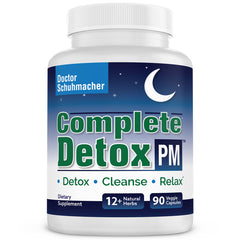
Longevity Complete Detox PM
- Size
- 90 capsules · 30 night supply
- Directions
- 3 capsules once daily, preferably about 30 minutes before sleep
- Ingredients
- Contains botanical extracts together with GABA and 5-HTP.
- Routine
- Designed as an evening supplement routine.
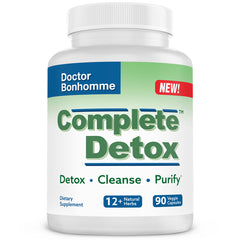
Longevity Complete Detox (Day Formula)
- Size
- 90 capsules · 30 servings
- Directions
- 3 capsules once daily
- Ingredients
- A botanical and fiber based formula containing ingredients including psyllium husk, green tea extract, dandelion extract and acai.
- Routine
- Designed for a simple daytime wellness routine.


