


Key takeaways
- Federal rules shape almost every line of a supplement label, right down to the wording and type size of the FDA notice.
- The Supplement Facts panel shows the serving size, the amounts per serving and a % Daily Value where one exists. Most botanicals have no Daily Value, so they get a symbol instead.
- A proprietary blend is a common, legal way to list a formula. It shows the blend's total weight and lists its ingredients from most to least by weight.
- Botanical ingredients list the part of the plant used, such as root, leaf or seed. That detail tells you a lot.
- The fine print fills in the rest. That's where you'll find other ingredients, allergen statements, directions and cautions, the lot number and the company's contact details.
The fine print in bold
Look closely at a supplement label that describes what an ingredient does. Somewhere you'll find a short notice in bold type at least one-sixteenth of an inch tall.[1] Federal rules set its exact wording and its type size. When it sits away from the claim it explains, the rules even require a box around it.[1]
That level of detail runs through the whole label. Each part has a job, and most parts follow set rules. Once you know what to look for, a label tells you what's in the bottle and how to take it. It also tells you which part of which plant is used and who to contact with a question.
This guide walks through a label from top to bottom. It uses simple made-up examples that don't describe any real product, and it points you to deeper guides along the way. FDA's Dietary Supplement Labeling Guide is the main reference behind it.[2] For the bigger picture on choosing a product, see our guide on how to choose a detox supplement.
The front of the bottle
The front panel names the product and identifies it as a dietary supplement. It also states how much is inside, such as 60 capsules.[2] Check that the capsule count matches what you expect from the serving size. A 60-capsule bottle with a 2-capsule serving holds 30 servings.
The Supplement Facts panel
Every supplement carries a Supplement Facts panel. Its title must be bold and set in larger type than anything else in the panel.[3] Read it from the top down.
Serving size and servings per container
Serving size comes first. It tells you how much makes one serving, such as 2 capsules. Every amount listed below it refers to that full serving, not to one capsule.[3] If a serving is 2 capsules, each capsule holds about half of each amount.
Servings per container comes next. It tells you how long a bottle lasts and helps you compare prices. Divide the price by the number of servings to get a fair comparison. Our guide to cost per serving shows the math.
Amount per serving and % Daily Value
The amount column lists dietary ingredients by name, with weights in metric units like milligrams (mg). An ingredient may show its own weight, or it may sit inside a blend that shows one total weight. For a dried extract, the weight shown is the weight of the extract itself.[3]
The % Daily Value column sits to the right. A Daily Value is a reference amount for a nutrient. The percent shows how much one serving contributes to your day. As a general guide, FDA says 5% or less is low and 20% or more is high.[4]
Most botanicals, such as milk thistle or ginger, have no Daily Value. Instead of a percentage, they carry a symbol, often a dagger (†) or an asterisk. The symbol leads to a footnote that reads "Daily Value not established."[3] That's normal. No official reference amount exists for these ingredients, so there's no percentage to show.
Proprietary blends: the total and the order
A proprietary blend is a group of ingredients listed under one name. It's a common way to present a formula, and federal rules spell out how it appears. The label shows the blend's total weight. The ingredients inside are listed from most to least by weight. For ingredients with no Daily Value, such as most botanicals, the rules don't call for each one's own amount. Vitamins and minerals inside a blend still show their amounts.[3]
Here is a simple made-up example. A label might list a 6-botanical blend at 1,200 mg per serving. Under the blend's name, it might list ginger root first, then peppermint leaf, fennel seed and three more plants. From a blend like this, you know the total, the full list, the plant parts and the order. The order tells you which ingredients make up more of the blend. Individual amounts aren't listed, which is standard for this format.
Plant parts and Latin names
Botanical ingredients come with extra details. Labels must use standard common names from a reference book called Herbs of Commerce. They must also name the plant part in English, such as root or leaves.[5] If a label uses a name that isn't in that book, it must add the plant's two-part Latin name in parentheses.[5]
The plant part tells you which piece of the plant went into the bottle. Dandelion root and dandelion leaf, for example, are separate ingredients. Our guide to Latin names on supplement labels goes further. For what each plant is and how it's traditionally used, see our field guide to botanical ingredients in detox supplements.
Extract ratios and standardization
Many botanicals appear as extracts, which concentrate some of a plant's compounds. Some labels add a ratio, such as 4:1. On a dried extract, that usually describes how much starting plant went into each part of finished extract. Other labels say an extract is standardized. That means the maker measures a marker compound and aims for a set level, often shown as a percentage.
Both details help, and each has limits. A bigger ratio doesn't automatically mean a stronger product. Our guides to extract ratios and standardized extracts explain how to weigh them.
Other ingredients
Right below the Supplement Facts panel, look for a list headed "Other ingredients" or simply "Ingredients." It covers everything that isn't a dietary ingredient listed in the panel.[5] That includes things like the capsule shell, fillers, binders and flavorings.[5][6] If you avoid certain ingredients, this is the place to check.
Directions, cautions and allergens
The directions tell you how much to take and when. An example label might read "Take 2 capsules once daily with breakfast." A label for a short routine may add a time frame, such as "Use for up to 7 days." Stick to the label's serving size unless your health care provider suggests a different amount.[6]
Cautions tell you who should check with a professional first and what to watch for. Some are required by rule. For example, supplement tablets and capsules that provide iron must carry a boxed warning to keep the product out of reach of children.[7] Other cautions reflect the ingredients. A formula with valerian or 5-HTP, for example, might say it's for adults only and that you shouldn't drive if you feel drowsy.
Allergen statements come next. Federal law names nine major food allergens, including crustacean shellfish such as shrimp and crab. These rules apply to supplements too.[8] A label must name a major allergen in the ingredient list or in a "Contains" statement next to it.[8]
Oysters are mollusks, not crustaceans, so they aren't on that federal list of nine.[9] A product with oyster extract may not need a "Contains" line for it, which makes a clear caution all the more useful. If you have a shellfish allergy, read the full ingredient list and the cautions too, and don't rely on the "Contains" line alone.
The asterisk and the FDA notice
When a label says an ingredient "supports" a normal body function, it's making a structure/function claim. Each claim either sits right beside the FDA notice or carries a symbol, usually an asterisk, that links it to the notice.[1] The notice has two sentences. The first says FDA has not evaluated the statements. The second says the product is not intended for any disease. Federal rules fix the wording. When a label makes more than one claim, the first sentence may switch from "This statement" to "These statements."[1] The notice must also appear on each panel of the label that carries a claim.[1]
FDA doesn't approve these claims ahead of time. Instead, a company must notify FDA within 30 days after it first sells a product with the claim. It must also have evidence that the claim is truthful and not misleading.[1][10] FDA can regulate a product that makes a disease claim as a drug.[1]
Lot number and best-by date
Look on the bottom or side of the bottle for a lot or batch number. FDA's manufacturing rules require the company to assign one to each lot of finished product. Records tied to that lot let the company trace a bottle's full manufacturing history.[11] If you ever have a question or a reaction, write the number down before you recycle the bottle.
A best-by or expiration date works differently. FDA's manufacturing rule doesn't require one. If a company prints a date, though, FDA expects it to have data to support that date.[12] Either way, store the bottle the way the label directs.
Quality marks: GMP and third-party seals
Every company that makes, packages, labels or holds supplements must follow FDA's current good manufacturing practice rules, often shortened to GMP.[12] A statement such as "manufactured in a facility that follows GMP requirements" describes that.
Third-party seals are separate. Groups such as USP, NSF International and ConsumerLab.com test products, and a product that passes may show their seal. According to the NIH Office of Dietary Supplements, a seal shows that a product was properly made, contains the listed ingredients and has no harmful levels of contaminants. A seal speaks to quality. It isn't a promise of safety or a rating of how well a product works.[6] Our guide to third-party supplement marks shows how to check one.
Who made it and how to reach them
Every label names the company that made or distributed the product.[2] It must also give a U.S. address or U.S. phone number where people can report serious problems.[13] That line is handy for everyday questions too, such as what's in a blend or what a lot number means.
You can look up many labels ahead of time. The NIH Office of Dietary Supplements runs the Dietary Supplement Label Database. It holds more than 200,000 labels, including label images.[14]
Label parts at a glance
| Label part | What it tells you | What to check |
|---|---|---|
| Product name and amount | What it is and how much is inside | The capsule count. |
| Serving size | How much makes one serving | Amounts are per serving. |
| Servings per container | How long the bottle lasts | Cost per serving. |
| Amount per serving | Weight of an ingredient or blend | Units, such as mg. |
| % Daily Value | Share of a daily reference amount | A symbol means no DV. |
| Proprietary blend | Total weight and order | Which ingredients come first. |
| Plant part and Latin name | Where in the plant it comes from | Root, leaf, seed or fruit. |
| Other ingredients | Capsule shell, fillers, flavors | Anything you avoid. |
| Allergen statement | Major allergens present | Shellfish and other allergies. |
| Directions and cautions | How, when and who | Time limits and drowsiness. |
| Asterisk and FDA notice | Which lines are claims | Every claim links to the notice. |
| Lot number and date | Batch and freshness | The lot, if you have a question. |
| Company contact | Who made it | A U.S. address or phone. |
A quick label checklist
- How many capsules make a serving, and how long will the bottle last?
- What does each serving contain, and which ingredients have a % Daily Value?
- If there's a blend, what's the total weight and which ingredient comes first?
- Which plant part is used for each botanical?
- Does anything in "Other ingredients" or the allergen statement rule the product out for you?
- What do the directions say about timing, water and how many days to use it?
- Which lines carry an asterisk, and where is the FDA notice?
- Where are the lot number and the company's contact details?
- If you take prescription medicine, has your pharmacist seen the label?
Same label parts, different routines
Every label follows the same rules, but the details shift with how a product is meant to be used. Here is how three made-up examples might differ.
- A daily formula taken in the morning might hold 60 capsules at 2 per serving, enough for a month of mornings. If it's built around fiber such as psyllium husk, you may see a reminder to take it with a full glass of water. If it includes green tea extract or guarana, both natural sources of caffeine, count it toward your daily caffeine.[15][16]
- An evening formula might ask you to take it shortly before bed. If it includes 5-HTP or valerian, you may see cautions about adult use, drowsiness and medicines that affect serotonin or sleep.
- A short routine with a clear start and finish might hold 14 capsules, or 2 a day for 7 days. Its directions carry the time frame, so read them before day one and mark the start and end dates on your calendar.
Whatever the routine, the same checks apply. Look at the serving size, the amounts, the plant parts, the other ingredients and the allergens. Then read the directions, the cautions, the asterisks and the FDA notice. Any supplement you choose sits alongside good food, water, movement and sleep.
Before you start
- Read the whole label, including the cautions, before your first serving.
- If a product contains psyllium, take it with a full glass of water. Psyllium guidance also advises spacing some medicines a few hours apart from it, so ask your pharmacist about timing.[17]
- Green tea extract and guarana are both natural sources of caffeine, so count them along with your coffee and tea.
- 5-HTP and valerian turn up in some evening formulas. Ask your doctor first if you take an antidepressant, a sedative or a sleep aid, and don't drive if you feel drowsy.
- Some formulas include oyster or other shellfish extracts. Skip them if you have a shellfish allergy.
- If you take prescription medicine, are pregnant or nursing, or have a health condition, bring the label to your pharmacist or doctor first.
Frequently asked questions
Why don't herbs like milk thistle have a % Daily Value?
Daily Values are reference amounts for nutrients. Botanicals don't have one, so the label shows a symbol and the footnote "Daily Value not established."[3]
Does FDA approve supplement labels before products are sold?
No. Supplements don't need FDA approval before they're sold.[6] For structure/function claims, the company must notify FDA within 30 days of first selling the product. It must also have evidence that the claim is truthful and not misleading.[10]
Why do some labels list a proprietary blend?
A blend is a common, legal way to present a formula. It shows the total weight and lists the ingredients from most to least by weight.[3] Companies use blends for different reasons, including protecting a formula they developed. If you have a question about a blend, the company's contact line is there for that.
What if my bottle has no expiration date?
FDA's rules don't require one. If a date is printed, FDA expects the company to have data behind it.[12] Store the bottle as directed, and keep the lot number handy if you have questions.
How can I see the full label for a product sold online?
Check the product images, contact the company, or search the NIH Dietary Supplement Label Database.[14]
The short version
A supplement label is built from parts with set rules. Start with the serving size and servings per container. Read the amounts and % Daily Value, and expect a symbol for most botanicals. For a proprietary blend, note the total and the order. Check the plant part, any extract details, the other ingredients and the allergen statement. Then read the directions, the cautions, the asterisks and the FDA notice. Finish with the lot number and the company's U.S. contact details. If you take prescription medicine, bring the label to your pharmacist.
This article is for general education. It is not medical advice, and nothing here is intended to diagnose, treat, cure or prevent any disease. If you take prescription medicines, are pregnant or breastfeeding, or have a medical condition, talk with your doctor or pharmacist before starting any supplement, and never stop or change a prescribed medicine on the basis of general information.
Sources
- Code of Federal Regulations. 21 CFR 101.93, Certain types of statements for dietary supplements. https://www.ecfr.gov/current/title-21/chapter-I/subchapter-B/part-101/subpart-F/section-101.93
- U.S. Food and Drug Administration. Dietary Supplement Labeling Guide. April 2005. https://www.fda.gov/food/dietary-supplements-guidance-documents-regulatory-information/dietary-supplement-labeling-guide
- Code of Federal Regulations. 21 CFR 101.36, Nutrition labeling of dietary supplements. https://www.ecfr.gov/current/title-21/chapter-I/subchapter-B/part-101/subpart-C/section-101.36
- U.S. Food and Drug Administration. Daily Value on the Nutrition and Supplement Facts Labels. Content current as of March 5, 2024. https://www.fda.gov/food/nutrition-facts-label/daily-value-nutrition-and-supplement-facts-labels
- Code of Federal Regulations. 21 CFR 101.4, Food; designation of ingredients (paragraphs (g) and (h), dietary supplements and botanical names). https://www.ecfr.gov/current/title-21/chapter-I/subchapter-B/part-101/subpart-A/section-101.4
- NIH Office of Dietary Supplements. Dietary Supplements: What You Need to Know. https://ods.od.nih.gov/factsheets/WYNTK-Consumer/
- Code of Federal Regulations. 21 CFR 101.17(e), Dietary supplements containing iron or iron salts. https://www.ecfr.gov/current/title-21/chapter-I/subchapter-B/part-101/subpart-A/section-101.17
- U.S. Food and Drug Administration. Food Allergies. Updated March 11, 2026. https://www.fda.gov/food/nutrition-food-labeling-and-critical-foods/food-allergies
- U.S. Food and Drug Administration. Guidance for Industry: Questions and Answers Regarding Food Allergens, Including the Food Allergen Labeling Requirements of the Federal Food, Drug, and Cosmetic Act (Edition 5). January 2025. https://www.fda.gov/regulatory-information/search-fda-guidance-documents/guidance-industry-questions-and-answers-regarding-food-allergens-including-food-allergen-labeling
- U.S. Food and Drug Administration. Dietary Supplement Labeling Guide: Chapter VI. Claims. https://www.fda.gov/food/dietary-supplements-guidance-documents-regulatory-information/dietary-supplement-labeling-guide-chapter-vi-claims
- Code of Federal Regulations. 21 CFR part 111, subpart L (sections 111.410 and 111.415), Requirements for packaging and labeling operations. https://www.ecfr.gov/current/title-21/chapter-I/subchapter-B/part-111/subpart-L
- U.S. Food and Drug Administration. Small Entity Compliance Guide: Current Good Manufacturing Practice in Manufacturing, Packaging, Labeling, or Holding Operations for Dietary Supplements. December 2010. https://www.fda.gov/regulatory-information/search-fda-guidance-documents/small-entity-compliance-guide-current-good-manufacturing-practice-manufacturing-packaging-labeling
- U.S. Food and Drug Administration. Guidance for Industry: Questions and Answers Regarding the Labeling of Dietary Supplements as Required by the Dietary Supplement and Nonprescription Drug Consumer Protection Act. September 2009. https://www.fda.gov/regulatory-information/search-fda-guidance-documents/guidance-industry-questions-and-answers-regarding-labeling-dietary-supplements-required-dietary
- NIH Office of Dietary Supplements. Dietary Supplement Label Database (DSLD). https://ods.od.nih.gov/Research/Dietary_Supplement_Label_Database.aspx
- National Center for Complementary and Integrative Health. Green Tea: Usefulness and Safety. Updated February 2025. https://www.nccih.nih.gov/health/green-tea
- Patrick M, Kim HA, Oketch-Rabah H, Marles RJ, Roe AL, Calderón AI. Safety of guarana seed as a dietary ingredient: a review. J Agric Food Chem. 2019;67(41):11281-11287. https://pubmed.ncbi.nlm.nih.gov/31539257/
- MedlinePlus Drug Information. Psyllium. https://medlineplus.gov/druginfo/meds/a601104.html
Product information
Facts from the product pages. Before using any supplement, read the full label, directions and cautions on the product page, and check with your doctor or pharmacist if you take medicines, are pregnant or nursing, or have a health condition.
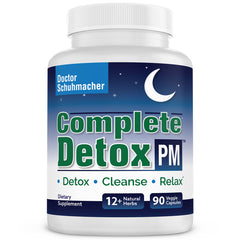
Longevity Complete Detox PM
- Size
- 90 capsules · 30 night supply
- Directions
- 3 capsules once daily, preferably about 30 minutes before sleep
- Ingredients
- Contains botanical extracts together with GABA and 5-HTP.
- Routine
- Designed as an evening supplement routine.
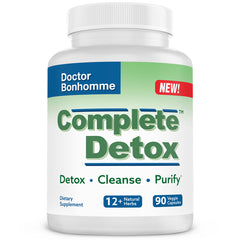
Longevity Complete Detox (Day Formula)
- Size
- 90 capsules · 30 servings
- Directions
- 3 capsules once daily
- Ingredients
- A botanical and fiber based formula containing ingredients including psyllium husk, green tea extract, dandelion extract and acai.
- Routine
- Designed for a simple daytime wellness routine.