


Key takeaways
- Psyllium is the husk of the seed of Plantago ovata, a small herb native to the Mediterranean region, North Africa and West Asia. India grows more of it than any other country.
- It is a soluble fiber that forms a thick gel with water. Gut bacteria break down only part of that gel, so it holds water all the way through the colon.
- In small studies of healthy adults, psyllium made stools heavier and more moist.
- Psyllium comes as a powder, in capsules and as one part of multi-ingredient formulas. Each fits into a day in its own way, alongside fiber-rich meals.
- Start low, take each dose with a full glass of water, and keep psyllium at least 2 hours apart from prescription medicines.
A seed coat that turns water into gel
Stir a spoonful of psyllium husk into half a cup of water. Set the glass on the counter and wait. In about 15 minutes, you have a thick, wobbly gel instead of a drink. One fiber researcher suggests this simple kitchen test to tell gel-forming fibers from fibers that just dissolve.[1]
That gel is why scientists have studied psyllium for decades. It is also why psyllium always comes with one firm rule: take it with plenty of water.
This guide covers where psyllium comes from and why it acts differently from most fibers. You will see what studies in people have measured and how psyllium fits into a day's fiber. You will also learn how to start gradually and how psyllium shows up in foods and supplements.
What psyllium is and where it comes from
Psyllium comes from Plantago ovata, a small herb in the plantain family. It is native to the Mediterranean region, North Africa and West Asia.[2]
The useful part is the husk, a thin coat on the outside of each tiny seed. When the seeds get wet, this coat swells into a slippery gel. Botanists think the gel may help protect the seed and help it spread. Millers strip the husk off with stone mills, and what comes off is more than 90% fiber by weight. India is now the world's largest producer.[3]
The part of the husk that forms the gel is a large, highly branched carbohydrate. It is built mostly from two sugars, xylose and arabinose.[4] Your digestive enzymes can't take it apart, and that is what makes it fiber.
Why psyllium stands apart from other fibers
Scientists sort fibers by a few traits. Does it dissolve in water? Does it thicken water into a gel? Do gut bacteria ferment it, or break it down? Those traits decide what a fiber does once it reaches your colon, the main part of the large intestine.
Psyllium checks three boxes that rarely go together. It is soluble, it forms a thick gel, and much of that gel resists fermentation. Here is how it compares with two other common types.[5]
| Fiber type | Examples | What it does in the colon |
|---|---|---|
| Coarse insoluble | Wheat bran | Rough pieces nudge the gut lining to release water and mucus |
| Soluble, quickly fermented | Inulin, wheat dextrin | Bacteria break it down, so little is left to hold water |
| Soluble, gel-forming, slowly fermented | Psyllium | The gel holds on to water all the way through |
In lab dishes, gut bacteria do ferment psyllium, but slowly. In one lab test, gas from psyllium took about 14 hours to start. Gas from wheat bran started in about 6 hours.[6]
Some studies in people have also found shifts in gut bacteria after psyllium. Researchers still debate how much of it gets fermented. Most agree that a good share of the gel survives the trip.[3] Our guide to why some fibers make more gas than others explains fermentation in more detail.
What the gel does in the colon
Your colon is a water saver. About 1.5 liters of watery leftovers reach it each day. As they move along, it reclaims more than 90% of that water.[1] The longer stool stays there, the drier it gets.
Psyllium's gel pushes back against that drying. The gel holds water, and much of it is not fermented. So stool stays softer and bulkier all the way through.[5]
A careful study at the University of Wisconsin showed this in healthy people. Fifteen healthy adults ate controlled diets for two 7-day periods. In one period they also took a psyllium product each day. With psyllium, their stools were heavier, wetter and slicker.
The researchers then pulled a thick gel out of those stools. It was made of the same sugars found in psyllium husk, and it had not been fermented. They concluded that the gel acts like a lubricant that helps things move along.[7]
An MRI study points the same way. In a small trial, 14 healthy volunteers took psyllium, wheat bran and a third fiber in turn. All three raised the water in the colon over the day before the scans. In the hours after a test meal, colon water kept rising with psyllium and fell with wheat bran. Breath tests showed no rise in hydrogen, a sign of fermentation, after psyllium. Wheat bran did raise it.[6]
What the research has looked at
Studies in healthy adults, like the two above, show how psyllium behaves in a normal gut. Researchers measure things they can weigh and see. They track how heavy and how wet stools are, what the gel is made of, and how much water sits in the colon over a day.[6][7]
Both studies used a crossover design. Each volunteer took psyllium in one period and a comparison in another, so every person served as their own comparison. In the Wisconsin study, the team also controlled the diets, so food didn't muddy the picture.[6][7]
Psyllium also turns up in larger reviews. In 2025, the British Dietetic Association published guidelines on diet and bowel habits in adults. They drew on 75 trials of foods, drinks and supplements, and 16 of those trials tested fiber supplements, psyllium among them.[8]
How to start gradually
A new fiber can bring a full feeling or changes in bowel habits at first, while your gut adjusts.[9] Starting low makes that easier.
- Build up fiber from food step by step. One researcher suggests starting with modest extra amounts in the first week, then building up over several weeks.[1]
- Follow the label. Psyllium powder labels say to start with one serving a day and work up.[9]
- Take every dose with at least 8 ounces of water or other liquid, about a full glass.[10]
- Change one thing at a time, so you can tell what is working for you.
- Keep a steady rhythm. The same time each day makes the habit easier to remember.
- Keep your food fiber rising too. Beans, oats, berries and vegetables each bring their own mix of fibers.
For a fuller plan, see our guide to adding fiber gradually. For the water side, our companion article on why hydration matters when you increase fiber or take psyllium goes deeper.
Psyllium and your daily fiber
Adults are advised to get 21 to 38 grams of fiber a day. On average, Americans eat about 16 grams.[11] Our guide to your daily fiber number helps you size your own gap.
Fiber comes in two broad kinds. Soluble fiber attracts water and turns to gel during digestion. You find it in oat bran, barley, nuts, seeds, beans, lentils, peas and some fruits and vegetables. Insoluble fiber does not dissolve in water. Wheat bran, vegetables and whole grains supply it.[11] Psyllium belongs with the gel formers, and much of its gel stays intact on the way through the colon.[5]
Picture a day that brings in several kinds. Oatmeal with berries and a few walnuts at breakfast. A bowl of lentil soup at lunch. Roasted vegetables and brown rice at dinner. Your psyllium fits in at the time you chose, with its full glass of water.
MedlinePlus suggests adding fiber gradually over a few weeks and drinking plenty of fluids through the day.[11] Each psyllium format has its own appeal. A powder stirs into your morning drink. Capsules come premeasured, with no mixing and no taste, and they travel well in a bag or a desk drawer. A multi-ingredient formula folds psyllium into one daily step with other botanicals.
Psyllium in foods, drinks and supplements
In food, psyllium mostly works behind the scenes. It is one of the most used gluten substitutes in commercial baking, and researchers have tested it in pasta and yogurt too. Most clinical studies, though, used the husk itself rather than a food made with it.[3]
At home, psyllium usually comes as a powder or a capsule. Picture a glass on the counter at breakfast. A rounded teaspoon of powder goes in first, then at least 8 ounces of water or another drink. You stir and drink it right away, before it thickens.[9] Capsules are swallowed one at a time, with a full glass of liquid.[12] Psyllium also appears as one ingredient in fiber-based formulas and in broader botanical blends, where it shares space with other plants.
A few label details tell you what you're getting:
- You may see "psyllium husk," often with the Latin name, Plantago ovata. The word "psyllium" on its own can refer to more than one plant species.[3]
- Drugstore psyllium labels list grams of psyllium per dose.[9][12] In a multi-ingredient formula, you may see one total weight for the whole blend. Our guide to reading a supplement label explains how these labels are laid out.
- Check the directions for how much liquid to take with each dose and how to time it around other medicines.[9][10]
- Scan the other ingredients. One drugstore powder lists sucrose, a sugar, alongside the husk.[9]
- Store it tightly closed, away from humidity.[9]
Our guide to fiber, hydration and movement shows how these daily habits work together.
Before you start
- Read the full label and follow its directions.
- Take each dose with at least 8 ounces of water or other liquid. Psyllium swells as it soaks up fluid. With too little liquid, it can swell in your throat or food pipe and cause choking.
- Skip psyllium if you have trouble swallowing. Get medical help right away if you have chest pain, vomiting, or trouble swallowing or breathing after a dose.[10]
- Take psyllium at least 2 hours before or after prescription medicines, since fiber can slow how some medicines are absorbed. A few medicines need a longer gap, so ask your pharmacist.[12][13]
- Check with your doctor or pharmacist first if you take prescription medicine, are pregnant or nursing, or have a health condition.
- Psyllium can share a formula with other botanicals, so read the whole label, including the cautions for each ingredient.
- Raise fiber from food gradually and spread your fluids across the day.
When to see a clinician
Some changes deserve a professional's eyes. Talk with a health care professional promptly if you notice:
- blood in your stool
- a change in bowel habits that lasts more than two weeks
- a week or longer without a bowel movement
- belly pain, nausea or vomiting that won't go away
- unexplained weight loss
- chest pain, or trouble swallowing or breathing, after taking any fiber product (get help right away)
Frequently asked questions
Is psyllium a soluble or an insoluble fiber?
Psyllium is a soluble fiber that forms a gel. That sets it apart from coarse insoluble fibers like wheat bran. Bran works in a different way, by nudging the gut lining to release water.[5]
How much water should I drink with psyllium?
Drink at least 8 ounces, about a full glass, with every dose. That goes for powder and capsules alike.[10] Then keep drinking through the day. Our article on hydration and fiber, linked above, covers how much fluid adults need.
Will psyllium make me gassy?
Some people notice more gas with fiber supplements. In the 2025 guideline, that finding came mostly from trials of inulin, a fiber that ferments quickly.[8] Psyllium ferments slowly. In one small trial, breath tests showed no rise in hydrogen after psyllium, while wheat bran raised it.[6] Starting low and building up over a few weeks helps.
Can I get psyllium from food?
Psyllium isn't a common kitchen ingredient, though some gluten-free breads use it for texture.[3] For most people, the plan that works is a mix. Let fiber-rich foods supply most of the day's fiber, and add psyllium on top.
When is the best time to take psyllium?
Start with the timing on your label, and keep it at least 2 hours away from prescription medicines. Many people tie it to breakfast. Our guide to anchor habits shows how to attach a new step to one you already do.
The short version
Psyllium is the husk of a small herb from the Mediterranean and West Asia, and nearly all of it is fiber. It forms a thick gel with water. Much of that gel holds on to water through the colon. Small studies in healthy adults found heavier, moister stools. Powder, capsules and multi-ingredient formulas each offer an easy way to make it part of a day built on fiber-rich meals. Start low, take every dose with a full glass of water, and keep it 2 hours from prescription medicines.
This article is for general education. It is not medical advice, and nothing here is intended to diagnose, treat, cure or prevent any disease. If you take prescription medicines, are pregnant or breastfeeding, or have a medical condition, talk with your doctor or pharmacist before starting any supplement, and never stop or change a prescribed medicine on the basis of general information.
Sources
- McRorie JW. Evidence-based approach to fiber supplements and clinically meaningful health benefits, part 2: what to look for and how to recommend an effective fiber therapy. Nutr Today. 2015;50(2):90-97. https://pmc.ncbi.nlm.nih.gov/articles/PMC4415970/
- Sarfraz RM, Khan H, Maheen S, et al. Plantago ovata: a comprehensive review on cultivation, biochemical, pharmaceutical and pharmacological aspects. Acta Pol Pharm. 2017;74(3):739-746. https://pubmed.ncbi.nlm.nih.gov/29513942/
- Strkalj L, Yakubov GE, Burton RA, Cowley JM. Structural and functional properties of fiber from psyllium (Plantago ovata) husk: current knowledge and strategies to expand its application in food and beyond. Compr Rev Food Sci Food Saf. 2025;24(5):e70297. https://pmc.ncbi.nlm.nih.gov/articles/PMC12455465/
- Fischer MH, Yu N, Gray GR, Ralph J, Anderson L, Marlett JA. The gel-forming polysaccharide of psyllium husk (Plantago ovata Forsk). Carbohydr Res. 2004;339(11):2009-2017. https://pubmed.ncbi.nlm.nih.gov/15261594/
- McRorie JW, McKeown NM. Understanding the physics of functional fibers in the gastrointestinal tract: an evidence-based approach to resolving enduring misconceptions about insoluble and soluble fiber. J Acad Nutr Diet. 2017;117(2):251-264. https://pubmed.ncbi.nlm.nih.gov/27863994/
- Gunn D, Murthy R, Major G, et al. Contrasting effects of viscous and particulate fibers on colonic fermentation in vitro and in vivo, and their impact on intestinal water studied by MRI in a randomized trial. Am J Clin Nutr. 2020;112(3):595-602. https://pubmed.ncbi.nlm.nih.gov/32619212/
- Marlett JA, Kajs TM, Fischer MH. An unfermented gel component of psyllium seed husk promotes laxation as a lubricant in humans. Am J Clin Nutr. 2000;72(3):784-789. https://pubmed.ncbi.nlm.nih.gov/10966900/
- Dimidi E, van der Schoot A, Barrett K, et al. British Dietetic Association guidelines for the dietary management of chronic constipation in adults. J Hum Nutr Diet. 2025;38(5):e70133. https://pmc.ncbi.nlm.nih.gov/articles/PMC12517116/
- U.S. National Library of Medicine, DailyMed. Discount Drug Mart Regular Flavor natural fiber psyllium husk powder, product label (revised August 2021). https://dailymed.nlm.nih.gov/dailymed/drugInfo.cfm?setid=7e295a5b-9c1b-44f7-8218-c46f23774056
- Code of Federal Regulations. 21 CFR 201.319, Specific labeling requirements: water-soluble gums, hydrophilic gums, and hydrophilic mucilloids. https://www.law.cornell.edu/cfr/text/21/201.319
- MedlinePlus. Fiber. U.S. National Library of Medicine (reviewed July 22, 2026). https://medlineplus.gov/ency/article/002470.htm
- U.S. National Library of Medicine, DailyMed. CareOne psyllium husk capsule, product label (updated August 2026). https://dailymed.nlm.nih.gov/dailymed/drugInfo.cfm?setid=3ec3ead0-382e-4765-bbe8-b21e7c7b42a6
- MedlinePlus. Psyllium. U.S. National Library of Medicine (revised June 20, 2024). https://medlineplus.gov/druginfo/meds/a601104.html
Product information
Facts from the product pages. Before using any supplement, read the full label, directions and cautions on the product page, and check with your doctor or pharmacist if you take medicines, are pregnant or nursing, or have a health condition.
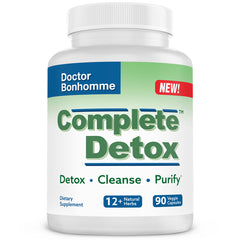
Longevity Complete Detox (Day Formula)
- Size
- 90 capsules · 30 servings
- Directions
- 3 capsules once daily
- Ingredients
- A botanical and fiber based formula containing ingredients including psyllium husk, green tea extract, dandelion extract and acai.
- Routine
- Designed for a simple daytime wellness routine.
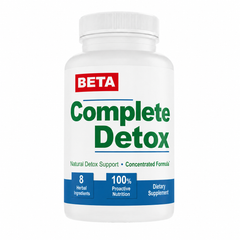
Longevity Complete Detox [BETA]
- Size
- 21 capsules · 7 servings
- Directions
- 3 capsules once daily
- Ingredients
- Contains botanical ingredients including milk thistle, psyllium, ginger, turmeric, acai and aloe vera.
- Routine
- Designed as a defined 7 day wellness routine.


