


Key takeaways
- You don't need to fast or do an extreme cleanse to look after your body's everyday processes. Your liver, kidneys and gut do that work every day, and steady daily habits keep them supplied.
- The building blocks are regular meals with fiber and protein, steady water, movement, enough sleep, a little stress care and less alcohol.
- New habits take time to feel automatic. In one well-known study, the typical habit took about 66 days, with a range of 18 to 254.
- Small steps tied to something you already do every day tend to stick, and missing a single day doesn't erase your progress.
- A supplement routine can ride on the same anchors. Think of a morning formula around breakfast, an evening formula at bedtime, or a short routine with a clear start and finish.
Why small habits outlast big plans
Picture one small healthy step, like eating a piece of fruit or going for a walk. Now picture doing it once a day, every day, right after the same cue.
That is what 96 volunteers did in a 12-week study of how habits form.[1] Each person picked one eating, drinking or activity habit and rated how automatic it felt. Among those whose progress could be charted clearly, the typical habit took about 66 days to reach its peak. Simple habits, like drinking water, got there faster than demanding ones, like doing 50 sit-ups.[2]
That finding is good news for anyone who has started a big wellness plan on a Monday and dropped it by Friday. You don't need to fast or do an extreme cleanse to take good care of your body's everyday processes. A handful of steady habits, added one at a time, gives your body what it uses every day.
This guide covers those habits and what research says about making them stick. It also lays out a plan for your first week and shows where a supplement routine can fit.
Your body already runs a daily routine
Your liver, kidneys and gut work around the clock. They rely on a steady supply of protein, fiber, water, vitamins and minerals, along with movement and sleep. Our guide to how your body's natural detoxification processes work every day walks through each organ.
Your gut also gets a natural break from food every night. Between meals, and especially overnight, a wave of muscle activity sweeps through the stomach and small intestine to clear out what's left. Our guide to the wave of movement that only runs when you stop eating explains how it works.
Some people enjoy a fasting practice, and that can be a personal choice made with a doctor. It isn't a fit for everyone, though. Johns Hopkins Medicine lists several groups who shouldn't try intermittent fasting. They include children and teens, people who are pregnant or breastfeeding, and some people who take insulin. Everyone else is advised to talk with a doctor before starting.[3] If you take any prescription medicine, ask your doctor before changing when or whether you eat.
The everyday building blocks
None of these asks for anything extreme. Each one has a simple target and an easy first step.
| Habit | A simple target | An easy first step |
|---|---|---|
| Meals | Protein foods at each meal, plus fiber-rich plants | Add fruit, beans or whole grains to one meal |
| Water | Water or unsweetened drinks through the day | A glass when you wake and with each meal |
| Movement | 150 to 300 minutes of moderate activity a week, plus strength work on 2 days | A 10-minute walk after one meal |
| Sleep | 7 or more hours a night for most adults | The same wake-up time every day |
| Stress care | A few minutes a day to reset | Five slow breaths before dinner |
| Alcohol | Less is better for overall health | A few alcohol-free days each week |
Meals come first. The 2025-2030 Dietary Guidelines for Americans ask you to include protein foods at every meal. Their daily goal is 1.2 to 1.6 grams of protein per kilogram of body weight, adjusted to your energy needs.[4] They also favor fiber-rich whole grains and note that high-fiber foods support a diverse gut microbiome.[4] Adults are advised to get about 21 to 38 grams of fiber a day, but Americans average about 16.[5] Our guide to fiber, hydration and movement shows how those three work together.
Regular mealtimes help, too. Eating at roughly the same times each day gives the rest of your routine fixed points to hang on. The National Institute of Mental Health lists healthy, regular meals among its everyday ways to handle stress.[6]
For water, the new guidelines call hydration a key factor in overall health. They point to water and unsweetened drinks as the main choices.[4] Needs vary with your size, activity and the weather, and our guide to how much fluid you need has the numbers.
For movement, adults are advised to get 150 to 300 minutes of moderate activity a week, such as brisk walking. Muscle strengthening on two or more days rounds it out. Any amount counts and short bouts add up. Some benefits, such as better sleep quality, can show up soon after you move.[7]
For sleep, the CDC says adults 18 to 60 need 7 or more hours a night.[8] Its tips fit neatly into a routine. Go to bed and get up at the same times. Avoid caffeine in the afternoon and evening, and skip large meals and alcohol close to bedtime. Turning off screens at least 30 minutes before bed helps too.[8]
Stress care can be quick. The National Institute of Mental Health suggests deep breathing or other relaxation exercises, along with regular exercise and a consistent sleep routine. It also suggests cutting back on excess caffeine and spending time with friends or family who help you cope.[6] Pick one that suits you and attach it to something you already do.
For alcohol, the 2025-2030 guidelines advise drinking less for better overall health. They also advise avoiding it entirely during pregnancy and when you take medicine that interacts with alcohol.[4] A few alcohol-free days each week is an easy place to start.
What habit research says
A habit forms when you repeat an action in the same situation until it starts to happen with little thought.
Habits take weeks to months. In the 12-week study, the time for a habit to reach its peak ranged from 18 to 254 days. The median was 66 days.[1][9] A 2024 review of 20 studies with 2,601 people found that habits can start forming in about two months. The time varied widely from person to person, and most of the studies were small, so the numbers are rough guides.[9]
A missed day is not a reset. In the 12-week study, missing one chance to do the habit did not meaningfully change how it formed.[1]
Small and specific works best. In advice written for family doctors, the same research group suggests small, manageable changes. They recommend doing the new step at the same time and place each day, tied to a cue from your existing routine. They also suggest expecting it to take about 10 weeks.[2] Our guide to anchor habits shows how to attach a new step to one that already runs itself.
Choice and timing matter too. In the 2024 review, habits people chose for themselves grew stronger than assigned ones. In one study it included, a stretching habit done in the morning became automatic sooner than the same habit done in the evening.[9]
Plan your first week
Start with two anchors, things you already do every day without fail, such as breakfast and brushing your teeth at night. Then add one small step a day.
- Day 1. Pick your two anchors and write down one small step for each.
- Day 2. Put a glass or water bottle where you'll see it at breakfast, and drink it before you eat. Our guide on where the bottle sits covers what is known about placement.
- Day 3. Build breakfast around protein and fiber, such as yogurt with berries and oats, or eggs with whole-grain toast and a piece of fruit.
- Day 4. Take a 10-minute walk after one meal. In a small study of 10 healthy men, a slow walk after eating helped the stomach empty faster than on days without the walk.[10]
- Day 5. Set a wind-down time 30 minutes before bed, with screens off.[8]
- Day 6. Spend 20 minutes planning or prepping a few meals for the week ahead. Our guide to the twenty minutes on Sunday shows how.
- Day 7. Look back. Keep what felt easy, and scale back anything that felt hard.
How to keep going after week one
After the first week, the work is repetition. Keep the same anchors and the same small steps until they feel automatic, then add one more.
- Track it simply. A checkmark on a calendar for each day you complete the step is enough.[2]
- Have a small version ready. On a hard week, a short walk and one glass of water still count. Our guide to the version of your routine that survives a bad week shows how to plan one.
- Return at the next anchor. If you miss a day, pick up at your next breakfast or bedtime.[1]
- Re-anchor when life changes. Travel, a new job or shift work can move your anchors. Our guide to building a routine around shift work or an unpredictable calendar has ideas.
- Add one new step at a time, once the last one feels easy.
Fitting a supplement routine onto your anchors
A supplement routine sticks best when it rides on the same anchors as your other habits. None of the usual rhythms asks you to skip meals or live on juice. Three of them fit neatly onto the anchors from your first week.
- A morning step around breakfast. Picture the bottle beside the coffee maker and a glass of water poured while the toast browns. A daily formula belongs here. Follow the label's timing, whether it says before or after the meal, and keep the same anchor every day.
- An evening step at bedtime. An evening formula built around botanicals traditionally taken at night can sit next to your toothbrush, so the step happens in the same quiet minute each night.
- A short routine with a clear start and finish. A formula meant for a set number of days can mark the first week of your new routine, and the label sets where it ends.
Keep each bottle where you'll see it at its anchor, and follow the label's storage directions. A pill organizer helps if you take several products. Our guide to morning or evening routines can help you choose the time that suits your day. Whichever rhythm you pick, read the directions, the ingredient list and any cautions on the label before you start.
Before you start
- Read the full label and follow the directions.
- Check with your doctor or pharmacist first if you take prescription medicine, are pregnant or nursing, or have a health condition.
- If a formula contains 5-HTP, keep in mind that your body turns it into serotonin.[11] Ask your doctor first if you take an antidepressant, a sedative, a sleep aid or anything else that affects serotonin or sleep. Take evening formulas before bed, as the label directs, and don't drive if you feel drowsy.
- Some formulas include oyster or other shellfish extracts. Check the allergen information if you are allergic to shellfish.
- Green tea extract and guarana are natural sources of caffeine, so formulas that contain them suit the morning.
- If a formula contains psyllium, take each dose with a full glass of water, and check with your doctor first if you've ever had trouble swallowing. MedlinePlus also advises keeping certain medicines at least 3 hours apart from psyllium, so ask your pharmacist about timing.[12] When you add fiber of any kind, increase it gradually over a few weeks.[5]
- Start one new product or habit at a time, so you can tell how each one suits you.
When to see a clinician
Check in with a health care professional if you notice:
- trouble falling or staying asleep most nights for more than a few weeks
- daytime sleepiness that makes it hard to drive or work safely
- stress or low mood that won't lift, or a feeling that you can't cope[6]
- a lasting change in bowel habits, belly pain that won't go away, or unexplained weight loss
- dizziness or feeling faint when you go a long time without eating
- any new symptom that started after a new medicine or supplement
If you ever feel in crisis, call or text 988 in the U.S.[6]
Frequently asked questions
Do I need to fast to give my digestive system a rest?
No. Your gut gets a natural break every night and between meals, when a wave of muscle activity clears the stomach and small intestine. If you're curious about a fasting practice, talk with your doctor first. Johns Hopkins Medicine advises against intermittent fasting during pregnancy or breastfeeding.[3]
How long does it take for a new habit to stick?
Often longer than people expect. In a widely cited study, the typical habit took about 66 days to feel automatic, and the range ran from 18 to 254 days.[1] Simple habits tend to get there sooner.[2]
What if I miss a day?
Pick up at your next anchor. Missing one chance did not meaningfully slow habit formation in the research.[1] A smaller version of your routine helps you keep the thread on busy days.
Do I need a cleanse to get started?
No. Steady daily habits are a strong place to start. If you like a defined start, a short routine with a clear first and last day can mark the week you begin. A daily supplement routine can then ride on the same anchors as your other habits.
Can a supplement replace these habits?
No. A supplement is meant to add to your diet and routine. It works best alongside the meals, water, movement and sleep your body uses every day.
The short version
You don't need to fast or follow an extreme cleanse to look after your body's everyday processes. Build regular meals with protein and fiber, steady water, movement, 7 or more hours of sleep, a little stress care and less alcohol. Add one small step at a time and tie it to something you already do. Expect a new habit to take about two months, and don't let a missed day stop you. A supplement routine can sit on the same anchors, in the morning, at bedtime or as a short routine with a clear start and finish.
This article is for general education. It is not medical advice, and nothing here is intended to diagnose, treat, cure or prevent any disease. If you take prescription medicines, are pregnant or breastfeeding, or have a medical condition, talk with your doctor or pharmacist before starting any supplement, and never stop or change a prescribed medicine on the basis of general information.
Sources
- Lally P, van Jaarsveld CHM, Potts HWW, Wardle J. How are habits formed: modelling habit formation in the real world. Eur J Soc Psychol. 2010;40(6):998-1009 (published online 2009). https://doi.org/10.1002/ejsp.674
- Gardner B, Lally P, Wardle J. Making health habitual: the psychology of 'habit-formation' and general practice. Br J Gen Pract. 2012;62(605):664-666. https://pmc.ncbi.nlm.nih.gov/articles/PMC3505409/
- Johns Hopkins Medicine. Intermittent Fasting: What is it, and how does it work? https://www.hopkinsmedicine.org/health/wellness-and-prevention/intermittent-fasting-what-is-it-and-how-does-it-work
- U.S. Department of Agriculture and U.S. Department of Health and Human Services. Dietary Guidelines for Americans, 2025-2030. January 2026. https://www.dietaryguidelines.gov
- MedlinePlus Medical Encyclopedia. Fiber. U.S. National Library of Medicine. https://medlineplus.gov/ency/article/002470.htm
- National Institute of Mental Health. I'm So Stressed Out! Fact Sheet. https://www.nimh.nih.gov/health/publications/so-stressed-out-fact-sheet
- Office of Disease Prevention and Health Promotion, U.S. Department of Health and Human Services. Top 10 Things to Know About the Second Edition of the Physical Activity Guidelines for Americans. https://odphp.health.gov/our-work/nutrition-physical-activity/physical-activity-guidelines/current-guidelines/top-10-things-know
- Centers for Disease Control and Prevention. About Sleep. https://www.cdc.gov/sleep/about/index.html
- Singh B, Murphy A, Maher C, Smith AE. Time to form a habit: a systematic review and meta-analysis of health behaviour habit formation and its determinants. Healthcare (Basel). 2024;12(23):2488. https://pubmed.ncbi.nlm.nih.gov/39685110/
- Franke A, Harder H, Orth AK, Zitzmann S, Singer MV. Postprandial walking but not consumption of alcoholic digestifs or espresso accelerates gastric emptying in healthy volunteers. J Gastrointestin Liver Dis. 2008;17(1):27-31. https://pubmed.ncbi.nlm.nih.gov/18392240/
- Maffei ME. 5-Hydroxytryptophan (5-HTP): natural occurrence, analysis, biosynthesis, biotechnology, physiology and toxicology. Int J Mol Sci. 2020;22(1):181. https://pmc.ncbi.nlm.nih.gov/articles/PMC7796270/
- MedlinePlus. Psyllium. U.S. National Library of Medicine. https://medlineplus.gov/druginfo/meds/a601104.html
Product information
Facts from the product pages. Before using any supplement, read the full label, directions and cautions on the product page, and check with your doctor or pharmacist if you take medicines, are pregnant or nursing, or have a health condition.
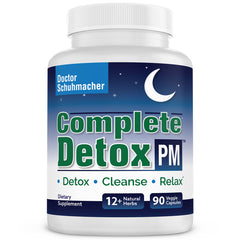
Longevity Complete Detox PM
- Size
- 90 capsules · 30 night supply
- Directions
- 3 capsules once daily, preferably about 30 minutes before sleep
- Ingredients
- Contains botanical extracts together with GABA and 5-HTP.
- Routine
- Designed as an evening supplement routine.
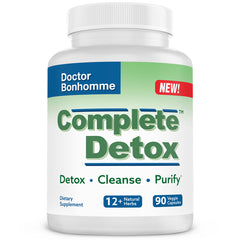
Longevity Complete Detox (Day Formula)
- Size
- 90 capsules · 30 servings
- Directions
- 3 capsules once daily
- Ingredients
- A botanical and fiber based formula containing ingredients including psyllium husk, green tea extract, dandelion extract and acai.
- Routine
- Designed for a simple daytime wellness routine.


