


Key takeaways
- Time of day shapes how a supplement fits your life. A formula with natural caffeine sources suits the morning, and a formula built for winding down suits your bedtime routine.
- Caffeine lingers. Its half-life is about 5 to 6 hours, and in a review of 24 studies it cut about 45 minutes from a night's sleep.
- Follow each label on timing and water. Fiber such as psyllium goes down with a full glass of liquid.
- Some supplements and medicines need space between them. A pharmacist can tell you how far apart to take yours.
- The best routine is tied to something you already do every day. If you work shifts, anchor it to your sleep instead of the clock.
One stretch, two times of day
In a study in France, 48 university students learned the same simple hip stretch. Half did it every morning right after waking. The other half did it every evening just before bed. Each day, they rated how automatic the stretch felt.[1]
The morning group was on track to make the stretch automatic in about 106 days. For the evening group, the estimate was about 154 days.[1] The researchers linked the gap to cortisol, a hormone that runs high in the morning.
It was one small study of one behavior, so read it as an early hint. A 2024 review of 20 studies also found that morning habits tended to be stronger.[2]
Time of day also shapes how a supplement fits your life. A natural caffeine source suits the start of the day, and a formula built for winding down suits the end. This guide covers your body clock, caffeine timing and evening ingredients. It also covers food, medicines and how to fit a routine around a real schedule, shift work included.
Your body keeps time
Nearly every tissue in your body runs on a roughly 24-hour cycle called a circadian rhythm. A master clock in the brain, a cluster of nerve cells called the suprachiasmatic nucleus, keeps the others in step.[3] Light and dark set that master clock more than anything else. Meals, activity, stress and temperature nudge it too.[3]
You feel this clock as the pull toward wakefulness in the morning and sleep at night. Our guide to why mornings are different explains what cortisol, the gut and the body clock are doing at the start of your day.
For a supplement routine, the practical point is simple. A formula with natural caffeine sources belongs on the morning side of the clock. A formula built for winding down belongs on the evening side.
Why a caffeine source belongs in the morning
Caffeine lasts longer than its buzz. Its half-life, the time your body takes to clear half of a dose, is about 5 to 6 hours, and longer in some people.[4] If you have caffeine at 7 a.m., roughly half of it is still in your system around noon or 1 p.m. About a quarter is still there at dinnertime.
That leftover caffeine can cost you sleep, even when you don't feel it. In a home study, 12 healthy sleepers took 400 milligrams of caffeine 6 hours before bed. They lost more than an hour of sleep on a sleep monitor, yet their sleep diaries suggested they hadn't noticed.[5]
A 2023 review of 24 studies found that caffeine cut total sleep by about 45 minutes on average. The authors suggested finishing a regular cup of coffee at least 8.8 hours before bed.[6] For a 10:30 p.m. bedtime, that means a last cup by about 1:45 p.m.
The CDC's simple version is to skip caffeine in the afternoon and evening.[7] Morning caffeine is a different matter. For most healthy adults, the FDA says up to 400 milligrams a day isn't generally linked to harmful effects. That's about two to three 12-ounce cups of coffee, though people vary widely in how sensitive they are.[8]
This is why formulas with caffeine-containing botanicals belong in the morning. Green tea extract and guarana are two examples, and both are natural sources of caffeine.[9][10] Guarana is sometimes called Brazilian cocoa.[10]
If you're sensitive to caffeine, count any formula with these botanicals along with your coffee and tea. Our guide to whether coffee and tea count toward your fluids covers the other side of your morning cup.
What makes an evening formula an evening formula
Many evening formulas lean on ingredients with a long history at bedtime. Valerian root has been used since ancient Greece and Rome, and sleep was among its traditional uses.[11] Wild jujube seed, called suan zao ren in Chinese, is a classic of traditional Chinese practice for calm and sleep. More than 155 ready-made traditional Chinese medicines contain it.[12]
Other evening ingredients are compounds your body already makes. GABA is the main chemical messenger your brain uses to quiet nerve signals.[13] 5-HTP is the step between tryptophan, an amino acid from protein foods, and serotonin, which your body later turns into melatonin.[14]
Researchers have explored GABA taken by mouth in placebo-controlled human studies of stress and sleep. A 2020 review gathered 14 of them, using GABA found naturally in foods or made by fermentation.[13]
Valerian is a plant native to Europe and Asia, and it also grows in North America. Its roots and underground stems are the parts used.[11] Our guide to evening wellness routines looks at each ingredient in more detail.
Timing matters for safety, too. Valerian shouldn't be taken along with alcohol or sedatives.[11] It also makes sense to save an evening formula for the end of the day, once the driving is done.
5-HTP needs its own care. It feeds into serotonin, and too much serotonin activity can be harmful.[14] It shouldn't be mixed with antidepressants or other products that affect serotonin unless a clinician says it's OK.
With food or without?
Start with the label. It tells you how the product was designed to be taken, and it beats any general rule.
A few patterns explain the labels you'll see. Fiber needs fluid, so psyllium should go down with at least 8 ounces of liquid.[15]
Morning formulas are often written around breakfast. Some labels give a window before the meal, and others say before or after it. The maker sets that timing for its own formula, so follow the one on your bottle. Breakfast makes a handy anchor either way, since the kettle is on and a glass of water is close at hand.
An evening formula's label may call for a dose with water shortly before sleep. The CDC suggests avoiding large meals close to bedtime, so a light evening and a glass of water make a good setting for it.[7]
Give your medicines some room
Supplements and medicines can affect each other. Some supplements change how your body absorbs, breaks down or clears a drug, which can leave you with too much or too little of it.[16]
Fiber is a common example. Psyllium can interact with some medicines, and MedlinePlus lists a few that shouldn't be taken within 3 hours of it.[15] If you take a daily medicine along with a fiber-based formula, ask your pharmacist how far apart to take them. It's a quick question, and the answer may shape your whole routine.
The FDA suggests bringing a list of everything you take, with doses and times, to every appointment.[16]
5-HTP and valerian raise a different question: whether to combine them with certain medicines at all. Talk with a professional first if you take antidepressants or sedatives, or other products that affect serotonin or sleep.
Anchor it to something you already do
The best time of day is the one you'll remember. Habits form when you repeat an action after the same cue, until the cue starts the action for you.[17] Habit researchers suggest a simple plan built on a cue you already meet every day. In their example, a person plans to eat a piece of fruit after having lunch at home.[17]
For supplements, that might sound like this:
- "After I start the coffee maker, I take my morning formula with a full glass of water."
- "After I lay out tomorrow's clothes, I take my evening capsules with water."
Keep the bottle where the cue happens. Our guides to where you keep the bottle and setting up a pill organizer have practical tips.
If your mornings are rushed and your evenings are steady, an evening anchor may be easier to keep. If it's the other way around, start in the morning. One missed day won't undo your progress. In habit research, people picked right back up after a single slip.[17]
When your schedule won't sit still
Night shifts and rotating schedules scramble the meaning of "morning" and "evening." The simplest fix is to anchor your routine to your sleep instead of the clock.
- Your "morning" is the start of your waking day, whatever the clock says. That's when a formula with natural caffeine sources fits, timed around your first meal as the label directs.
- Your "evening" is the stretch just before your main sleep. That might be 10 p.m. one week and 9 a.m. the next.
- Front-load caffeine. NIOSH training for nurses suggests having caffeine at the start of a night shift. Stop several hours before the shift ends to protect the sleep that follows.[4]
- Never take anything meant for bedtime before the drive home. Wait until you're home and settled.
- On days off, keep the same anchors, even if the clock times move.
Our guide to routines for shift work and unpredictable calendars has more on planning around a schedule that changes.
Routine options at a glance
In this table, a morning formula is one with caffeine-containing botanicals, and an evening formula is one built around botanicals traditionally taken at night.
| Your schedule | Morning formula | Evening formula |
|---|---|---|
| Regular daytime hours | Around breakfast | As part of your bedtime routine |
| Early riser | Around your first meal, even if it's at 5 a.m. | Before your early bedtime |
| Night shift | Around your first meal after waking, before or early in your shift | Before daytime sleep, once you're home |
| Rotating shifts | Around your first meal after your main sleep | Before your main sleep |
| Days off | Same anchor, even if the time moves | Same bedtime anchor, even if the time moves |
Picturing both ends of the day
Neither routine calls for fasting. Each one rides along with a moment your day already has.
A morning formula with caffeine-containing botanicals belongs around breakfast. Picture it beside the cereal bowl or the kettle, with a tall glass of water poured while the toast browns. Taken early, its caffeine has the whole day to wear off before bed. If it also contains fiber, such as psyllium husk, that glass of water matters twice over.
An evening formula built around botanicals traditionally taken at night belongs at the other end. Picture the house going quiet, the dishes put away, the car keys on their hook and the lights turned low. Taken at the time the label gives, it becomes one more step in winding down. Formulas at either end of the day may also list traditional botanicals such as milk thistle, dandelion or turmeric. If ragweed or daisies bother you, see the allergy note in the list below.
If you use both, they bracket your day, one around breakfast and one before bed. Compare the two ingredient lists, since the same botanical can show up in both. A pharmacist can check the full list against anything else you take. Our guide to daily support versus a 7 day reset explains how a defined week can fit around either one.
Before you start
- Read the full label, follow the directions and store supplements out of reach of children.
- Some evening formulas contain 5-HTP, which affects serotonin, and formulas with it are for adults only. Talk with your doctor first if you take an antidepressant, a sedative, a sleep aid or anything else that affects serotonin or sleep.
- Skip alcohol with any formula that contains valerian, since valerian shouldn't be taken along with alcohol or sedatives.[11] Don't drive or use machinery if you feel drowsy.
- Some formulas contain oyster or other shellfish extracts. Check the allergen information if you are allergic to shellfish.
- Milk thistle and dandelion are relatives of ragweed, daisies and marigolds. Milk thistle may cause allergic reactions in people allergic to those plants.[18]
- Green tea extract and guarana can both contain caffeine. Count them with your coffee and tea, and take them early in your day.
- Take psyllium with a full glass of water, and ask your pharmacist how to space it from your medicines.[15]
- Check with your doctor first if you are pregnant or nursing, take prescription medicine, or have a health condition.
When to see a clinician
Sleep and energy problems that linger deserve a professional's eyes. Talk with a health care professional if you notice:
- trouble falling or staying asleep on most nights for more than a few weeks
- loud snoring, gasping or pauses in breathing during sleep
- daytime sleepiness that makes driving or work unsafe
- a pounding or racing heartbeat, shakiness or jitters
- any new symptom that started after a new supplement or medicine
Frequently asked questions
Can I take a formula with caffeine sources in the afternoon?
It's best kept to the morning, around breakfast. Caffeine can linger for hours, so a late dose can cut into your sleep, even if you don't feel it.
Can I take a morning formula and an evening formula on the same day?
They're set up for opposite ends of the day, one around breakfast and one before bed. Compare the two ingredient lists for overlap. If you take other supplements or medicines, ask your pharmacist to check the full list.
What if I forget my morning dose?
Pick it back up the next morning instead of taking it late in the day. One missed day doesn't undo a habit.[17]
What if I need to drive around the time of my evening dose?
Wait until the driving is done, and take it once you're home and settled. Valerian shouldn't be taken along with alcohol or sedatives,[11] and you shouldn't drive if you feel drowsy.
Do I have to take an evening formula at exactly the same time every night?
No. Tie it to your bedtime routine and the timing on the label. A steady anchor matters more than the exact minute.
The short version
Your body runs on a daily clock, and a supplement routine works best when it follows that clock. A formula with caffeine-containing botanicals belongs around breakfast, since caffeine can linger for hours and cost you sleep. A formula built around botanicals traditionally taken at night belongs in your bedtime routine, after the day's driving is done. Follow each label on timing and water, give your medicines room, and ask a pharmacist when in doubt. Tie each step to something you already do, and if you work shifts, time it to your sleep, whatever the clock says.
This article is for general education. It is not medical advice, and nothing here is intended to diagnose, treat, cure or prevent any disease. If you take prescription medicines, are pregnant or breastfeeding, or have a medical condition, talk with your doctor or pharmacist before starting any supplement, and never stop or change a prescribed medicine on the basis of general information.
Sources
- Fournier M, d'Arripe-Longueville F, Rovere C, et al. Effects of circadian cortisol on the development of a health habit. Health Psychol. 2017;36(11):1059-1064. https://pubmed.ncbi.nlm.nih.gov/28650196/
- Singh B, Murphy A, Maher C, Smith AE. Time to form a habit: a systematic review and meta-analysis of health behaviour habit formation and its determinants. Healthcare (Basel). 2024;12(23):2488. https://pmc.ncbi.nlm.nih.gov/articles/PMC11641623/
- National Institute of General Medical Sciences. Circadian Rhythms. Updated May 2025. https://www.nigms.nih.gov/education/fact-sheets/Pages/circadian-rhythms.aspx
- National Institute for Occupational Safety and Health. NIOSH Training for Nurses on Shift Work and Long Work Hours, Module 6: Improving Your Sleep and Alertness (Prepare for Sleep). https://www.cdc.gov/niosh/work-hour-training-for-nurses/longhours/mod6/04.html
- Drake C, Roehrs T, Shambroom J, Roth T. Caffeine effects on sleep taken 0, 3, or 6 hours before going to bed. J Clin Sleep Med. 2013;9(11):1195-1200. https://pmc.ncbi.nlm.nih.gov/articles/PMC3805807/
- Gardiner C, Weakley J, Burke LM, et al. The effect of caffeine on subsequent sleep: a systematic review and meta-analysis. Sleep Med Rev. 2023;69:101764. https://pubmed.ncbi.nlm.nih.gov/36870101/
- Centers for Disease Control and Prevention. About Sleep. Reviewed November 2023. https://www.cdc.gov/sleep/about/index.html
- U.S. Food and Drug Administration. Spilling the Beans: How Much Caffeine Is Too Much? August 2024. https://www.fda.gov/consumers/consumer-updates/spilling-beans-how-much-caffeine-too-much
- National Center for Complementary and Integrative Health. Green Tea. Updated February 2025. https://www.nccih.nih.gov/health/green-tea
- National Center for Complementary and Integrative Health. Energy Drinks. https://www.nccih.nih.gov/health/energy-drinks
- National Center for Complementary and Integrative Health. Valerian. Updated May 2025. https://www.nccih.nih.gov/health/valerian
- Gong L, Xie JB, Luo Y, et al. Research progress of quality control for the seed of Ziziphus jujuba var. spinosa (Bunge) Hu ex H.F. Chow (Suan-Zao-Ren) and its proprietary Chinese medicines. J Ethnopharmacol. 2023;307:116204. https://pubmed.ncbi.nlm.nih.gov/36720435/
- Hepsomali P, Groeger JA, Nishihira J, Scholey A. Effects of oral gamma-aminobutyric acid (GABA) administration on stress and sleep in humans: a systematic review. Front Neurosci. 2020;14:923. https://pmc.ncbi.nlm.nih.gov/articles/PMC7527439/
- Maffei ME. 5-Hydroxytryptophan (5-HTP): natural occurrence, analysis, biosynthesis, biotechnology, physiology and toxicology. Int J Mol Sci. 2020;22(1):181. https://pmc.ncbi.nlm.nih.gov/articles/PMC7796270/
- MedlinePlus. Psyllium. U.S. National Library of Medicine. Revised June 2024. https://medlineplus.gov/druginfo/meds/a601104.html
- U.S. Food and Drug Administration. Mixing Medications and Dietary Supplements Can Endanger Your Health. https://www.fda.gov/consumers/consumer-updates/mixing-medications-and-dietary-supplements-can-endanger-your-health
- Gardner B, Lally P, Wardle J. Making health habitual: the psychology of 'habit-formation' and general practice. Br J Gen Pract. 2012;62(605):664-666. https://pmc.ncbi.nlm.nih.gov/articles/PMC3505409/
- National Center for Complementary and Integrative Health. Milk Thistle. Updated February 2025. https://www.nccih.nih.gov/health/milk-thistle
Product information
Facts from the product pages. Before using any supplement, read the full label, directions and cautions on the product page, and check with your doctor or pharmacist if you take medicines, are pregnant or nursing, or have a health condition.
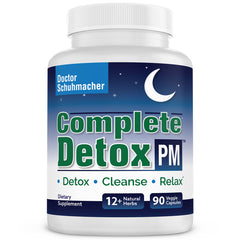
Longevity Complete Detox PM
- Size
- 90 capsules · 30 night supply
- Directions
- 3 capsules once daily, preferably about 30 minutes before sleep
- Ingredients
- Contains botanical extracts together with GABA and 5-HTP.
- Routine
- Designed as an evening supplement routine.

Longevity Complete Detox (Day Formula)
- Size
- 90 capsules · 30 servings
- Directions
- 3 capsules once daily
- Ingredients
- A botanical and fiber based formula containing ingredients including psyllium husk, green tea extract, dandelion extract and acai.
- Routine
- Designed for a simple daytime wellness routine.


