


![Longevity Complete Detox [BETA 21 Caps]: 7 Day Intensive Detox & Digestive Support](http://longevitypremier.com/cdn/shop/files/DetoxBeta-mid_100x100.png?v=1787365739)





10 g/day Soluble Fiber (Psyllium) Cut LDL About 20% in Trials
Soluble fiber lowers LDL cholesterol, and the effect holds up across decades of controlled trials. Aim for a moderate amount of soluble fiber daily, on top of whatever you already get from a normal diet, with psyllium around 10 g/day being the most studied and consistent dose. Food sources should come first; a supplement fills the gap when meals fall short. Anyone on statins or other lipid medication should loop in a doctor before adding fiber supplements, since timing and dosing can shift.
TL;DR:
- Consuming about 10 grams of psyllium daily can lead to a 20% reduction in LDL cholesterol over eight weeks.
- The LDL-lowering effect from soluble fiber increases with dose, approximately doubling as intake rises from 5 to 10 grams per day.
- Food sources like oats, barley, beans, and fruits naturally provide soluble fiber, which can help reach 8 to 10 grams daily without supplements.
- The blood lipid benefits begin to appear within four weeks, with more substantial changes happening between eight and twelve weeks.
- People on lipid medications should consult their doctor before adding fiber supplements to avoid interactions and ensure appropriate dosing.
Table of Contents
- Does Soluble Fiber Really Lower LDL Cholesterol?
- How Much Fiber Do You Need, and When Will It Show Up on a Blood Test?
- What Foods Give You the Most Soluble Fiber Per Serving?
- How Do You Take Psyllium and Other Fiber Supplements Correctly?
- Why Does Fiber Lower Cholesterol in the First Place?
- What Side Effects Should You Watch For When Adding Fiber?
- What Results Should You Expect on Your Next Lipid Panel?
- How We Think About Fiber in Practice
- A Complementary Option for Your Cholesterol Strategy
- Sources
Does Soluble Fiber Really Lower LDL Cholesterol?
Yes, and the evidence isn’t thin. A 2023 dose-response meta-analysis pooling 181 randomized controlled trials and more than 14,500 participants found that soluble fiber supplementation cut LDL cholesterol by a mean of roughly 8 mg/dL, with total cholesterol dropping alongside it. That’s not a rounding error. For someone with an LDL in the 160s, that reduction alone can be the difference between “needs medication” and “let’s watch it for another quarter.”
The relationship is dose-dependent, meaning more fiber, within reason, produces a bigger drop. Each additional 5 grams per day tends to move the needle further, though the curve isn’t perfectly linear across every fiber type. That single fact should reframe how you think about a “fiber supplement”: it’s not a fixed pill with a fixed effect, it’s a dial you can turn.
Psyllium carries some of the strongest individual trial data of any soluble fiber. A randomized trial in men with mild-to-moderate hypercholesterolemia found that around 3.4 grams taken with each meal, roughly 10 grams total per day, produced an LDL reduction of about 20% over eight weeks. That’s a bigger effect than most people expect from something you stir into water.
Older research backs up the pattern from a different angle. A classic meta-analysis by Brown and colleagues compared oats, psyllium, pectin, and guar gum and found broadly similar LDL and total-cholesterol reductions per gram of soluble fiber across all four. That matters because it means you aren’t locked into one “best” fiber. If you hate the texture of psyllium, oat beta-glucan or a legume-heavy diet can get you into a similar range.
Controlled feeding studies add a timeline dimension. An NEJM metabolic-diet trial found that very high-fiber diets reduced blood lipids within about four weeks, and the effect was more pronounced when the background diet was already low in saturated fat. Fiber doesn’t work in isolation. It works better when it isn’t fighting a diet loaded with butter and bacon.
Key figures from the pooled trial evidence:
- Average LDL reduction across 181 RCTs: about 8 mg/dL
- Psyllium-specific trial (8 weeks, ~10 g/day): approximately 20% LDL reduction
- Effect size is dose-dependent, scaling with each additional 5 g/day
- Oats, psyllium, pectin, and guar gum show comparable per-gram potency
Trial snapshot: Across more than 14,500 participants in randomized trials, soluble fiber’s average LDL reduction landed around 8 mg/dL, roughly comparable to what some people see from a modest weight-loss or dietary-fat change alone.
None of this means the evidence is flawless. Meta-analyses combine studies with different fiber types, doses, baseline diets, and trial lengths, which introduces heterogeneity that no statistical adjustment fully erases. Some of the older, smaller trials likely suffered from publication bias, where positive results were more likely to get published than null ones. The honest takeaway: soluble fiber has a real, repeatable, moderate effect on LDL. It is not a replacement for statins in someone with severe hypercholesterolemia, but it is a legitimate, evidence-backed lever for people looking to shave meaningful points off their numbers.
How Much Fiber Do You Need, and When Will It Show Up on a Blood Test?
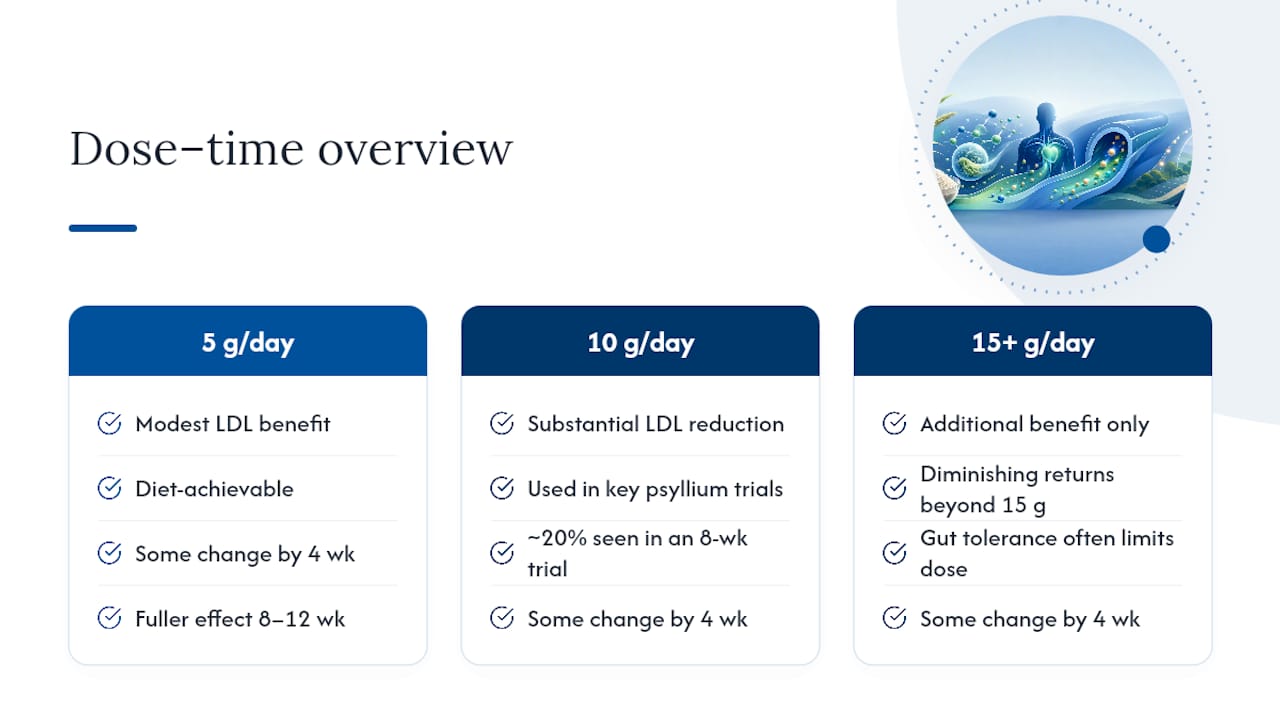
Clinical guidance from Mayo Clinic puts the effective range at 5 to 10 grams of soluble fiber per day, sometimes more, to meaningfully decrease LDL. That range isn’t arbitrary. It reflects where the dose-response curve in the trial data starts to bend upward.
Consider incremental levels of soluble fiber intake: a modest benefit achievable through diet alone with about 5 grams per day; around 10 grams per day as the dose used in key psyllium trials producing substantial LDL reductions; and higher amounts possibly showing additional benefits, though with diminishing returns beyond certain intakes.
Statistically, this is what dose escalation buys you: going from 5 to 10 g/day roughly doubles the fiber intake and, per the dose-response meta-analysis, produces a proportionally larger LDL reduction, though not a perfect doubling. Diminishing returns set in past 15 grams for most people, and gut tolerance becomes the limiting factor before the cholesterol math does.
Timeline matters as much as dose. Trial data consistently shows a pattern: some lipid change is visible by four weeks, but the fuller effect typically shows up between eight and twelve weeks of consistent daily intake. The psyllium trial that produced the 20% LDL drop ran for eight weeks, and Harvard Health’s summary of pooled psyllium research reinforces that lipid improvements tend to be progressive rather than immediate. If you check your labs at two weeks and see nothing, that’s expected, not a failure.
A sensible monitoring plan: get a baseline lipid panel before you start, stay consistent with your fiber intake daily (not just on days you remember), and recheck at 8 to 12 weeks. That window gives the fiber enough time to do its work and gives you a real signal rather than noise.
What Foods Give You the Most Soluble Fiber Per Serving?
Food-first is the right starting point, and it’s more achievable than people assume once you know where the fiber actually lives.
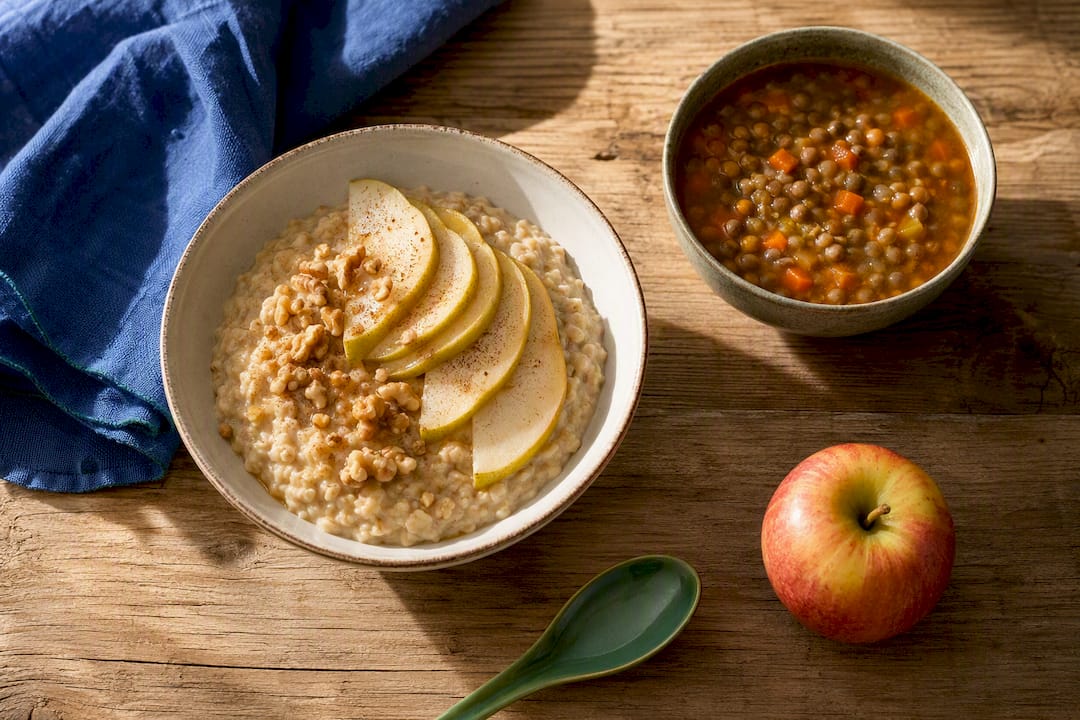
Oats and oat bran anchor most food-based approaches. A single serving of oatmeal or oat bran provides about 3 to 4 grams of soluble fiber, largely from beta-glucan, the same viscous compound responsible for oats’ cholesterol-lowering reputation. Two servings a day gets you most of the way to the 5 gram floor before you’ve eaten anything else.
Barley works through a similar beta-glucan mechanism and slots easily into soups, grain bowls, or as a rice substitute.
Beans and lentils are underrated here. A cooked cup of most legumes delivers several grams of soluble fiber along with plant protein, which makes them one of the most efficient foods on this list per calorie.
Apples, pears, and citrus fruits contribute pectin, a soluble fiber that also shows LDL-lowering activity in the Brown meta-analysis discussed earlier. Eating the skin matters, since a chunk of the fiber sits there.
Psyllium husk, while usually thought of as a supplement, is technically a food-grade fiber and can be stirred into oatmeal, smoothies, or baked goods as a bulk ingredient rather than taken as a standalone dose.
A realistic day that hits 8 to 10 grams without much effort: oatmeal with sliced pear for breakfast, a lentil soup or bean salad at lunch, and an apple as an afternoon snack. That’s not a restrictive diet, it’s three normal food choices stacked on top of each other.
MedlinePlus’s dietary guidance notes something worth sitting with: most people fall well short of recommended fiber intake, soluble or otherwise. The gap isn’t usually a lack of good options, it’s a lack of awareness that these everyday foods are doing real cardiovascular work. Beyond the cholesterol angle, these same foods bring fiber-driven satiety, steadier blood sugar, and micronutrients that a supplement bottle can’t replicate.
How Do You Take Psyllium and Other Fiber Supplements Correctly?
Psyllium has more clinical backing behind it than any other soluble-fiber supplement, largely because it’s cheap, well-tolerated in large trials, and highly viscous, which happens to be the exact property that drives its cholesterol effect. The pooled trial dose that shows up again and again is around 10 grams per day, split across meals rather than taken all at once.
Form matters more than most people realize. A powder that you mix with water and drink forms a viscous gel in the gut, and that gel is central to how the fiber binds bile acids. Dry capsules can work, but Harvard Health notes that gel-forming powdered forms are generally more effective than encapsulated versions, partly because capsules require more water intake to hydrate properly and people often skip that step.
If you’re deciding between the two, a psyllium capsule versus powder comparison is worth reading before you buy, since the format you pick affects both tolerance and how well it actually works.
Here’s a stepwise plan that mirrors how clinicians generally advise patients to start:
- Week 1: Start at 3 to 4 grams per day, mixed into a full glass of water, taken with a meal.
- Week 2 to 3: Increase gradually toward 7 to 8 grams per day, still split across meals, watching for bloating or gas.
- Week 3 onward: Reach the 10 gram target if tolerated, taken consistently every day rather than sporadically.
- Ongoing: Keep hydration high, since fiber without enough water is the most common cause of constipation, not the fiber itself.
A psyllium husk source in bulk form gives you more control over exact dosing than pre-measured capsules, which some people prefer once they’ve found their target amount.
Pro Tip: Mix psyllium powder immediately before drinking. It thickens fast, and letting it sit turns a smooth drink into something closer to pudding within a couple of minutes.
One detail that trips people up: fiber supplements can bind to certain oral medications and reduce their absorption if taken together. The practical fix is spacing, not avoidance, which the next section covers in more detail. Anyone managing a chronic condition with prescription drugs should run their specific supplement plan by a clinician before locking in a dose.
Why Does Fiber Lower Cholesterol in the First Place?
The mechanism isn’t mysterious once you break it into three parts, and understanding it makes the dosing advice above make a lot more sense.
Bile acid binding is the main driver. Viscous soluble fiber forms a gel in the small intestine that traps bile acids, the cholesterol-derived compounds your liver uses to digest fat. Normally, your body recycles most bile acids efficiently. When fiber binds them and carries them out in stool, the liver has to pull cholesterol out of circulation to manufacture replacement bile acids. That extra demand is essentially what shows up as a lower LDL number on your next blood panel.
Fermentation adds a secondary effect. Gut bacteria ferment soluble fiber into short-chain fatty acids, including propionate, which appears to modestly interfere with cholesterol synthesis in the liver. This pathway contributes less than bile binding, but it’s part of why fiber fermented by gut flora tends to outperform inert bulking agents that pass through unchanged.
Slower nutrient absorption plays a supporting role. Viscous fiber thickens the contents of your gut, which slows how fast sugar and fat get absorbed after a meal. Blunting that post-meal glucose and insulin spike matters because insulin drives some hepatic cholesterol production; flatten the spike, and you dial back that stimulus too.
Viscosity and molecular weight explain why not all fibers are equal per gram. Higher-viscosity, higher-molecular-weight fibers, certain psyllium and guar preparations among them, bind more bile acid per gram than thinner, less viscous soluble fibers. That’s the biochemical reason psyllium punches above its weight in trials compared to some other fiber sources at the same dose.
What Side Effects Should You Watch For When Adding Fiber?
The most common problem with soluble fiber isn’t danger, it’s discomfort, and it’s almost always avoidable with slower titration.
- Gas and bloating show up in the first one to two weeks for most people and typically fade as the gut microbiome adjusts to the new fermentable load.
- Constipation or, less often, loose stools usually trace back to insufficient water intake relative to the fiber dose, not the fiber itself.
- Medication absorption interference is a real interaction risk, not a theoretical one. Fiber can physically bind certain oral drugs in the gut before they’re absorbed.
The fix for that last point is straightforward: separate fiber supplements from oral medications by about two hours, taking pills either well before or well after your fiber dose. This applies broadly to oral medications, not just one drug class, so if you take anything daily, build the two-hour gap into your routine regardless of what it is.
Certain people should talk to a doctor before starting any fiber supplement rather than after: anyone with a history of bowel obstruction, difficulty swallowing, recent bowel surgery, or who is pregnant. These aren’t edge cases to gloss over, they’re situations where a bulking fiber can create a genuine mechanical problem rather than just discomfort.
Pro Tip: If you experience severe abdominal pain, chest tightness while swallowing the fiber mixture, or difficulty swallowing it at all, stop and call a doctor rather than pushing through. Those symptoms aren’t normal adjustment, they’re a signal something is caught.
For most people, the side-effect profile settles down within two to three weeks of gradual titration, which is exactly why the stepwise dosing plan earlier starts low and climbs slowly rather than jumping straight to 10 grams on day one.
What Results Should You Expect on Your Next Lipid Panel?
Based on the pooled trial data, a realistic expectation is an LDL drop somewhere in the range of a modest single-digit mg/dL improvement at the lower end of consistent intake, up to a considerably larger percentage reduction for people hitting the full 10 gram psyllium dose over eight or more weeks. Where you land in that range depends on your starting LDL, your consistency, and what else you’re doing with your diet.
That last part matters more than people assume. Fiber’s benefit is additive, not a replacement, for other cholesterol-lowering strategies. Cutting saturated fat, staying active, and taking prescribed lipid medication when indicated all stack on top of what fiber contributes, rather than competing with it.
A simple monitoring checklist:
- Get a baseline lipid panel before changing your fiber intake.
- Stay consistent daily for at least 8 to 12 weeks before rechecking.
- Pair fiber increases with lower saturated fat intake where possible, since the NEJM feeding trial found this combination outperforms fiber alone.
- If you’re on statins or other lipid medication, keep your clinician looped in rather than adjusting fiber intake as a silent substitute.
How We Think About Fiber in Practice
Soluble fiber is one of the few cholesterol interventions where the evidence, the dosing, and the food math all line up cleanly, which is rarer than it should be in nutrition advice. A formulation approach informed by extensive healthcare practice experience shows a simple lesson: food-first works until it doesn’t, and that’s where a well-formulated supplement earns its place, not as a shortcut but as a backstop.
We’d rather see someone eat the oatmeal and the lentils first. When schedules or appetites make that unreliable, a fiber-inclusive supplement fills a real gap. Either way, if you’re on lipid medication, involve your doctor. Our educational resources exist to make that conversation more informed, not to replace it.
— Charles
A Complementary Option for Your Cholesterol Strategy
Getting to 10 grams of soluble fiber daily through food and psyllium alone takes real planning, and most people’s diets have gaps on busy weeks. The Longevity Cholesterol Formula is built to complement that food-first approach, combining plant sterols, red yeast rice, garlic, and fiber-supportive ingredients into one daily formulation rather than asking you to juggle separate bottles.
This isn’t positioned as a substitute for the dosing strategies above, it’s designed to sit alongside them, especially on days when hitting your oatmeal-and-lentils target just isn’t happening. If you’re currently on statins or any other lipid medication, talk to your doctor before adding this or any new supplement, the same way you would before increasing psyllium intake. For anyone ready to build a more complete cardiovascular support routine, the three-bottle value pack is the practical starting point, and it pairs naturally with the food-first habits covered throughout this guide.
This article is general information, not a substitute for advice from a qualified doctor. Consult a qualified healthcare professional about your own circumstances before acting on anything here.
Sources
- Soluble Fiber Supplementation and Serum Lipid Profile: A Systematic Review and Dose-Response Meta-Analysis of Randomized Controlled Trials
- Cholesterol-Lowering Effects of Psyllium Hydrophilic Mucilloid for Hypercholesterolemic Men
- Cholesterol: Top foods to improve your numbers
- Psyllium fiber, regularity, and healthier lipid levels (Harvard Health)
- Effect on Blood Lipids of Very High Intakes of Fiber in Diets …
- How to lower cholesterol with diet (MedlinePlus)