


![Longevity Complete Detox [BETA 21 Caps]: 7 Day Intensive Detox & Digestive Support](http://longevitypremier.com/cdn/shop/files/DetoxBeta-mid_100x100.png?v=1787365739)




Psyllium Capsules: Benefits, Dosage, and Buying Guide
Psyllium capsules work as a convenient, pre-dosed form of soluble fiber that supports regularity, helps lower LDL cholesterol modestly, and moderates post-meal blood sugar when taken consistently with enough water. The catch: capsules often require a higher pill count than most people expect to hit research-backed gram amounts. Anyone on medications, with swallowing difficulty, or managing a GI condition should check with a clinician before starting.
TL;DR:
- Achieving a 10 gram daily dose for cholesterol benefits requires swallowing 20 to 33 capsules, which can be inconvenient and costly.
- Psyllium capsules must be taken with a full glass of water and spread across meals to avoid choking and optimize blood sugar moderation.
- Side effects like bloating, gas, or constipation are common initially but typically improve with gradual dose increases and proper hydration.
- People on medications should space psyllium doses at least one to two hours apart due to potential interference with drug absorption.
- For targeted cholesterol or blood sugar lowering, powder forms provide more flexible dosing with less expense but less convenience.
Table of Contents
- What Do Psyllium Capsules Actually Do?
- How Much Psyllium Should You Take, and How?
- Are Psyllium Capsules Safe? Side Effects and Interactions
- Capsules vs. Powder: Which Form Actually Fits Your Life?
- How to Choose a Quality Psyllium Capsule Product
- Building a Psyllium Capsule Routine That Actually Sticks
- Where Longevity Premier Fits Into the Fiber Conversation
- The Gap Between Psyllium’s Reputation and Its Real Use Case
- Sources
What Do Psyllium Capsules Actually Do?
Psyllium comes from the seed husk of Plantago ovata, and once it hits water in your gut, it swells into a thick gel. That gel is the whole story mechanically: it adds bulk to stool, speeds up or slows down transit depending on what your gut needs, and binds bile acids in the intestine, which forces your liver to pull more cholesterol out of the blood to make replacement bile acids.
That bile-acid binding is why psyllium shows up in cholesterol conversations more than most fiber supplements. A meta-analysis of 28 trials found that 10 grams of psyllium daily for at least three weeks lowered LDL cholesterol by about 13 mg/dL, with some individual studies reporting reductions closer to 24 percent. The FDA has gone a step further, endorsing the idea that 7 grams or more of soluble psyllium fiber daily, paired with a diet low in saturated fat, helps reduce the risk of coronary heart disease.
Blood sugar response depends heavily on timing. Taking psyllium before a meal slows carbohydrate absorption enough to blunt the post-meal glucose spike, but that effect resets if you skip doses. Consistency, not occasional use, is what separates people who see a real change on their glucose meter from those who don’t.
On the digestive side, psyllium is one of the few fiber supplements with evidence for both directions of GI trouble. It’s a reliable bulk-forming laxative for constipation, and the same gel-forming property firms up loose stool during diarrhea. Some clinical trials also report reduced IBS symptom severity, likely tied to psyllium’s role as a prebiotic. It ferments in the colon and feeds bacteria that produce short-chain fatty acids, compounds tied to gut lining health and digestive stability.
What the numbers actually mean for you:
- Cholesterol changes typically take three to eight weeks of daily use to show up on a lipid panel.
- Regularity improvements often show up within days to two weeks.
- Weight loss evidence is weaker: trials using around 10.8 grams daily for nearly five months found modest reductions in some participants, but broader research is mixed. Don’t buy psyllium capsules expecting a weight-loss drug in a bottle.
Quick stat: A daily dose in the 10 gram range, sustained for several weeks, is the threshold most cholesterol research is built around. Below that, and used sporadically, effects shrink fast.
How Much Psyllium Should You Take, and How?
Most clinical trials testing psyllium for cholesterol or blood sugar use somewhere between 6 and 15 grams a day, with 10 grams as the most common therapeutic target. The dosing range consumer guides cite most often is 7 to 14 grams daily, which lines up with both the research and typical label recommendations.
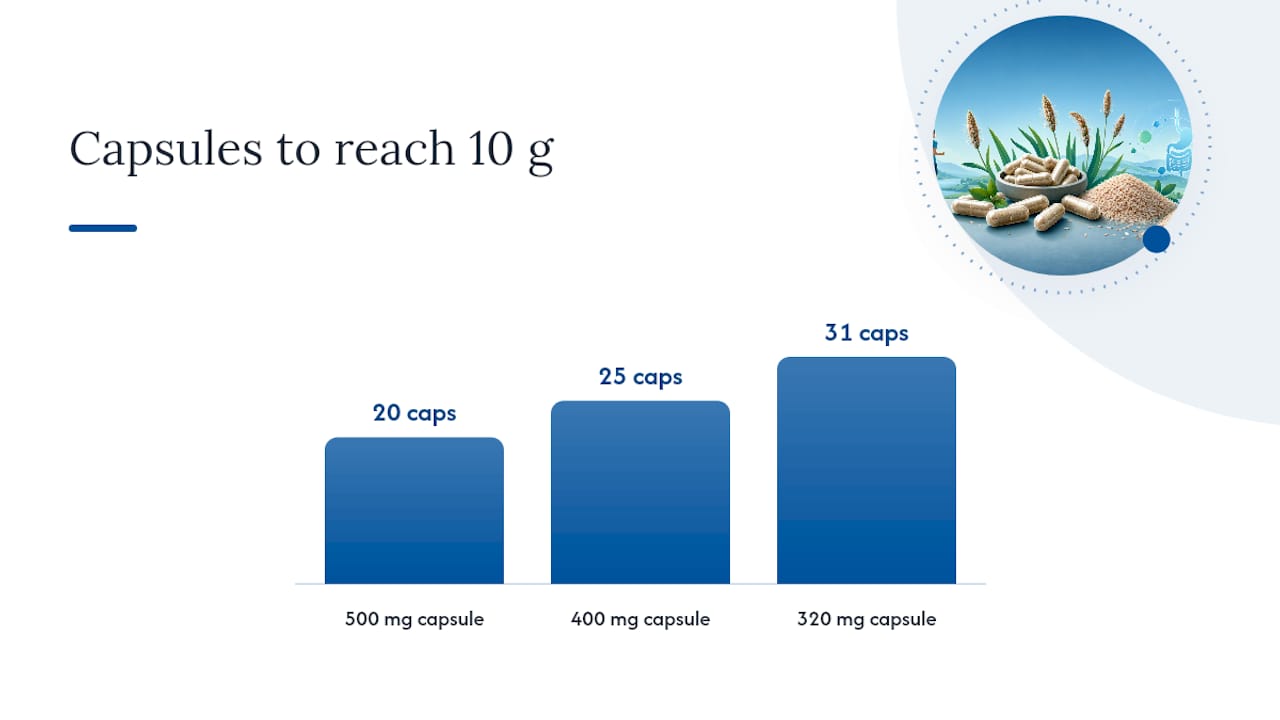
Here’s where capsules get tricky: most psyllium capsules contain somewhere between 300 and 500 mg of psyllium husk per capsule. Do the math and a 10 gram target means swallowing 20 to 33 capsules a day, split across doses. That’s not a hypothetical, it’s the actual pill count many people don’t realize until they’ve already bought a bottle.
A few real-world conversions:
- 500 mg capsules: 20 capsules to reach 10 grams.
- 400 mg capsules: 25 capsules to reach 10 grams.
- 320 mg capsules (common with some brands): roughly 31 capsules to reach 10 grams.
For general maintenance, a much smaller dose, often 3 to 6 capsules a day, is plenty to support regularity without chasing a specific cholesterol-lowering gram target.
How to actually take them:
- Swallow capsules upright, one at a time if needed, with a full 8-ounce (240 mL) glass of water.
- Never take psyllium capsules lying down or with minimal liquid. The husk expands fast and can swell before it clears your esophagus.
- Take doses before meals if blood sugar moderation is your goal. The fiber needs to be present in the gut before carbohydrates arrive to blunt the glucose response.
- Spread the total daily dose across two or three sittings instead of one large one. It’s gentler on digestion and easier to hit consistently.
- Start at roughly a third of your target dose for the first week and build up gradually.
Pro Tip: Set a phone reminder for your psyllium doses tied to meals, not to a clock time. “Before lunch” is a habit that sticks; “1:00 PM” is one you’ll forget the first busy Tuesday.
Are Psyllium Capsules Safe? Side Effects and Interactions
Psyllium has a long track record as a fiber supplement, but “safe for most people” isn’t the same as “safe to ignore instructions.”
- Gas, bloating, and abdominal discomfort are the most common complaints, especially in the first one to two weeks. They usually fade as your gut adjusts, and starting at a lower dose minimizes them.
- Occasional constipation, ironically, can happen if you increase fiber without increasing water intake proportionally. The fiber needs liquid to do its job; without it, you get the opposite of the intended effect.
- Choking or esophageal obstruction risk is the serious one. Psyllium capsules must be taken with a full glass of water, swallowed one or two at a time rather than a fistful at once. People with any history of swallowing difficulty (dysphagia) should talk to a doctor before starting, and anyone who experiences chest discomfort or a sensation of something stuck after taking a dose should seek medical attention.
- Medication interactions are a real concern because psyllium’s gel can physically trap other drugs in the gut and reduce how much gets absorbed. The standard guidance is to space psyllium at least one to two hours away from oral medications, particularly ones with a narrow therapeutic window like certain thyroid medications, diabetes drugs, or blood thinners. If you’re on any prescription medication, check with a pharmacist about timing before adding daily psyllium.
- Who should avoid psyllium or talk to a doctor first: anyone with a history of bowel obstruction, esophageal stricture, difficulty swallowing, or an active flare of inflammatory bowel disease. Pregnant or breastfeeding individuals should also run any new supplement by their provider.
Cleveland Clinic’s drug information on psyllium reinforces the same core rule that shows up across every credible source on this ingredient: mix it or take it with a full glass of water and follow label directions exactly. It sounds almost too simple to be the main safety rule, but it’s the one people skip most often.
Capsules vs. Powder: Which Form Actually Fits Your Life?
Capsules win on convenience. They’re premeasured, don’t need mixing, travel well in a pocket or bag, and skip the gritty texture that turns some people off psyllium powder entirely. If your goal is a modest daily maintenance dose, capsules are genuinely the easier habit to keep.
Powder wins on dose flexibility and cost. Reaching a full 10 gram therapeutic dose with capsules can mean swallowing 20 or more pills a day, which gets expensive fast and is a lot to remember. A single tablespoon of powder, roughly 5 to 6 grams depending on the brand, gets you most of the way to that target in one scoop mixed into water or juice. Powder also tends to cost less per gram of actual fiber, since you’re not paying for capsule shells.
Where each form makes sense:
- Choose capsules if you want general regularity support, travel often, or find the taste and texture of mixed fiber drinks unpleasant.
- Choose powder if you’re specifically targeting the 10 gram research dose for cholesterol management and want to avoid a two-dozen-pill daily routine.
- A hybrid approach works too: powder for your main dose, capsules on the go when mixing isn’t practical.
Consumer guidance on psyllium consistently notes this tradeoff between convenience and dosing practicality, and it’s the single biggest factor in whether people actually stick with psyllium long term.
How to Choose a Quality Psyllium Capsule Product
Supplements aren’t regulated with the same pre-market scrutiny as prescription drugs, so the burden of quality-checking falls more on the label and the manufacturer’s transparency than on any government stamp of approval. The FDA’s own consumer safety reporting system exists partly because supplement quality control varies so widely between brands.
Here’s a practical checklist before you buy:
- Look for third-party testing seals, such as USP Verified or NSF Certified. These indicate an independent lab confirmed the product contains what the label claims and screened for contaminants.
- Check the mg-per-capsule figure and total grams per serving. A label that only says “psyllium husk fiber” without a milligram amount is a red flag; you can’t calculate your dose without it.
- Scan for fillers and additives. Some products bulk up capsules with unnecessary binders. Shorter ingredient lists are generally a good sign for a single-ingredient fiber supplement.
- Confirm capsule material if you’re vegetarian, vegan, or avoiding gelatin. Plant-based capsule shells are common but not universal.
- Check allergen statements, especially if you have sensitivities to soy, wheat, or other common allergens processed in the same facility.
- Ask whether a certificate of analysis is available. Brands that willingly share batch-testing results tend to be more transparent overall.
- Check the expiration date and packaging integrity. Fiber supplements degrade slowly, but moisture exposure through poor packaging can affect potency over time.
Third-party certification doesn’t guarantee a product works better, but it does confirm the label matches what’s actually in the capsule, which is the baseline any supplement should clear before you trust it with your daily routine.
Building a Psyllium Capsule Routine That Actually Sticks
Jumping straight to 20 capsules a day is the fastest way to quit within a week. A gradual ramp works better for both comfort and adherence.
- Week 1: Take about a third of your target dose, split into two servings with meals, each with a full glass of water.
- Week 2: Increase to roughly two-thirds of your target dose if your gut has adjusted comfortably.
- Week 3 onward: Reach your full target dose, maintaining consistent timing around meals.
- Every dose, every time: a full 8-ounce glass of water, and a gap of one to two hours from any oral medication.
If bloating or gas becomes disruptive, drop back a step and hold there for a few extra days before increasing again. Splitting one large dose into three smaller ones across the day often resolves discomfort without abandoning the supplement entirely. If cramping, severe bloating, or any swallowing discomfort persists beyond adjustment, stop and check with a clinician.
Expect regularity changes within one to two weeks. Cholesterol or blood sugar shifts take longer, generally three to eight weeks of consistent daily use before a lab test shows a meaningful difference.
Pro Tip: Keep your psyllium capsules next to your water glass at the breakfast table, not in the medicine cabinet. Visibility at the moment you’re already reaching for water does more for consistency than any reminder app.
Where Longevity Premier Fits Into the Fiber Conversation
Formulation quality is the variable most people underweight when comparing supplements, and it’s the area where Longevity Premier has built its approach over more than three decades of healthcare practice experience. The company’s work on digestive health, detoxification, and metabolic support formulas reflects the same principle that applies to any psyllium product: purposeful ingredient selection and careful formulation reduce the guesswork around dosing consistency and quality control.
That focus on targeted, well-tested formulations, rather than generic wellness claims, is what separates a supplement you can dose with confidence from one you’re just hoping works. Readers wanting a deeper look at how Longevity Premier approaches digestive and metabolic formulation can find more detail in the brand’s educational resources.
The Gap Between Psyllium’s Reputation and Its Real Use Case
Psyllium gets treated in a lot of wellness content like a mild, forgettable fiber add-on. The research doesn’t support that framing. A 13 mg/dL LDL drop from 10 grams daily is a meaningful clinical number, not a rounding error, and the FDA’s own heart-health language around 7 grams of soluble fiber daily reflects that.
Where conventional advice falls short is the capsule math. Almost nobody selling psyllium capsules walks buyers through the fact that hitting a therapeutic dose can mean 20 or more pills a day. That omission sets people up to either underdose without realizing it or quit out of frustration when the bottle runs out in four days instead of thirty.
My take: decide your goal before your format. If you want a therapeutic cholesterol or blood sugar dose, do the capsule math first or default to powder. If you want gentle daily regularity support, capsules are genuinely the more livable choice. Either way, the water rule isn’t optional, and the timing around medications isn’t a suggestion. Those two habits determine whether psyllium works for you at all.
— Charles
This article is general information, not a substitute for advice from a qualified doctor. Consult a qualified healthcare professional about your own circumstances before acting on anything here.
Sources
- Psyllium fiber, regularity, and healthier lipid levels — Harvard Health
- Clinical research on psyllium and weight/metabolic effects — PMC
- Psyllium (powder for solution) — Cleveland Clinic
- Psyllium’s prebiotic effects and gut microbiome support — PubMed
- Psyllium: What Are the Health Benefits? — Healthline