


![Longevity Complete Detox [BETA 21 Caps]: 7 Day Intensive Detox & Digestive Support](http://longevitypremier.com/cdn/shop/files/DetoxBeta-mid_100x100.png?v=1787365739)




Fatty Liver: Turmeric Lowers ALT About 4 U/L, But Rare Injury Reported
Turmeric can modestly lower liver enzyme levels in some people with fatty liver disease, but concentrated, high-absorption supplements have been linked to rare cases of serious liver injury. The enzyme benefit shows up mainly in short-term NAFLD trials with modest effect sizes. The safety risk clusters around piperine-boosted and nanoparticle formulations, not the spice in your kitchen. Anyone with existing liver disease or on interacting medications should talk to a clinician before starting a supplement.
TL;DR:
- Concentrated, high-absorption turmeric supplements, especially those boosted with piperine or formulated as nanoparticles, increase the risk of serious liver injury in rare cases.
- Most trials show only modest enzyme reductions within 8 to 12 weeks, mainly benefiting those with mild fatty liver disease, without evidence of slowing disease progression.
- Liver injury signs include jaundice, dark urine, fatigue, or abdominal pain, and symptoms require immediate cessation of supplements and medical evaluation.
- Use culinary turmeric or low-dose standard extracts to minimize risk, and consult a clinician before starting higher-dose or bioavailability-enhanced formulations.
- Interactions with blood thinners, diabetes medications, and liver-metabolized drugs are possible, so proper testing and medical advice are essential for supplement users.
Table of Contents
- What Does the Clinical Evidence Show for Turmeric and Liver Health?
- What Are the Safety Signals Behind Turmeric-Associated Liver Injury?
- Do Piperine and Nanoparticle Formulas Change the Risk?
- How Much Turmeric Is Safe, and What Interacts With It?
- What Are the Warning Signs of Liver Injury and What Should You Do?
- How Should You Try Turmeric for Liver Health Safely?
- How Does Longevity Premier Approach Turmeric and Liver Support?
- Author Perspective: A Practical Take on Turmeric and Liver Health
- Explore Longevity Premier’s Liver and Detox Support Options
- Sources
What Does the Clinical Evidence Show for Turmeric and Liver Health?
The strongest signal for turmeric for liver health comes from a 2023 GRADE-assessed systematic review and dose response meta-analysis, which pooled randomized controlled trials and found curcumin or turmeric supplementation produced a weighted mean difference of −4.09 U/L for ALT and −3.81 U/L for AST. Those numbers sound small, and they are. A four-point drop in ALT will not turn a failing liver panel into a normal one. But for someone tracking mild, chronic enzyme elevation tied to nonalcoholic fatty liver disease (NAFLD), that kind of movement is a real biochemical signal worth noting.
One trial that illustrates the pattern gave patients with NAFLD 2 grams of turmeric daily for eight weeks and measured drops in AST, ALT, and GGT alongside improvements in some lipid markers and liver echogenicity on ultrasound. Short trials like this one show a consistent direction of effect: enzymes trend down, some metabolic markers improve, and imaging occasionally reflects less fatty infiltration. What they don’t show is whether that translates into slower fibrosis progression or fewer downstream complications over years, because nobody has run a trial long enough to answer that.
Mechanistic reviews help explain why the effect exists at all. Curcumin, the primary bioactive compound in turmeric, appears to act on inflammatory pathways, reduce oxidative stress, and interfere with some of the signaling that drives fibrosis in liver tissue, according to a comprehensive review of curcumin’s role in chronic liver disease. That review also notes single oral doses ranging from 0.5 to 12 grams have been tolerated in various study settings, though tolerance and effectiveness are not the same question.
Several limitations keep this evidence from being definitive:
- Most trials run 8 to 12 weeks, far too short to capture disease progression or reversal.
- Study quality varies widely, and pooled analyses flag meaningful heterogeneity between trials in dose, formulation, and patient population.
- Enzyme improvements are statistically significant but clinically modest, meaning they’re a biochemical signal rather than proof of liver repair.
- Few trials use biopsy-confirmed outcomes, relying instead on enzymes and imaging as proxies.
The takeaway on effect size: a WMD of roughly 4 U/L on ALT is the kind of change you might see from moderate weight loss or cutting back on alcohol for a few weeks. It’s real, but it’s an adjunct, not a replacement for the changes that actually move the needle on NAFLD.
Adults managing mild NAFLD who want an added biochemical nudge alongside diet and exercise are the group most likely to see a plausible benefit. People expecting turmeric alone to reverse existing liver damage are working from evidence that doesn’t exist yet.
What Are the Safety Signals Behind Turmeric-Associated Liver Injury?
Rare cases of turmeric-associated liver injury follow a recognizable pattern, according to the NIH’s LiverTox database: fatigue and nausea first, then dark urine, and eventually jaundice as the liver’s ability to clear bilirubin falters. The typical latency runs one to four months after starting a supplement, which is exactly why patients rarely make the connection themselves. Nobody expects a “natural” spice supplement to cause symptoms that show up ten weeks later.
LiverTox describes the injury pattern as usually hepatocellular, meaning the damage centers on liver cell enzymes (ALT and AST) rather than the bile duct markers you’d see in a cholestatic injury. Some case series report an association with the HLA-B*35:01 genetic marker, suggesting an immune-mediated, idiosyncratic reaction in genetically susceptible people rather than a dose-dependent toxic effect that would hit everyone equally. That distinction matters for how clinicians think about risk: this isn’t a poison-by-volume problem, it’s a specific-person-specific-product reaction.
Here’s what the case reports consistently show:
- Onset typically between 1 and 4 months after starting a high-potency turmeric or curcumin product.
- Liver enzyme elevations often reach levels consistent with acute hepatitis before diagnosis.
- Most patients recover within 1 to 3 months of stopping the supplement.
- Continuing the product after symptoms start raises the risk of a more severe course.
- Several documented cases involved high-bioavailability formulations rather than plain turmeric powder or culinary use.
Incidence remains genuinely uncertain. There’s no reliable population-level rate for how often turmeric-associated liver injury occurs, largely because supplement use isn’t tracked the way prescription drug use is, and mild cases likely go unreported. What the case-series data does make clear is that this is uncommon but not theoretical, and the outcome is usually reversible if caught early.
The instruction from LiverTox and the case literature is unambiguous: if you develop nausea, unusual fatigue, dark urine, or yellowing skin or eyes while taking a turmeric or curcumin supplement, stop it immediately and get liver function tests. Don’t wait to see if it passes on its own, and don’t restart the product later to “test” whether it was really the cause. Rechallenge after a suspected reaction is associated with faster, more severe recurrence.
Do Piperine and Nanoparticle Formulas Change the Risk?
Curcumin on its own absorbs poorly. The body metabolizes most of an oral dose before it ever reaches systemic circulation, which is a major reason early turmeric research showed underwhelming effects. That poor bioavailability wasn’t just a research inconvenience. It also happened to keep concentrated turmeric fairly safe by default, because so little of it ever entered the bloodstream in an active form.
Supplement makers solved the absorption problem with a few specific strategies:
- Piperine (black pepper extract): inhibits the liver enzymes that break curcumin down, dramatically increasing how much reaches circulation.
- Liposomal and lipid nanoparticle delivery: encapsulates curcumin in a fat-based carrier that the gut absorbs more efficiently.
- Phospholipid complexes: bind curcumin to phosphatidylcholine to improve solubility and uptake.
Each of these methods works. They also change the risk profile. LiverTox and related case-series reporting note that clusters of acute hepatitis linked to turmeric supplements have skewed heavily toward these enhanced-absorption products rather than plain turmeric root or powder, and the mechanism appears to be some combination of idiosyncratic immune reaction and simply higher systemic exposure. In plain terms: the same feature that makes an enhanced formulation more effective is what makes it more likely to trigger a reaction in someone predisposed to one.
The insider read on this, gathered from how the case reports cluster, is that the formulation matters more than the turmeric root itself. Standardized extracts boosted with piperine or reformulated as nanoparticles behave almost like a different substance pharmacologically compared to the ground spice you’d use in a curry.
Pro Tip: If you’re trying a curcumin supplement for the first time, skip the piperine-enhanced or nanoparticle versions initially. A standard extract lets you gauge tolerance before you introduce a compound designed specifically to push more curcumin into your bloodstream.
The practical rule that follows from all this: absorption-enhanced formulations deserve closer monitoring, not because they’re inherently dangerous for most people, but because they’re the category where nearly every documented severe case has originated.
How Much Turmeric Is Safe, and What Interacts With It?
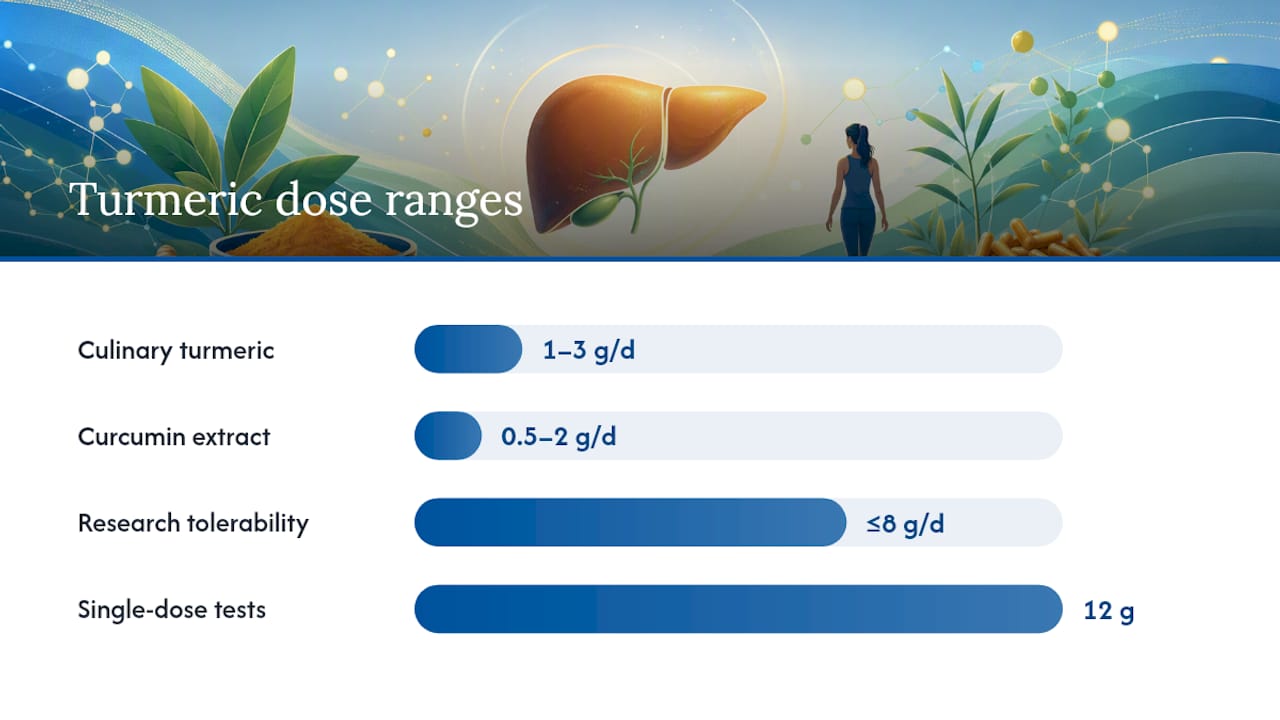
Culinary turmeric has a long track record. It’s generally recognized as safe (GRAS) in food use, and some reviews describing study intake note that amounts up to roughly 8 grams per day have been tolerated in research settings without safety signals. That’s a useful anchor point: the turmeric in your spice rack, even used liberally, sits in a completely different risk category from a standardized 500 to 1,000 milligram curcumin extract taken daily for months.
Supplement dosing in clinical trials varies more than most labels suggest:
- Culinary turmeric powder: typically 1 to 3 grams per day in food, well within traditional dietary patterns.
- Standard curcumin extract (95% curcuminoids): most NAFLD trials used doses in the 500 milligram to 2 gram per day range, often split into two doses.
- High-bioavailability formulations (piperine or nanoparticle-based): frequently marketed at similar milligram amounts but deliver substantially higher systemic exposure per dose.
- Research-only single doses: some tolerability studies have tested single doses up to 12 grams, which does not reflect typical daily supplement use and shouldn’t be replicated at home.
Interactions deserve real attention here, not a throwaway disclaimer. Curcumin has measurable effects on blood clotting, blood sugar, and liver drug metabolism, which means it can interact meaningfully with several common medication classes:
- Anticoagulants and antiplatelet drugs (warfarin, clopidogrel, aspirin): curcumin’s mild antiplatelet activity can add to bleeding risk.
- Glucose-lowering medications: turmeric and curcumin can produce additive blood-sugar-lowering effects, raising hypoglycemia risk in people with diabetes.
- Drugs metabolized through the liver’s CYP450 pathways: high-dose curcumin can alter how the liver processes certain medications, changing their effective blood levels.
Anyone taking blood thinners, diabetes medication, or drugs with a narrow therapeutic window should talk to a clinician before adding a concentrated turmeric supplement, and it’s reasonable to ask about baseline liver function tests if you plan to use a higher-dose product for more than a few weeks.
What Are the Warning Signs of Liver Injury and What Should You Do?
Certain symptoms should send you straight to a clinician, not to a search engine for reassurance. Watch for:
- Yellowing of the skin or the whites of the eyes (jaundice)
- Dark, tea-colored urine
- Unusual, persistent fatigue that doesn’t track with sleep or activity
- Pain or tenderness in the upper right abdomen
- Nausea or loss of appetite that doesn’t resolve
- Itchy skin (pruritus) without a rash
If any of these appear while you’re taking turmeric or curcumin in supplement form, stop the product immediately. Don’t taper, don’t wait for a follow-up appointment weeks out, and don’t switch to a “gentler” version of the same supplement to see if it helps.
A clinician evaluating suspected turmeric-related liver injury will typically order a standard workup: liver function tests (ALT, AST, bilirubin, alkaline phosphatase), viral hepatitis panels to rule out infectious causes, and sometimes autoimmune antibody testing or imaging to exclude other explanations. Documenting the exact product, brand, and batch number matters, since formulation differences between products are often the real variable driving risk.
Recovery is the encouraging part of this picture. Most documented cases of turmeric-associated liver injury resolve within one to three months of stopping the supplement, with liver enzymes returning to normal ranges and no lasting damage in the majority of reported cases. The critical variable is timing: cases that continue past symptom onset, or where the product gets restarted, tend to run a more severe course. Prompt cessation and prompt evaluation are what keep this a reversible event rather than a lasting one.
How Should You Try Turmeric for Liver Health Safely?
If you want to explore turmeric’s potential enzyme benefits without taking on unnecessary risk, a conservative, stepwise approach makes sense:
- Start with culinary turmeric or a low-dose standard extract. Skip piperine-enhanced or nanoparticle-delivery products as your first exposure, since these are the formulations most linked to reported injury clusters.
- Read the label carefully. Look for a clearly stated curcuminoid content (not just “turmeric extract”), an absence of unnecessary proprietary absorption blends, and evidence of third-party testing for purity and potency.
- Get baseline liver function tests if you’re at elevated risk. This applies to anyone with existing liver disease, heavy alcohol use, obesity-related fatty liver, or use of other medications processed by the liver.
- Reassess at 4 to 12 weeks if you’re using a higher-dose or high-bioavailability product. A follow-up liver panel catches problems early, before symptoms would prompt you to notice on your own.
- Keep the product packaging and batch information. If anything unusual happens, this makes reporting and clinical follow-up far more useful.
Pro Tip: Treat any new supplement, turmeric included, the way you’d treat a new medication: one change at a time. If you start a curcumin extract and a new probiotic in the same week and something goes wrong, you’ll have no way to know which one caused it.
If you do experience an adverse reaction, report it. In the United States, that means contacting your clinician and, where appropriate, filing a report with FDA MedWatch, which helps regulators track patterns across supplement brands and formulations that individual case reports alone can’t reveal.
How Does Longevity Premier Approach Turmeric and Liver Support?
The company builds its detoxification and digestive-health formulas around the same standard this article has applied to turmeric: look at the evidence, respect the rare but real risks, and favor transparency over hype. The approach is informed by extensive healthcare practice experience guiding ingredient selection and dosing in formulas.
If you’re researching complementary liver-support ingredients beyond turmeric, an internal review of NAC for liver health covers another commonly discussed compound with its own evidence base and limitations. A milk thistle product is available and worth understanding for the same reason: milk thistle’s active compound, silymarin, has a different mechanism and safety profile than curcumin, which matters if you’re comparing options.
When evaluating any liver-support supplement, including turmeric products, look for three markers:
- Clearly labeled curcuminoid or active-ingredient content, not vague blend percentages
- Third-party testing for purity and contaminants
- Transparent disclosure of whether piperine or other absorption enhancers are included, so you can make an informed call on risk
Author Perspective: A Practical Take on Turmeric and Liver Health
The evidence here doesn’t point to a clean yes or no, and I think that’s the honest answer readers actually need. Turmeric can nudge liver enzymes down a few points in people with fatty liver disease. It can also, rarely, put someone in a clinic with jaundice three months after they started a “natural” supplement they assumed was risk-free. Both things are true, and neither cancels the other out.
What I’d tell a friend: if you have healthy liver function and no interacting medications, culinary turmeric is close to a non-issue. If you’re drawn to a concentrated extract, start with the plain version, not the piperine-boosted one, and get a baseline liver panel if you plan to stay on it. The decision isn’t about turmeric being good or bad. It’s about matching the dose and formulation to your actual risk, not the marketing on the bottle.
— Charles
Explore Longevity Premier’s Liver and Detox Support Options
If you’ve read this far, you already know the smartest move with turmeric is starting conservative and choosing formulations built around transparency, not just marketing claims about absorption. Longevitypremier applies that same standard across its detox and digestive-health lineup, including Complete Detox Formula and the milk thistle supplement many readers pair with liver-focused routines.
Every formula lists its active ingredient amounts clearly, so you’re not guessing what’s actually in the capsule or how it compares to the doses discussed in clinical research. If turmeric’s blood-sugar interactions gave you pause, Longevitypremier’s Gluco Formula takes a similarly transparent approach to glucose metabolism support, using bitter melon, berberine, and Ceylon cinnamon instead of high-absorption curcumin. Visit Longevitypremier to compare formulas, check current bundle pricing, and talk to your clinician about which option, if any, fits your liver-health plan before you check out.
Sources
Readers and clinicians evaluating turmeric for liver health can check the primary sources behind this article directly:
- Effects of curcumin/turmeric supplementation on liver function in adults: A GRADE-assessed systematic review and dose–response meta-analysis of randomized controlled trials
- Turmeric - LiverTox - NCBI Bookshelf - NIH
- Role of Curcumin in Chronic Liver Diseases: A Comprehensive Review
Bring these sources to your own physician or hepatologist if you’re weighing turmeric supplementation against your specific health history.
This article is general information, not a substitute for advice from a qualified doctor. Consult a qualified healthcare professional about your own circumstances before acting on anything here.