


![Longevity Complete Detox [BETA 21 Caps]: 7 Day Intensive Detox & Digestive Support](http://longevitypremier.com/cdn/shop/files/DetoxBeta-mid_100x100.png?v=1787365739)




Science First: When Detox vs Cleanse Help and When They Harm
A cleanse usually targets your digestive tract; a detox claims to support broader organ function, especially the liver and kidneys. Neither term has a formal scientific definition, and most commercial versions of either aren’t backed by strong evidence. Your safest bet: skip the extreme versions, support your body’s own detox systems with real food and hydration, and check with a clinician before trying anything restrictive.
TL;DR:
- Most commercial detoxes and cleanses lack scientific backing and primarily rely on calorie restriction or mechanical elimination rather than toxin removal.
- A guided, nutrient-focused detox shows biochemical changes, but unregulated products often contain undisclosed ingredients that may harm your health.
- Short-term benefits like feeling lighter or less bloated result mostly from behavior changes and water or calorie loss, not actual detoxification.
- Risks include electrolyte imbalances, dehydration, nutrient deficiencies, and interactions with medications, especially during prolonged fasting or laxative use.
- Investing in whole foods, hydration, sleep, and consulting a healthcare professional offers safer, evidence-based support for body detoxification.
Table of Contents
- Detox vs Cleanse: The Real Difference
- What the Research Actually Says About Detox Program Benefits
- Common Detox Methods and What They Actually Do to Your Body
- Why People Report Feeling Better, and What’s Actually Happening
- Detox and Cleanse Safety: Who Should Skip It and Why
- How Longevitypremier Thinks About Safe, Evidence-Aligned Detox Support
- The Bottom Line on Detox vs Cleanse
- An Editorial Take on the Detox and Cleanse Industry
- A Practical Next Step From Longevitypremier
- Sources
Detox vs Cleanse: The Real Difference
The confusion is understandable because the marketing world treats these words as interchangeable when they’re not describing the same thing. A cleanse, in most commercial contexts, means something that acts on your gut: dietary changes, laxatives, enemas, or a stretch of juice-only eating meant to “flush” your system. A detox is the broader, vaguer claim. It usually implies support for organs involved in filtering waste from your body, mainly the liver and kidneys, often through supplements, teas, or multi-day protocols.
Here’s the part that matters most: neither term has an agreed-upon clinical definition. The Cleveland Clinic notes that both concepts are largely wellness marketing terms rather than medical categories, which is why you’ll see wildly different products sold under the same label.
A few distinctions worth holding onto:
- Cleanses tend to focus narrowly on digestion and bowel activity.
- Detoxes tend to make bigger claims about organ-level “toxin removal” or metabolic support.
- Neither has a standardized formula, dose, or duration, so two products with the same name can work completely differently.
- Marketing language frequently swaps the words based on what sounds more appealing that month, not on what the product actually does.
Knowing this difference between detox and cleanse claims is the first step to reading a label skeptically instead of hopefully.
What the Research Actually Says About Detox Program Benefits
Most of the evidence here is thinner than the marketing suggests. The National Center for Complementary and Integrative Health (NCCIH) states plainly that there’s little compelling evidence that detox diets remove toxins or produce lasting health benefits, and the agency catalogs the usual suspects: fasting, juice diets, supplements, and colonics.
The one study worth knowing about: a 2023 clinical trial tracked a 28-day guided metabolic detoxification program and found a 40% increase in total cellular antioxidant capacity alongside a 13% decrease in reactive oxygen species in healthy participants. That’s a real, measurable biochemical shift, not a placebo story. But it’s one trial, on a structured, supervised program, not a generic juice cleanse you’d buy off a shelf. Reactive oxygen species markers moving in a favorable direction over 28 weeks of guided intervention doesn’t translate to “any detox tea works.”
A few caveats keep this evidence grounded:
- Small sample sizes are common across detox and cleanse research, which limits how far results generalize.
- Regulatory bodies including the FDA and FTC have taken action against detox products for hidden ingredients or unproven medical claims.
- Short follow-up periods mean nobody knows whether biomarker improvements last once the program ends.
The honest takeaway: some guided, nutrient-focused protocols show promise on paper. Most commercial detox program benefits marketed to you at checkout have never been tested that rigorously.
Common Detox Methods and What They Actually Do to Your Body
Understanding the mechanism behind each popular method helps you tell a plausible approach from a risky gimmick.
- Juice and water cleanses. These work almost entirely through calorie restriction. The scale drop you see in the first few days is mostly water and glycogen loss, not fat and definitely not “toxins.”
- Fasting (intermittent vs. prolonged). Intermittent fasting has a real research base tied to metabolic health, separate from detox marketing. Prolonged fasting is different territory. Clinical guidance from University Hospitals advises caution with prolonged fasting without medical supervision, largely because of electrolyte risk, without specifying an exact duration.
- Detoxing foods and supplements. Herbal blends vary enormously in potency and purity. Some contain undisclosed ingredients that can strain the liver or interact with prescription medications.
- Colonics and enemas. These produce an immediate emptying sensation, but that’s mechanical, not detoxifying, and they carry documented risks for people with gastrointestinal, kidney, or heart conditions.
Why People Report Feeling Better, and What’s Actually Happening
The benefits people describe after a cleanse are usually real. They’re just not caused by what the label claims.
- Drinking more water and cutting processed food for a week will make almost anyone feel lighter and less bloated.
- Lower calorie intake during a juice cleanse explains most of the quick weight change, and it tends to reverse once normal eating resumes.
- A small number of guided, supplement-based programs have shown biomarker shifts, including the 40% antioxidant capacity increase noted earlier, but that’s the exception, not the rule.
Experts quoted by PBS NewsHour point out that your liver and kidneys already detox your body continuously, around the clock, with no juice required. What most people are actually experiencing is a placebo effect layered on top of genuine behavior change, and that’s not nothing. It’s just not what the bottle says.
Detox and Cleanse Safety: Who Should Skip It and Why
This is the section that matters most if you’re actually considering trying one of these programs. The risks are specific, not hypothetical.
Real risks tied to restrictive cleanses and detoxes:
- Electrolyte imbalance from extended fasting or laxative overuse
- Dehydration, especially with juice-only or water-only protocols
- Kidney or liver strain from concentrated herbal ingredients
- Nutrient deficiencies from prolonged calorie restriction
- Dangerous interactions between detox supplements and prescription medications
Clinical toxicologists have flagged that “natural” ingredients aren’t automatically safe. Some herbal detox ingredients can damage the kidneys or liver, or interact with medications you’re already taking.
Who should avoid these programs altogether, or only proceed under supervision: pregnant or breastfeeding people, anyone with diabetes, people with existing kidney or liver disease, older adults, and anyone who is immunocompromised.
Pro Tip: Before buying any detox or cleanse supplement, check for third-party testing seals from NSF or USP. Regulatory gaps mean plenty of products never get verified for what’s actually in the bottle, and the FDA has pursued action against sellers over exactly this problem.
If you try a moderate approach anyway: stay hydrated, keep protein and calories at a reasonable level, avoid unpasteurized juice products, and stop immediately if you notice dizziness, irregular heartbeat, or severe cramping. That’s not caution for its own sake. Those are the actual warning signs clinicians watch for.
How Longevitypremier Thinks About Safe, Evidence-Aligned Detox Support
Built on more than 30 years of healthcare formulation experience, Longevitypremier’s approach to detoxification leans toward the biochemistry, not the bowel-flushing shortcuts. Nutritional research on liver phase II detox pathways suggests that antioxidants and specific phytonutrients, ingredients like milk thistle or NAC, can meaningfully support the enzymes your liver already uses to process waste. That’s a different mechanism than a juice fast, and it works alongside real dietary change, not instead of it. Anyone on medication or managing a chronic condition should still run targeted supplementation past a clinician first.
The Bottom Line on Detox vs Cleanse
Most commercial cleanses and detoxes aren’t necessary for a healthy body, and the science behind them is thinner than the marketing suggests. Three things worth doing instead:
- Prioritize whole foods, hydration, and sleep over any short-term flush.
- Skip extreme restriction and unregulated supplement stacks entirely.
- Talk to your clinician before starting anything beyond basic dietary cleanup, especially if you take medication or manage a chronic condition.
An Editorial Take on the Detox and Cleanse Industry
The evidence here supports a narrow, unglamorous conclusion: the human body already runs a detox system, and it doesn’t need a $60 tea to do its job. What gets overlooked in most detox coverage is that the interesting research isn’t happening in juice cleanses at all. It’s happening in structured, nutrient-based protocols aimed at liver enzyme pathways, the kind of biochemistry that doesn’t fit neatly on a bottle label promising you’ll “flush toxins” by Friday.
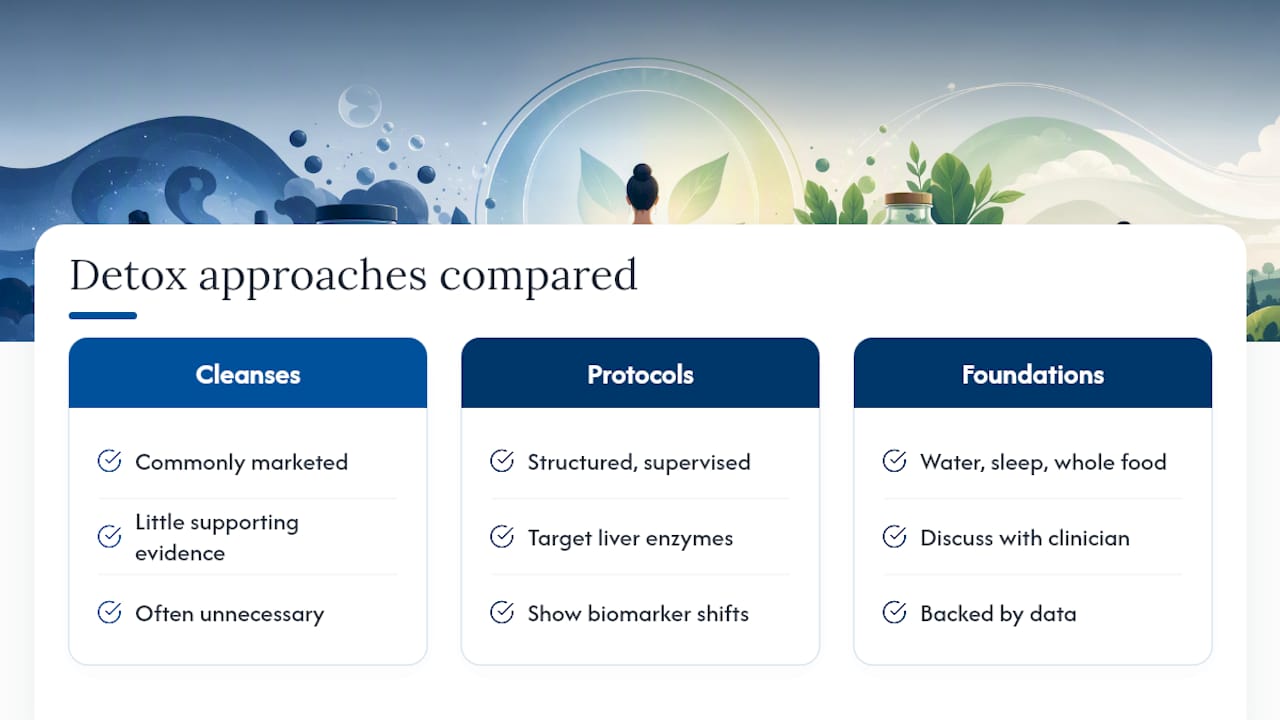
Conventional advice tends to lump all detox products into one bucket, either “total scam” or “worth a try.” Both miss the point. The honest read is that most commercial cleanses are unnecessary, a handful of guided, supervised programs show real biomarker shifts, and the gap between those two categories is enormous. If you’re going to spend money on this, spend it on ingredients with a plausible mechanism, not a flush.
What should come first, before any supplement or program, is the boring stuff: water, sleep, whole food, and a conversation with your clinician if you have any underlying condition. That’s not a lesser strategy. It’s the one with actual data behind it.
— Charles
A Practical Next Step From Longevitypremier
If you’re past the juice cleanse phase and want something with a real biochemical rationale behind it, some detox formulas are built around liver-support science discussed above, rather than bowel flushing or calorie starvation. The Complete Detox line is formulated with targeted nutrients meant to support natural detox pathways daily, not as a seven-day extreme reset.
For readers specifically interested in liver-focused ingredients, Longevitypremier’s milk thistle formulation is one option worth a look, alongside deeper reading on NAC and liver health if you want to understand the evidence before you buy anything. If you manage a related metabolic concern, a functional medicine perspective on metabolic syndrome is a useful companion read for anyone building a longer-term plan with a clinician. Whichever route fits your situation, the free wellness guide is a solid place to start figuring out what your body actually needs before you commit to a bottle.
This article is general information, not a substitute for advice from a qualified doctor. Consult a qualified healthcare professional about your own circumstances before acting on anything here.
Sources
- Detox or Cleanse: What To Know Before You Start
- PubMed: 28-day guided metabolic program (clinical trial)
- “Detoxes” and “Cleanses”: What You Need To Know | NCCIH
- How to ‘detox’ your body for free without juice, teas or flushes | PBS NewsHour