




![Longevity Complete Detox [BETA 21 Caps]: 7 Day Intensive Detox & Digestive Support](http://longevitypremier.com/cdn/shop/files/DetoxBeta-mid_100x100.png?v=1787365739)







Magnesium and Blood Pressure: What the Evidence Shows
Magnesium supplementation lowers systolic blood pressure by an average of −2.81 mm Hg and diastolic pressure by −2.05 mm Hg compared with placebo, according to a 2025 meta-analysis of 38 randomized controlled trials covering 2,709 participants. That’s the honest, population-level answer. The effect is modest for someone with normal blood pressure, but it gets considerably more interesting for two specific groups: people with hypertension already taking blood pressure medication, and people with documented magnesium deficiency.
In those subgroups, the numbers move more. Hypertensive patients on antihypertensive drugs saw systolic reductions averaging −7.68 mm Hg, and people with confirmed hypomagnesemia saw drops around −5.97 mm Hg. The typical trial that produced these numbers used a median dose of about 365 mg of elemental magnesium per day, taken for roughly 12 weeks.
Here’s the practical takeaway before we get into the mechanisms and the fine print:
- Magnesium is not a replacement for prescribed blood pressure medication.
- The strongest, most consistent benefit shows up in people who are hypertensive, magnesium-deficient, or both.
- A food-first approach modeled on the DASH diet should come before supplementation, with targeted supplements added under a clinician’s guidance when it makes sense.
Statistic snapshot: Across 38 trials and nearly 2,700 participants, magnesium supplementation produced a pooled systolic reduction of −2.81 mm Hg and diastolic reduction of −2.05 mm Hg, with considerably larger effects concentrated in hypertensive and magnesium-deficient subgroups.
Key Takeaways
Magnesium supplementation produces its most meaningful blood pressure reductions in hypertensive and magnesium-deficient adults, not in people with already-normal readings.
| Point | Details |
|---|---|
| Overall effect is modest | Pooled trial data shows −2.81 mm Hg systolic and −2.05 mm Hg diastolic reduction across all participants. |
| Subgroups see bigger drops | Treated hypertensive patients averaged −7.68 mm Hg systolic, nearly triple the overall pooled effect. |
| Dose and duration matter | Trials using 400 mg or more daily for 12 weeks or longer tended to show stronger effects. |
| Check kidney function first | Advanced kidney disease and several common medications require medical supervision before supplementing. |
| Diet-first, supplement second | Longevitypremier’s Blood Pressure Formula is positioned as an adjunct for cleared patients, built on evidence-based dosing after diet and medication are addressed. |
Table of Contents
- What the clinical evidence on magnesium and blood pressure actually shows
- How magnesium plausibly lowers blood pressure
- Who actually benefits from magnesium supplementation for blood pressure
- Magnesium dosage for blood pressure: forms, amounts, and timing
- Safety, drug interactions, and when magnesium is not a good idea
- Diet-first strategies: magnesium-rich foods and the DASH pattern
- A step-by-step protocol to discuss with your clinician
- Why the diet-first message gets lost in translation
- A supplement option worth knowing about if your clinician gives the go-ahead
- Sources
What the clinical evidence on magnesium and blood pressure actually shows
The single most important paper here is the 2025 Hypertension meta-analysis, and it’s worth understanding exactly what it did and didn’t find. Researchers pooled 38 randomized controlled trials involving 2,709 people and compared magnesium supplementation against placebo. The overall result: a −2.81 mm Hg drop in systolic pressure and a −2.05 mm Hg drop in diastolic pressure. On its own, that sounds unremarkable. Blood pressure medications routinely produce reductions two to three times larger.
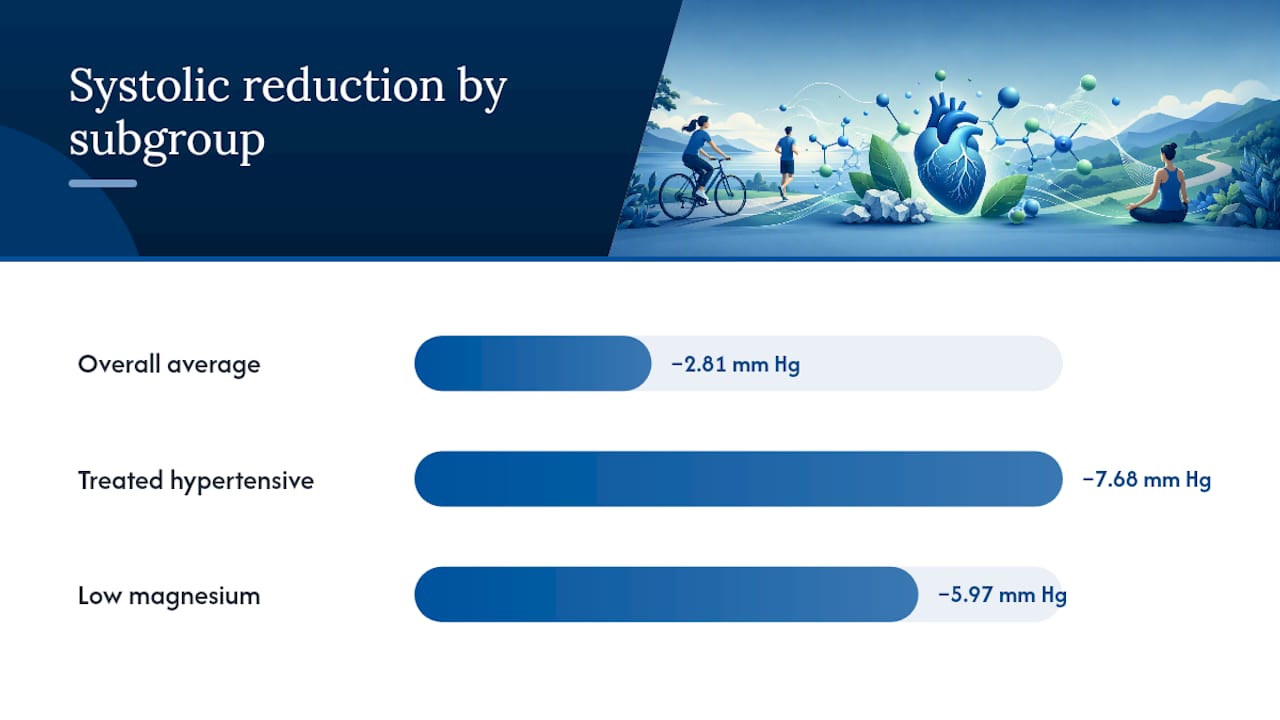
But averages hide the interesting part. When researchers split participants by baseline health status, the picture changed substantially. Hypertensive patients already on blood pressure medication saw systolic reductions of −7.68 mm Hg, nearly three times the pooled average. People with lab-confirmed low magnesium levels saw reductions around −5.97 mm Hg. Meanwhile, people with normal blood pressure and adequate magnesium stores barely moved at all. This is a textbook example of a treatment that works best for people who actually need it, and does close to nothing for people who don’t.
Statistic callout: Treated hypertensive patients in the pooled trials averaged a systolic drop nearly three times larger than the overall trial population, at −7.68 mm Hg versus −2.81 mm Hg overall.
A separate umbrella meta-analysis, which pools results across multiple prior meta-analyses rather than individual trials, reached a similar conclusion from a different angle. It found small but statistically real reductions in both systolic and diastolic pressure overall, and it flagged a dose and duration pattern worth paying attention to: trials using 400 mg per day or more, and lasting 12 weeks or longer, tended to show stronger effects than shorter or lower-dose trials.
That dose-duration relationship matters for anyone trying to interpret single studies that report “no effect.” A four-week trial at 200 mg per day and a 16-week trial at 500 mg per day are testing different questions, and lumping their results together without noting the difference is a common mistake in casual reporting on this topic.
Why the trial evidence looks messier than it should
Three factors explain most of the inconsistency you’ll see if you read individual studies on magnesium and hypertension:
- Trials used wildly different doses, ranging from roughly 80 mg to over 600 mg of elemental magnesium daily.
- Study populations varied: some enrolled only hypertensive adults, others enrolled healthy volunteers, and pooling both groups dilutes any real signal.
- Magnesium supplement forms differ in absorption, and few trials standardized which form participants took.
The PMC review on magnesium and cardiovascular disease points out that dietary magnesium deficiency is common enough in Western diets that many hypertensive patients may be walking around depleted without knowing it, since standard blood work rarely flags it. That’s a big part of why subgroup effects are so much larger than the overall pooled number. You’re not really measuring “does magnesium lower blood pressure” so much as “does correcting a deficiency lower blood pressure,” and those are different questions with different expected answers.
None of this means the pooled −2.81/−2.05 mm Hg figure is meaningless. At a population level, a systolic reduction of a few points, applied across millions of people, shifts stroke and cardiovascular event rates in ways epidemiologists take seriously. It just means an individual reader shouldn’t expect dramatic personal results unless they fall into one of the higher-response subgroups.
How magnesium plausibly lowers blood pressure
Magnesium’s connection to blood pressure runs through several biological systems at once, which is part of why researchers have struggled to isolate one clean mechanism. The Frontiers 2024 review on magnesium in hypertension lays out the main pathways.
- Vascular smooth muscle relaxation. Magnesium acts as a natural calcium channel blocker at the cellular level, competing with calcium at L-type calcium channels in vascular smooth muscle. Less calcium influx means less muscle contraction, so blood vessels relax and widen. This is mechanistically similar to how calcium channel blocker medications work, just far gentler.
- Endothelial support. Magnesium supports the endothelium’s ability to produce nitric oxide, the molecule responsible for vasodilation. A healthier endothelium responds more readily to signals telling blood vessels to relax.
- Renal sodium handling. Magnesium influences kidney transport proteins including TRPM6, TRPM7, NKCC2, and ROMK, which regulate how much sodium and potassium the kidneys retain versus excrete. This matters because salt sensitivity, meaning how much your blood pressure rises in response to dietary sodium, varies significantly between people, and magnesium status appears to be part of what drives that variation.
- Neurohormonal calming. Magnesium dampens sympathetic nervous system activity and modulates the renin-angiotensin-aldosterone system (RAAS), the hormonal cascade that raises blood pressure by constricting vessels and retaining fluid.
- Reduced inflammation and oxidative stress. Chronic low-grade inflammation and oxidative stress both contribute to arterial stiffening over time, and magnesium appears to blunt both processes.
That creates a feedback loop where high blood pressure drives magnesium loss, and magnesium loss makes blood pressure control harder. It’s not simply that low magnesium causes hypertension in a one-way street. The two conditions can reinforce each other, which is exactly why correcting magnesium status tends to help most in people who already have hypertension rather than in people who don’t.
Pro Tip: If you’re on a thiazide or loop diuretic for blood pressure, ask your clinician about checking your magnesium status specifically. Diuretics are a leading cause of magnesium depletion, and treating the deficiency they cause can sometimes make your existing blood pressure treatment work better.

Who actually benefits from magnesium supplementation for blood pressure
Not everyone reading this article will see the same result from adding magnesium, and being upfront about that distinction is more useful than a generic “it helps blood pressure” pitch.
- People with diagnosed hypertension, especially those on medication. This group shows the largest measured benefit in the trial data, with systolic reductions averaging −7.68 mm Hg in the pooled analysis. If you’re already being treated for high blood pressure and your numbers still run higher than your target, magnesium is a reasonable adjunct to discuss with your prescriber, not a replacement for what you’re already taking.
- People with documented or suspected low magnesium. Risk factors include long-term diuretic use, proton pump inhibitor (PPI) use, poorly controlled diabetes, older age, and diets low in leafy greens, nuts, and whole grains. This group saw reductions around −5.97 mm Hg in trials, close to the hypertensive-on-medication group.
- People with normal blood pressure and adequate magnesium intake. The evidence here is thin to nonexistent. If your pressure already sits in a healthy range and you eat a reasonably varied diet, supplementing for blood pressure specifically isn’t likely to move the needle, though there can be other reasons to maintain adequate intake.
- Anyone on multiple medications or with kidney, heart, or liver conditions. This group needs a clinician in the loop before starting anything, full stop. Polypharmacy raises the odds of an interaction, and impaired kidney function changes how magnesium is cleared from the body.
If you’re not sure which group you fall into, the honest answer is: ask your doctor to check your kidney function and consider your medication list before you start. A five-minute conversation prevents most of the problems that come from self-directed supplementation.
Magnesium dosage for blood pressure: forms, amounts, and timing
The Recommended Dietary Allowance for magnesium sits at 420 mg per day for men and 320 mg per day for women, and that baseline matters because most people don’t hit it through diet alone. The median dose used across the 38 trials in the Hypertension meta-analysis was about 365 mg per day, close to the RDA itself, taken for a median of 12 weeks. The umbrella meta-analysis noted that doses at or above 400 mg per day, sustained for 12 weeks or longer, tended to produce larger reductions in subgroups likely to respond.
Supplement form matters more than most people realize:
- Magnesium glycinate is bound to the amino acid glycine, absorbs well, and tends to be the gentlest option on digestion, making it a common choice for anyone who’s had stomach trouble with other forms.
- Magnesium citrate offers higher bioavailability than cheaper forms but can cause loose stools at higher doses, since unabsorbed magnesium draws water into the intestine.
- Magnesium oxide is inexpensive and widely available, but its absorption is comparatively poor, which means you may need a higher labeled dose to get the same elemental magnesium effect.
When people ask which magnesium type for blood pressure makes the most sense, glycinate tends to be the practical answer for daily, ongoing use, simply because tolerability determines whether someone actually keeps taking it for the 8 to 12 weeks trials suggest are needed to see a measurable change.
Don’t expect an overnight shift. The trials showing meaningful blood pressure change ran 8 to 12 weeks, not days. If you start supplementing, track your numbers with a home blood pressure monitor rather than relying on memory or occasional office readings, and take multiple readings at the same time of day, seated and rested, averaging them over a week rather than trusting any single reading.
Pro Tip: Start at a lower dose, around 200 to 250 mg, for the first week to see how your digestion responds, then increase toward your target dose. Splitting the dose between morning and evening, and taking it with food, cuts down on the gastrointestinal side effects that cause most people to quit early.

Safety, drug interactions, and when magnesium is not a good idea
Magnesium is generally well tolerated, but it isn’t harmless, and the biggest risk factor by far is kidney function. The kidneys are what clear excess magnesium from the body, so anyone with advanced chronic kidney disease should not take high-dose oral magnesium without direct medical supervision, since impaired renal excretion can allow magnesium to accumulate to dangerous levels.
Several common medications interact with magnesium in ways worth knowing about:
- Thiazide and loop diuretics increase magnesium loss through urine, which is part of why people on long-term diuretic therapy for blood pressure often run low.
- Tetracycline and quinolone antibiotics bind to magnesium in the gut, reducing absorption of both the antibiotic and the mineral if taken at the same time; most guidance suggests separating doses by several hours.
- Proton pump inhibitors (PPIs), used long-term for acid reflux, are associated with an increased risk of magnesium depletion.
- ACE inhibitors and ARBs, common blood pressure medications, don’t directly deplete magnesium, but combining any blood-pressure-lowering supplement with these drugs warrants monitoring for excessive blood pressure drops, particularly early in treatment.
At extreme overdose levels, magnesium toxicity can cause hypotension, an abnormally slow heart rate, and in severe cases respiratory depression. This is rare with typical oral supplement doses in someone with normal kidney function, but it underscores why megadosing without supervision is a bad idea.
Statistic callout: Less than 1% of the body’s total magnesium circulates in the blood, according to the Frontiers review, which is exactly why a normal serum magnesium test can miss a real underlying deficiency. If your clinician suspects depletion despite a normal blood test, ask about additional evaluation rather than ruling it out on lab numbers alone.
Diet-first strategies: magnesium-rich foods and the DASH pattern
Clinicians consistently recommend a food-first approach before reaching for a bottle, and the Harvard Health explainer makes the case clearly: whole foods deliver magnesium alongside potassium, calcium, and fiber, a combination that works better for long-term blood pressure control than any single nutrient in isolation.
- Leafy greens. One cup of cooked spinach delivers a substantial amount of magnesium, representing a significant portion of the recommended daily allowance for women.
- Nuts and seeds. An ounce of almonds or pumpkin seeds provides 80 to 150 mg, making them an easy snack swap.
- Legumes. A cup of cooked black beans or lentils contributes 60 to 120 mg alongside plant protein and fiber.
- Whole grains. Brown rice, quinoa, and whole wheat bread all contribute meaningful amounts compared with their refined counterparts.
- Low-fat dairy. A cup of yogurt or milk adds modest magnesium along with calcium and potassium, both part of the DASH framework.
The DASH diet was built specifically around this kind of nutrient combination, emphasizing fruits, vegetables, whole grains, and low-fat dairy while cutting sodium. It isn’t a magnesium supplement in disguise. It’s a pattern that happens to deliver magnesium, potassium, and calcium together while reducing the sodium load that drives blood pressure up in the first place. Simple swaps that move the needle: trade white rice for quinoa, swap a mid-afternoon chip snack for a handful of almonds, and add a cup of spinach to dinner instead of iceberg lettuce. Longevitypremier’s free guide on diet-first strategies walks through practical meal swaps in more detail if you want a starting framework.
A step-by-step protocol to discuss with your clinician
If you and your doctor decide a magnesium trial makes sense, structure matters more than enthusiasm. Here’s a sequence that mirrors how the better-designed clinical trials approached it.
- Establish a baseline. Review current medications for interactions, check kidney function (eGFR), and log home blood pressure readings for one to two weeks before starting anything. Ask about a serum magnesium test, understanding its limitations, along with other relevant electrolytes.
- Choose a starting dose. Most evidence-aligned protocols start in the 240 to 400 mg per day range of elemental magnesium, adjusted for age, sex, and existing dietary intake. Doses above this range should only happen under direct medical supervision.
- Commit to a real trial period. Give it 8 to 12 weeks, matching the duration used in the trials that actually showed benefit. Stopping after two weeks because nothing changed isn’t a fair test.
- Track blood pressure properly. Use a validated home monitor, take readings at the same time each day while seated and rested, and average multiple readings across the week rather than reacting to any single number.
- Know your red flags. Contact your clinician promptly if you notice unusual fatigue, muscle weakness, an irregular heartbeat, or if home readings show a sudden, unexplained drop in blood pressure alongside dizziness.
- Reassess with your clinician. At the end of the trial period, review your logged numbers together and decide whether to continue, adjust the dose, or stop.
Pro Tip: Bring your logged home blood pressure readings to your appointment on paper or in an app rather than trying to recall numbers from memory. Clinicians make better dosing decisions from a full data trend than from a single “it felt lower” impression.
Why the diet-first message gets lost in translation
Most coverage of magnesium and blood pressure jumps straight to supplement dosing without addressing why the evidence looks the way it does, and that’s a disservice to readers trying to make a real decision.
The honest takeaway from the 2025 Hypertension meta-analysis isn’t “take magnesium and lower your blood pressure.” It’s narrower and more useful than that: if you’re hypertensive, on medication, or magnesium-deficient, a properly dosed trial has real evidence behind it. If none of those apply to you, the same intervention probably won’t do much, and no amount of marketing changes that math.
What gets underestimated is how much the deficiency itself is often driven by things people don’t connect to their blood pressure medication, particularly long-term diuretic use. A patient managing hypertension for a decade on a thiazide diuretic may have slowly built a magnesium deficit without anyone flagging it, because standard checkups rarely test for it and serum levels are a poor proxy for total body stores. That’s not a reason to distrust the medication. It’s a reason to have a specific, separate conversation about magnesium status with whoever manages your prescriptions.
Longevitypremier’s approach reflects more than three decades of healthcare-informed formulation practice, built on the conviction that targeted nutritional support works best as a complement to sound medical care, not a substitute for it. The priority in developing something like the Longevity Blood Pressure Formula has always been ingredient quality and dosing that reflects what the clinical literature actually supports, rather than whatever sounds impressive on a label. Food first, medication as prescribed, and supplementation used deliberately where the evidence and your own clinician agree it fits.
— Charles
A supplement option worth knowing about if your clinician gives the go-ahead
If you’ve talked with your doctor and decided a targeted magnesium supplement makes sense alongside your diet and any prescribed medication, the Longevity Blood Pressure Formula was built around exactly that use case: an adjunct, not a replacement, formulated with dosing logic informed by the same kind of evidence covered above rather than guesswork.

The formulation reflects ingredient selection focused on the nutrients most consistently tied to blood pressure support in the clinical literature, dosed with the kind of transparency that lets you and your clinician evaluate exactly what you’re adding to your routine. Before starting any magnesium product, confirm your kidney function and review your current medications for interactions, particularly if you take diuretics, PPIs, or blood pressure drugs. If you want the bigger picture first, Longevitypremier’s free ebook on diet-first blood pressure strategies is a useful starting point, and the full supplement lineup is worth a look if cholesterol or glucose management are also on your radar. When you’re ready, the three-bottle value pack is the most practical way to commit to a full 8 to 12 week trial period at a lower per-bottle cost.
Sources
- Magnesium Supplementation and Blood Pressure (Hypertension, 2025)
- Impact of Magnesium Supplementation on Blood Pressure: An Umbrella Meta-Analysis (2024)
- Magnesium in hypertension: mechanisms and clinical implications (Frontiers, 2024)
- Should you take a magnesium supplement to lower your blood pressure? (Harvard Health, 2026)