




![Longevity Complete Detox [BETA 21 Caps]: 7 Day Intensive Detox & Digestive Support](http://longevitypremier.com/cdn/shop/files/DetoxBeta-mid_100x100.png?v=1787365739)






What to Write in the Notes Column of a Blood Pressure Log
In the notes column, always record medication timing, any symptoms, recent activity or food and drink, which arm you used, and whether you actually rested before the reading. Those five items give a clinician the context that turns a lone number into something they can act on.
Not every entry needs all five. Some belong in every row; others only matter when something was off.
Always write:
- Medication name, dose, and time since your last dose
- Any physical symptom, even mild (headache, dizziness, fatigue)
Write when relevant:
- Recent activity or posture (just walked in, stood up fast, still sitting)
- Food, caffeine, alcohol, or smoking in the last 30 minutes
- Which arm you used, and any device glitch (low battery, error code, movement)
Each item exists because it changes how a reading gets interpreted. A 148/94 reading means something different if you sprinted up the stairs five minutes earlier versus if you had been resting quietly for ten.
Key Takeaways
Detailed, specific notes turn a blood pressure log from a list of numbers into a tool your clinician can actually use to adjust your care.
| Point | Details |
|---|---|
| Record medication timing | Always note the drug, dose, and minutes since your last dose. |
| Describe symptoms specifically | Write “lightheaded after standing” instead of “felt off.” |
| Note context before each reading | Flag recent activity, food, caffeine, alcohol, or a skipped rest period. |
| Track which arm you used | Switching arms without noting it makes trends harder to compare. |
| Consider added nutritional support | Longevity Premier’s blood pressure formula offers targeted support alongside consistent logging and medical care. |
Table of Contents
- What Should You Write in the Notes Column of a Blood Pressure Log?
- How Do You Write Notes a Clinician Can Actually Use?
- When Should You Take Readings to Make the Notes Meaningful?
- How Do Clinicians Actually Use the Notes Column?
- Sample Entries and a Mini Template You Can Copy
- Which Data Fields Belong in a Blood Pressure Log?
- A Small Note That Changed a Treatment Plan
- Support Your Readings With the Right Nutritional Backup
- Frequently Asked Questions
- Sources
What Should You Write in the Notes Column of a Blood Pressure Log?
The short answer: enough specific detail that someone who wasn’t in the room with you could reconstruct why the number looks the way it does. Vague notes like “felt tired” or “normal day” don’t do that. Specific notes do.
Medication. Write the drug name, the dose, and the time gap between taking it and the reading. Something like “lisinopril 10 mg, took 45 min before” tells your provider whether your blood pressure medication had time to kick in. If you skipped a dose or took it late, say so plainly. The CDC’s printable blood pressure log specifically flags medication timing as one of the two most useful things to note, alongside symptoms.
Symptoms. Keep these short and factual. “Mild headache, started 30 min earlier” or “lightheaded after standing” tells a much clearer story than “didn’t feel great.” The American Heart Association’s patient log guidance also recommends noting your mood, since anxiety and stress can push numbers up temporarily without reflecting your baseline.
Activity and posture. Note whether you’d just exercised, were rushing to make the reading before an appointment, or had been lying down for a while. Kaiser Permanente’s home monitoring guidance specifically calls out recording recent activity, since a reading taken right after climbing stairs isn’t comparable to one taken at rest.

Food, caffeine, alcohol, smoking. Anything consumed within 30 minutes of the reading belongs in the notes, with rough amount and timing: “iced coffee, 12 oz, 20 min before” or “one glass of wine with dinner, 15 min before.”
Which arm, and device issues. Readings can differ by several points between arms, so note which one you used, plus anything about cuff fit: “right arm, cuff snug against bare skin.” If your monitor didn’t save the reading or threw a movement error, write that down too.
Pro Tip: Keep a running shorthand key on the first page of your log, like “LH = lightheaded” or “PM dose” for evening medication, so your notes stay fast to write and easy for anyone to decode later.
How Do You Write Notes a Clinician Can Actually Use?
There’s a real difference between a note that fills space and one that answers a question before it’s asked.
Compare these two entries for the same reading:
- Vague: “Felt off.”
- Useful: “Lightheaded, began 10 min before reading. Stood up fast from chair after sitting 45 min.”
The second version tells your provider when the symptom started, how long it lasted, and what triggered it. That’s the difference between a note that gets read and one that gets skipped.
Build a consistent shorthand and stick to it. A simple structure works well: medication and dose, then time since dose, then symptom, then activity, then drink, then arm. Something like “Lis 10mg / 45m / none / rested / none / L arm” packs a lot of context into a narrow column.
Clinics generally prefer short, consistent shorthand over long narrative entries. A tight one-line structure fits better in a paper log’s notes column and transcribes more cleanly into an electronic health record than a paragraph of free text.
Abbreviate activities and drinks if you want (“ex” for exercise, “cf” for coffee), but spell out symptoms and medication names in full. A misread abbreviation for a drug name is the kind of mistake nobody wants to explain later.
If a problem keeps showing up, flag it visually. A small triangle or asterisk next to entries with recurring morning spikes makes the pattern jump out during an appointment, instead of getting buried across two weeks of rows.
When Should You Take Readings to Make the Notes Meaningful?
Timing turns your notes from isolated comments into a pattern your clinician can actually read.
The CDC recommends taking readings at the same times each day, typically once in the morning before medication or food, and once in the evening. Take two readings, one to two minutes apart, at each session.
- If you skipped the standard 5 minute rest period before measuring, write “no rest” in the notes.
- If you had caffeine, needed the bathroom, or talked during the reading, note it. Any of these can shift numbers by several points.
- Record both readings if you take two, and note whether you averaged them or reported just one to your provider.
- Always note which arm you used. Switching arms between sessions without recording it makes trends harder to trust.
Skipping the prep steps isn’t a failure. It’s information. A rushed reading with “no rest, just got off phone call” attached is more useful to a clinician than a clean-looking number with no context at all.
How Do Clinicians Actually Use the Notes Column?
Clinicians aren’t scanning your log for one dramatic number. They’re looking for patterns, and the notes column is what tells them whether a pattern means something.
Notes influence decisions like whether to adjust medication timing, whether to order 24-hour ambulatory monitoring, or whether to investigate a possible side effect. A single high reading rarely triggers action on its own.
- Repeated dizziness paired with high systolic readings tends to prompt follow-up questions about medication or dehydration.
- A pattern of morning spikes that always coincide with “forgot AM dose” points toward a scheduling fix rather than a dosage change.
- One outlier reading with a clear explanation attached (“just finished a run”) usually gets noted and set aside.
Consistency matters more than any single entry. A clinician reading two weeks of honest, specific notes can spot a trend in seconds. A page of blank notes columns next to a string of high numbers tells them nothing except that something might be wrong, without saying what.
Sample Entries and a Mini Template You Can Copy
Concrete examples beat instructions. Here are four realistic log rows showing how the same format adapts to different situations.
| Reading | Notes Column Entry |
|---|---|
| — | Lisinopril 10mg, 1h before. No symptoms. Rested 5 min. Right arm. |
| — | Missed AM dose (forgot). No symptoms. Rushed, ran to catch bus. Right arm. |
| — | Med taken on time. No symptoms. 20 min after brisk walk. Left arm. |
| — | Med taken on time. Lightheaded, stood up fast. No rest period. Right arm. |
A minimal template for the notes column itself needs only six fields: time since medication, medication name and dose, symptom (or “none”), recent activity, beverage or food in the last 30 minutes, and which arm.
Paper logs work fine for this, but a lot of people find a simple notes app or spreadsheet easier to search when they’re prepping for an appointment. Either way, bring the log itself, or a clear printout, rather than trying to summarize two weeks of readings from memory.
Which Data Fields Belong in a Blood Pressure Log?
Before the notes column matters, the basic fields need to be right. Every reading should include the date, the time of day, your systolic and diastolic numbers, and your pulse rate. Skipping the pulse is a common shortcut, but heart rate context matters when a clinician is evaluating whether a medication is working as intended.
UNC Medicine’s downloadable blood pressure log template includes a dedicated column for which arm was used alongside the standard numbers, and that field matters more than most people assume. Readings between arms can differ by 10 points or more in some people, so tracking which arm you’re using keeps your trend line comparable across days.
Standard formatting also helps. Write systolic over diastolic in the usual format (“128/82”), not as two separate numbers scattered across the row, and keep pulse in its own column rather than folding it into notes. The British Heart Foundation’s diary guidance follows this same structure, which is worth copying if you’re building your own log from scratch rather than using a printed one.
Additional fields worth adding if your template has room: sleep quality the night before and general stress level, both of which clinical summaries flag as useful context that doesn’t fit neatly into a symptom or medication note but still shapes how a reading should be read.
A Small Note That Changed a Treatment Plan
One reader’s log showed weeks of morning spikes. The notes column revealed the pattern: her medication was consistently taken 20 minutes late. The doctor adjusted the schedule, and the spikes stopped. Keep writing the details. They matter more than you’d guess.
Support Your Readings With the Right Nutritional Backup
Good notes tell your clinician the story behind your numbers, but what you put into your body every day shapes that story too. Longevity Premier makes a cardiovascular support supplement formulated around ingredients selected for targeted heart and blood pressure support, built from decades of healthcare formulation experience rather than a generic multivitamin approach.

If you want a starting point before you commit to anything, grab the free wellness ebook for practical background on cardiovascular health that pairs naturally with the logging habits covered above. Whatever you decide, talk to your doctor before adding any new supplement to your routine, especially if you’re already on blood pressure medication. Your clinician can tell you whether it fits your specific treatment plan.
Frequently Asked Questions
What should you write in the notes column of a blood pressure log? Write medication name and timing, any symptoms, recent activity or food/drink, which arm you used, and whether you rested before the reading. These five details give your clinician the context needed to interpret the number correctly.
How often should you take and log blood pressure readings? Take readings once in the morning before medication or food and once in the evening, with two readings one to two minutes apart at each session, following CDC guidance.
Should you note if you forgot to take your medication? Yes. A missed or delayed dose is one of the most useful notes you can write, since it often explains an unexpected spike without indicating your treatment isn’t working.
Do certain foods or drinks need to be logged even if you feel fine? Yes. Caffeine, alcohol, and high-sodium meals within 30 minutes of a reading can shift your numbers even without symptoms, so note them regardless of how you feel.
Can a supplement replace consistent blood pressure logging? No. A supplement like Longevity Premier’s blood pressure formula is meant to complement medical care and healthy habits, not replace monitoring, medication, or your clinician’s guidance.
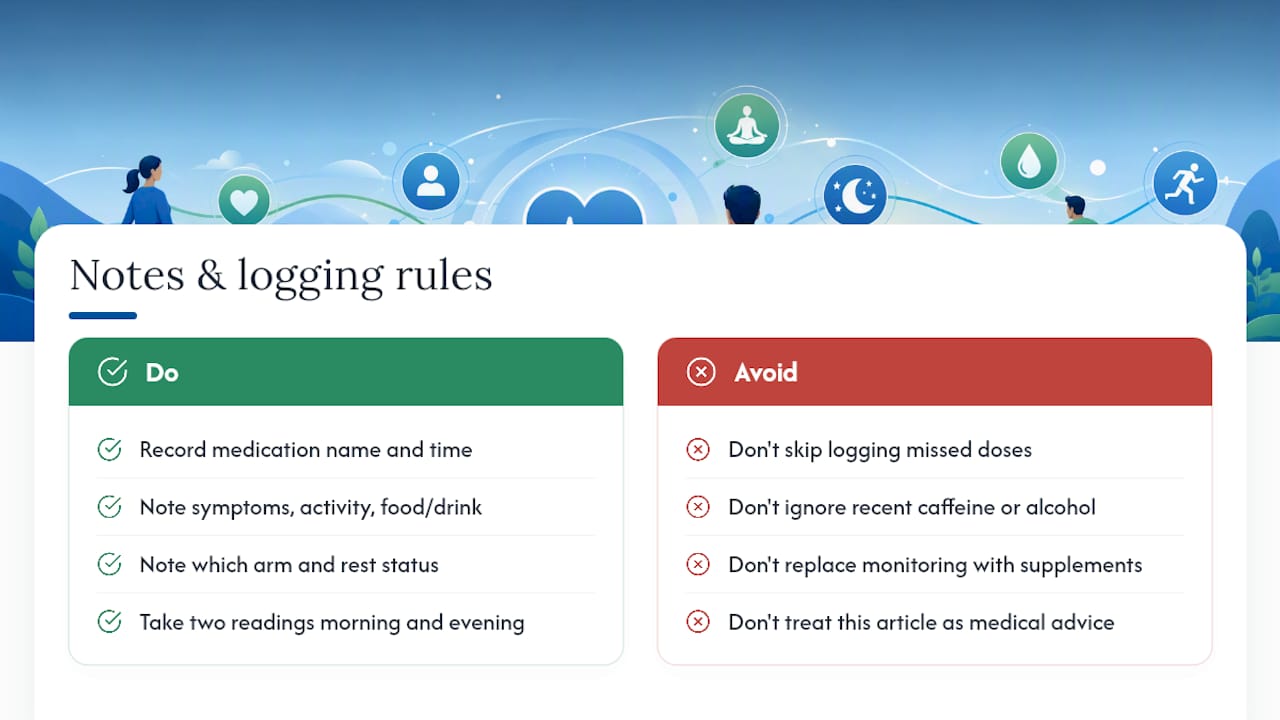
This article is general information, not a substitute for advice from a qualified doctor. Consult a qualified healthcare professional about your own circumstances before acting on anything here.
Sources
- My Blood Pressure Log (CDC)
- Tracking your blood pressure numbers (American Heart Association / AMA)
- Checking your blood pressure at home (Kaiser Permanente)
- Blood pressure log (UNC Medicine)
- Blood Pressure Log: How to track readings (Cardilog)