




![Longevity Complete Detox [BETA 21 Caps]: 7 Day Intensive Detox & Digestive Support](http://longevitypremier.com/cdn/shop/files/DetoxBeta-mid_100x100.png?v=1787365739)






1,000–1,500 mg/day Berberine for Adults: Meal Timed Dosing
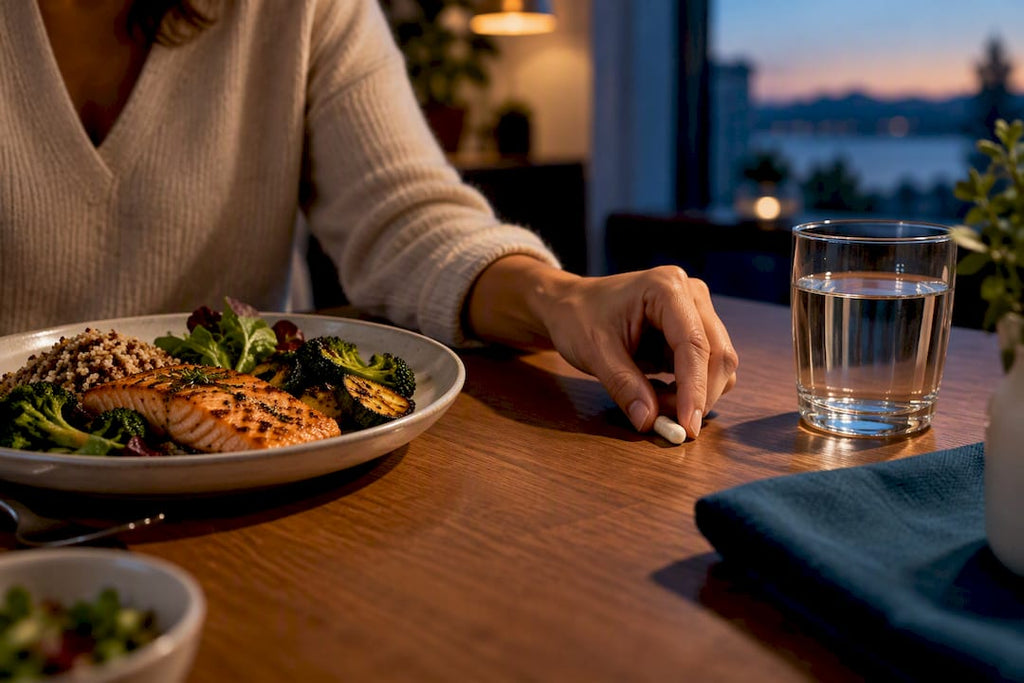
Most adult clinical trials used 500 mg of berberine two or three times a day, adding up to 1,000–1,500 mg total daily, taken with or just before meals. That range comes from randomized studies like Yin et al., not marketing copy. If you’re pregnant, breastfeeding, or on other medications, talk to a clinician before starting, since NCCIH flags real interaction risks.
TL;DR:
- Most clinical studies use a daily dose of 1,000 to 1,500 mg of berberine, divided into two or three doses with meals, for effective results.
- Taking berberine 20 to 30 minutes before or with the start of a meal maximizes blood sugar support and minimizes digestive discomfort.
- Digestive side effects such as diarrhea and nausea occur in about a third of users but typically improve within a few weeks or with dose adjustments.
- Pregnant or breastfeeding women should avoid berberine due to risks in infants, and those on liver-metabolized medications need medical guidance before use.
- Starting with a lower dose and gradually increasing over several weeks improves tolerability and helps prevent early discontinuation.
Table of Contents
- Berberine Dosage Recommendations by Study and Label
- Why Timing Matters More Than You’d Think
- Side Effects, Contraindications, and Drug Interactions
- How to Start Berberine Without Wrecking Your Stomach
- What the Clinical Trials Actually Show
- How Longevity Premier Approaches Berberine Formulation
- Your Berberine Dosage Checklist
- A Practitioner’s Take on Fitting Berberine Into a Bigger Plan
- Ready to Match Your Routine to a Trial-Informed Formula?
- Sources
- FAQ
Berberine Dosage Recommendations by Study and Label
Clinical trials didn’t experiment with wild dosing schemes. They mostly landed on the same window because that’s where the balance between effect and tolerability seems to sit.

The Yin et al. trial had participants take 500 mg three times daily, right at the start of meals, for about 13 weeks. A 2024 systematic review and meta-analysis covering 50 studies found the most common total dose across trials was 0.9 to 1.5 grams per day, which lines up almost exactly with the older trial data. Cleveland Clinic describes similar territory in plainer terms: typical dosing is 500 mg twice daily, with totals capped around 1,500 mg per day split into two or three doses.
Here’s how that typically breaks down on a standard 500 mg capsule, which is what most supplement labels sell:
- Twice daily: 500 mg with breakfast and 500 mg with dinner, totaling 1,000 mg per day.
- Three times daily: 500 mg with breakfast, lunch, and dinner, totaling 1,500 mg per day.
- Reduced schedule: 300 mg three times daily (using a lower strength capsule), a common step down when the full 500 mg dose causes stomach upset.
- Combination therapy: Some clinicians drop to 300 mg t.i.d. when berberine is paired with other glucose-support strategies, to ease the digestive load.
A few outlier studies have pushed past 1.5 grams a day, sometimes for shorter windows or under closer supervision. Those aren’t the norm, and there’s no good reason for most people to chase a higher number than what the bulk of the trial evidence actually used. Sticking to the 1,000–1,500 mg/day range, divided across meals, keeps you inside the territory that’s actually been studied.
Why Timing Matters More Than You’d Think
Berberine doesn’t hang around in your system very long. Its half-life runs roughly 4 to 6 hours, which is the whole reason nobody studies it as a once-daily pill. A single morning dose would be mostly cleared out before dinner, leaving the back half of your day uncovered.
Splitting the dose into two or three servings keeps levels more consistent and lines up with when your body actually needs the support most: right after you eat, when blood sugar rises.
That’s also the logic behind meal-timed dosing. Taking berberine with or shortly before a meal is commonly suggested to time its activity with the post-meal glucose rise and to ease it into your digestive system alongside food, which tends to reduce stomach complaints compared with taking it on an empty stomach.
Practical timing options that work with most schedules:
- Take it 20 to 30 minutes before eating, if your stomach tolerates it well.
- Take it with the first bite of food, if you notice queasiness on an empty stomach.
- If you’re only doing two doses a day, put them at your two largest or highest-carbohydrate meals rather than spacing them evenly by clock time.
Statistic to know: In the foundational Yin trial, dosing was tied directly to meals, taken at the start of each one, for a 13-week stretch. That meal-anchored pattern is still the backbone of how most people use berberine today.
Side Effects, Contraindications, and Drug Interactions
Berberine’s most common complaints are digestive, not dangerous. In the Yin trial, gastrointestinal adverse events showed up in about 34.5% of patients, mainly diarrhea, gas, and mild nausea. Most of these cluster in the first couple of weeks and settle down as the body adjusts, or once the dose is trimmed back.
Two contraindications are not optional. Berberine should not be used during pregnancy or while breastfeeding. It can contribute to bilirubin buildup in infants, which carries a risk of kernicterus, a serious condition in newborns. This isn’t a gray area worth testing.
Drug interactions deserve equal caution. NCCIH notes that berberine can change how the body processes other medications, largely through effects on liver enzymes and transport proteins that also handle drugs like cyclosporine and other immunosuppressants. Anyone on prescription medication, especially anything with a narrow safety margin, should review the combination with a pharmacist or physician first.
- Diarrhea, gas, and nausea are the most reported effects, often easing within the first few weeks.
- Pregnancy and breastfeeding are firm no-go situations.
- Immunosuppressants and other CYP-metabolized drugs need a clinician’s review before combining.
- If you’re already using another glucose-support supplement or medication, ask about lowering the berberine dose to offset additive digestive effects.
Pro Tip: If you’re combining berberine with metformin or a similar approach, some clinicians in trial settings reduced the dose from 500 mg to 300 mg three times daily specifically to manage stomach upset without abandoning the combination altogether. Comparing berberine and metformin side by side is worth doing before you settle on a plan.
How to Start Berberine Without Wrecking Your Stomach
Jumping straight to 500 mg three times a day is the most common reason people quit before giving berberine a fair shot. A slower ramp-up almost always tolerates better.
- Weeks 1 to 2: Start with 500 mg once daily, taken with your largest meal.
- Weeks 3 to 4: Move to 500 mg twice daily, one with breakfast and one with dinner.
- Week 5 onward: If tolerated, add a third dose, reaching the standard 500 mg three times daily, for a 1,500 mg total.
Pause or scale back if you hit severe GI symptoms, if you find out you’re pregnant, or if a new medication introduces an interaction risk. People who can’t tolerate standard berberine sometimes look into alternative forms like dihydroberberine or phytosome-bound versions, which some report absorbing differently, though these still warrant a conversation with a clinician rather than a solo experiment.
Most side effects show up in the first two to four weeks. If you’re past that window and still uncomfortable, that’s a signal to check in with a healthcare provider rather than push through.
Pro Tip: Keep a simple log of what you took, when, and how your stomach felt for the first month. Patterns show up fast, and it makes the conversation with your doctor a lot more useful than “I think it upset my stomach sometimes.”
What the Clinical Trials Actually Show
The numbers behind berberine dosing come from a small but consistent body of research, not folklore.
Yin and colleagues ran a 13-week trial using 500 mg three times daily, taken at the start of meals.
The 2024 Frontiers meta-analysis, pulling from 50 separate studies, found 0.9 to 1.5 grams per day was the most frequently used range, with treatment cycles typically running one to three months. Reported outcomes leaned toward improvements in glucose and lipid markers, though the review is careful to frame these as study results across varied populations and formulations, not a guaranteed personal outcome.
Statistic to know: Some meta-analytic data point to average reductions in fasting glucose and HbA1c at these trial doses, though the numbers vary a fair amount from study to study and population to population.
- Trial durations mostly ran 8 to 13 weeks, meaning long-term data beyond a few months is still thin.
- Doses clustered tightly around 0.9 to 1.5 g/day across the reviewed studies.
- Formulation and participant differences mean results don’t automatically transfer from one study population to another.
How Longevity Premier Approaches Berberine Formulation
I’m Charles, and I’ve spent time looking at how supplement formulation should map back to actual trial data rather than guesswork. Some supplement makers draw on practitioner-informed formulation experience, and that can show in how ingredients get paired rather than just bundled.
Some glucose-support formulas combine berberine with bitter melon, Ceylon cinnamon, and ginseng, designed to support healthy glucose metabolism within the same dosing logic seen in the research. The idea isn’t to reinvent the dose, it’s to build a formulation that respects what the studies actually tested.
If you’re comparing supplements, look for third-party testing and a supplier with a track record. And regardless of how good a formulation looks on paper, run it by a clinician before adding it to any medication routine.
Your Berberine Dosage Checklist
Keep this simple: 500 mg two to three times daily, with or just before meals, totaling 1,000 to 1,500 mg per day.
Before you start:
- Review current medications with a clinician, especially anything metabolized by liver enzymes.
- Start at the lowest dose and titrate up over several weeks.
- Skip it entirely if you’re pregnant or breastfeeding.
Give it a realistic trial window of 8 to 12 weeks before judging whether it’s worth continuing, and pay attention to both tolerability and how you feel day to day.
A Practitioner’s Take on Fitting Berberine Into a Bigger Plan
Berberine works best as one piece of a broader natural-health approach, not a stand-alone fix. The strongest results in the research came from people who paired it with attention to diet and activity, not from the pill doing all the work on its own. I think that’s the honest framing, and it’s the one worth holding onto instead of expecting a single capsule to carry the whole plan.
If you’re managing a chronic condition or taking prescription medication, loop in a clinician before adding berberine to the mix. That’s not caution for its own sake. It’s how you get the most out of a natural approach without stepping on something else you’re already doing for your health.
— Charles
Ready to Match Your Routine to a Trial-Informed Formula?
Longevity Premier builds its glucose-support formulas around the same dosing logic seen in the clinical research covered here, not a generic blend thrown together for the label. Longevity Gluco-Blend™ pairs berberine with bitter melon, Ceylon cinnamon, and ginseng to support healthy glucose metabolism, giving you a formulation built around ingredients that work together rather than a single isolated compound.

If you’d rather keep things simple with a single-ingredient option, Wholesome in bulk™ Berberine gives you berberine on its own, without added botanicals, for readers who prefer to build their own combination. Either way, talk to your clinician before adding either product to a medication routine, particularly if you’re managing blood sugar with other prescriptions. Ready to see which formulation fits your routine? Visit the Longevity Gluco-Blend product page to review ingredients and get started.
This article is general information, not a substitute for advice from a qualified doctor. Consult a qualified healthcare professional about your own circumstances before acting on anything here.
Sources
- Efficacy of Berberine in Patients with Type 2 Diabetes
- Effects of administering berberine alone or in combination on type 2 diabetes mellitus: a systematic review and meta-analysis
- Berberine and weight loss: What you need to know — NCCIH
- Berberine: What It Is, Benefits & Side Effects — Cleveland Clinic
FAQ
How much berberine should I take per day?
Most trials used 1,000 to 1,500 mg total daily, split into two or three doses of 500 mg, taken with meals. That range comes from studies like the Yin et al. trial, which used 500 mg three times daily for about 13 weeks.
What is the best time to take berberine for blood sugar support?
Taking it with or 20 to 30 minutes before meals is the most commonly suggested approach, since it lines the dose up with the after-meal rise in blood sugar. This timing also tends to reduce stomach discomfort compared to taking it on an empty stomach.
Does berberine cause side effects?
Digestive symptoms like diarrhea, gas, and nausea are the most common complaints, showing up in roughly 34.5% of participants in one clinical trial. These effects often ease within the first two to four weeks or after lowering the dose.
Can I take berberine with cinnamon or other supplements?
Combining berberine with ingredients like Ceylon cinnamon is common in formulated blends, such as Longevity Gluco-Blend™, which pairs the two alongside bitter melon and ginseng. Always check with a clinician first if you’re also taking prescription medication.
Who should not take berberine?
Berberine is not recommended during pregnancy or breastfeeding due to a risk of bilirubin buildup in infants. Anyone taking medications processed by liver enzymes, including certain immunosuppressants, should consult a healthcare provider before starting.