


![Longevity Complete Detox [BETA 21 Caps]: 7 Day Intensive Detox & Digestive Support](http://longevitypremier.com/cdn/shop/files/DetoxBeta-mid_100x100.png?v=1787365739)





Do Probiotics Help Bloating? What the Evidence Shows
Certain probiotics do reduce bloating, but the effect is strain-specific, modest on average, and strongest in people with irritable bowel syndrome. A randomized, placebo-controlled trial testing a multi-species synbiotic found that a notably higher proportion of participants reported “never” or “rarely” experiencing bloating after six weeks compared to placebo, indicating a meaningful improvement. A separate meta-analysis of 23 trials covering 3,288 adults with IBS found a statistically significant reduction in bloating scores, though the benefit varied widely between studies.
That’s the honest picture: real, reproducible, but not universal.
- The bottom line: probiotics containing specific, clinically studied strains can meaningfully reduce bloating for many people, especially those with IBS or post-infectious gut symptoms.
- The evidence anchors: a large synbiotic RCT with clear improvement outcomes, and a meta-analysis showing statistical significance despite high variability between trials.
- The practical move: pick one strain-specific product, commit to a 4 to 8 week trial, track your symptoms, and stop if things get worse instead of better.
Key Takeaways
Probiotics reduce bloating most reliably when the strain, dose, and trial length match what clinical research has actually tested.
| Point | Details |
|---|---|
| Evidence is strain-specific | Bifidobacterium infantis, Bifidobacterium lactis, and select Lactobacillus strains carry the strongest clinical support. |
| Give it 6 to 8 weeks | Most RCTs measured results at 6 weeks; judge a product only after a full trial. |
| Watch for early adjustment gas | Temporary bloating in the first two weeks is common and usually resolves on its own. |
| Read past the species name | Look for a full strain ID, guaranteed CFU at expiry, and third-party testing on the label. |
| Longevitypremier fits the checklist | Its digestive formulation pairs transparent, strain-specific probiotics with digestive enzymes for a structured, trackable trial. |
Table of Contents
- What Does the Research Say About Probiotics for Bloating?
- Which Probiotic Strains Have the Best Evidence for Bloating?
- Who Benefits Most From Probiotics, and Who Shouldn’t Bother?
- How Do You Choose a Probiotic for Bloating?
- How Long Should You Try a Probiotic Before Judging It?
- Are Probiotics Safe? Side Effects and Who Should Be Cautious
- Why Longevity Premier’s Digestive Formula Fits This Evidence
- Inside the Trial Data: What the Numbers Actually Show
- A Formulator’s View: Matching Strains to Real-World Symptoms
- Ready to Try a Strain-Specific Digestive Formula?
- Primary Sources and Where to Learn More
- Frequently Asked Questions
- Sources
What Does the Research Say About Probiotics for Bloating?
The strongest data comes from two very different kinds of studies, and both point the same direction. The first is a large, decentralized randomized trial of 350 adults with self-reported bloating, none of whom needed a formal IBS diagnosis to participate. They took a multi-species synbiotic with pomegranate extract daily for six weeks. By the end, a notably higher proportion reported rarely or never feeling bloated, compared to the placebo group, with parallel improvements on validated quality-of-life scores like the PROMIS-GI 13a.
The second data point comes from a stricter clinical population. The systematic review and meta-analysis pooling 23 randomized trials and 3,288 adults diagnosed with IBS found a mean difference in bloating scores of -2.13, with a 95% confidence interval of -3.96 to -0.30 and a p-value of 0.0224. That’s a real, statistically significant effect. It’s also a wide confidence interval, which tells you something important: some trials showed a big benefit, others showed almost none.
Older consensus reviews back this up qualitatively. They note that specific probiotics improve bloating, distension, and stool consistency in subsets of IBS patients, but the word “subsets” matters. Nobody is claiming a universal fix.
Quick stat check: 72.3% vs. 55.9% (synbiotic vs. placebo, “never/rarely bloated” at 6 weeks) and a mean bloating-score difference of -2.13 across 23 IBS trials. Both numbers describe a real effect. Neither describes a guarantee.
- High heterogeneity across trials (different strains, doses, and outcome measures) is the main reason average effect sizes look modest even when individual trials look impressive.
- The synbiotic trial recruited a general population with self-reported bloating, not a diagnosed patient group, which is useful if you don’t have an IBS diagnosis but still deal with regular bloating.
- The meta-analysis focused exclusively on IBS patients, so its findings apply most directly to that group.
Which Probiotic Strains Have the Best Evidence for Bloating?
Species-level labeling is where most shoppers get misled. Bifidobacterium infantis, Bifidobacterium lactis, and select Lactobacillus species carry the most consistent evidence for reducing bloating and gas, particularly in IBS-related trials. Multi-species blends, especially those studied as synbiotics with prebiotic fiber or polyphenol extracts, tend to outperform single strains in trials measuring broader gut comfort.
- Single-strain products have the cleanest data trail. If a specific strain was tested in a trial and it worked, that trial’s results apply only to that exact strain, not the species in general.
- Multi-strain blends show up frequently in bloating research because gas production and motility involve multiple microbial pathways at once. A blend hits more of those pathways.
- Synbiotics (probiotics paired with prebiotics or plant extracts like pomegranate) showed some of the largest effect sizes in the trials reviewed here, likely because the added compounds feed the probiotic strains and influence gut metabolism tied to gas and motility.
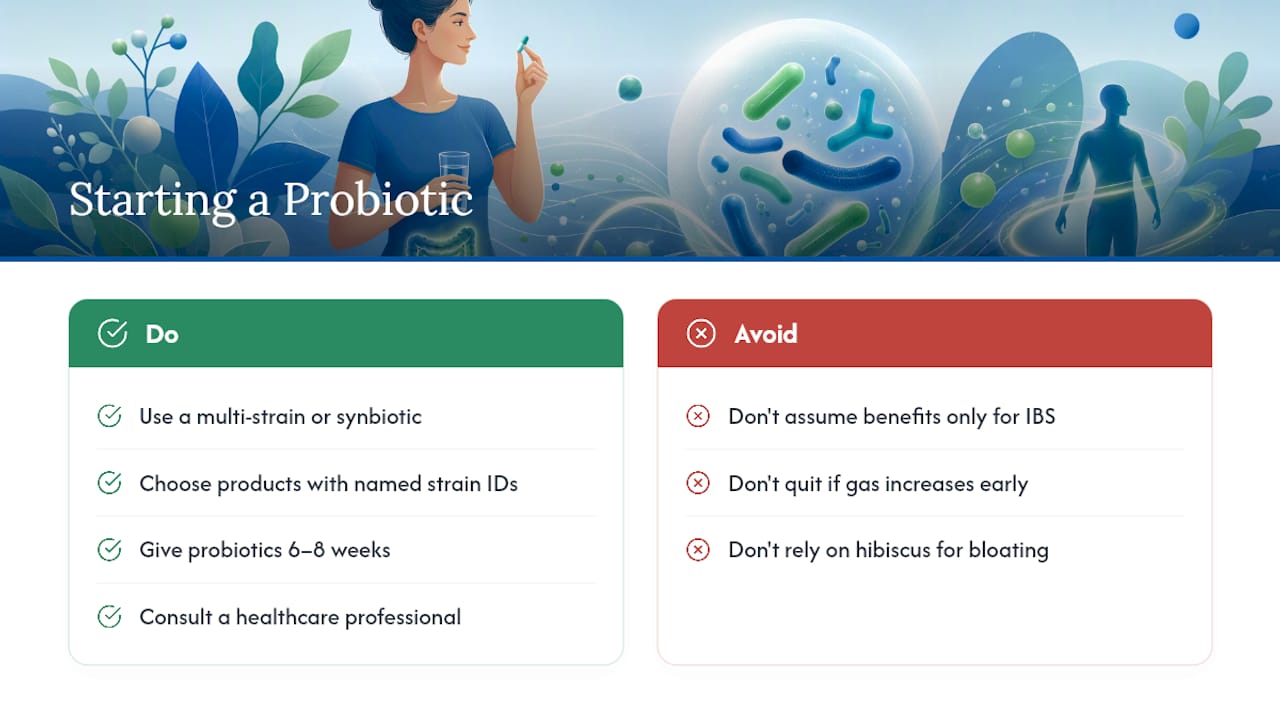
Pro Tip: Check the label for a full strain identifier, something like Bifidobacterium lactis HN019, not just “Bifidobacterium lactis.” The strain code after the species name is what connects the product to actual clinical data. Without it, you’re buying a species, not a studied formula.
Plenty of products list only the species and skip the strain code entirely. That’s a marketing shortcut, not a scientific one. The same species can behave completely differently strain to strain, so a product that only names the species is asking you to trust an assumption the research doesn’t actually support.
Who Benefits Most From Probiotics, and Who Shouldn’t Bother?
People with diagnosed IBS see the most consistent benefit in the clinical literature, especially those with post-infectious symptoms or a recent, identifiable shift in bowel habits. If your bloating tracks with irregular stool patterns, abdominal discomfort after meals, or a clear IBS diagnosis, you’re in the group most likely to respond.
Probiotics are far less likely to help in a few specific situations:
- Swallowed air and overeating. If your bloating shows up right after large meals or fizzy drinks, that’s a mechanical issue, not a microbial one.
- Unresolved constipation. Fixing motility with fiber, hydration, or, when appropriate, a clinician-guided laxative often does more than adding bacteria.
- Undiagnosed food intolerances. Lactose or fructose intolerance produces bloating that mimics IBS but responds to dietary changes, not probiotics.
- Small intestinal bacterial overgrowth (SIBO). Adding more bacteria to an already overgrown small intestine can worsen symptoms in some cases. This one deserves testing, not guessing.
Some symptoms mean it’s time to see a clinician before trying anything from a store shelf: unexplained weight loss, blood in the stool, persistent severe pain, or new-onset bloating in someone over 50 who hasn’t had this problem before. Those aren’t probiotic problems. They need a diagnostic workup.
One more group needs caution regardless of symptoms: people who are severely immunocompromised or have central intravenous lines. Clinical guidance notes rare but real bloodstream infection risk from live organisms in fragile patients. If that’s you or someone you’re buying for, talk to a clinician before starting any live-culture supplement.
How Do You Choose a Probiotic for Bloating?
Most bloating-focused probiotics on shelves fail one or more of these checks. Run through this before you buy:
- Strain ID, not just species. Look for the full strain code on the label, not a generic species name.
- CFU at expiration, not manufacture. Live counts drop over shelf life. A trustworthy label states the guaranteed count at expiry, not just at the moment it left the factory.
- Clear dosing instructions. Reputable products state exact daily amounts and timing, not vague “take as needed” language.
- Storage requirements listed. Some strains need refrigeration to stay viable; others are shelf-stable. The label should say which.
- Third-party testing. A certificate of analysis or an independent testing seal tells you the CFU claim on the bottle actually matches what’s inside.
- A real expiration date, not just a manufacture date.
Formulation matters too. Single-strain products are easiest to match to specific trial data. Multi-strain and synbiotic formulas, especially ones that pair probiotics with prebiotic fiber or plant extracts, showed some of the strongest results in recent trials because the added compounds support the probiotic strains’ activity rather than leaving them to work alone.
Watch for these red flags: a “proprietary blend” that hides strain identities, a CFU number with no third-party verification, dosing claims that sound too aggressive, or health claims that go well beyond what any single ingredient could plausibly do.
Pro Tip: Pick one product and stick with it for the full trial period before judging results. Swapping supplements every week makes it impossible to tell what’s actually working, and it resets your gut’s adjustment period every time you switch.
How Long Should You Try a Probiotic Before Judging It?
Most clinical trials run 4 to 8 weeks, and that’s a reasonable window for a real-world trial too. The synbiotic study measured meaningful improvement at six weeks. Give a product at least that long before deciding it isn’t working.
Expect a gradual pattern, not an overnight switch. Some people notice a brief uptick in gas during the first week or two as the gut microbiome adjusts. That transient increase usually settles within a couple of weeks and shouldn’t be confused with the product failing.
A few rules to guide the process:
- Stop immediately if symptoms clearly worsen beyond that early adjustment window, especially if new pain, cramping, or diarrhea shows up.
- Continue through the full 6 to 8 week trial if you’re seeing incremental improvement, even if it’s not dramatic yet.
- If there’s no change at all by week 8, that strain likely isn’t the right fit. Try a different, well-documented strain rather than assuming probiotics don’t work for you at all.
- Keep a simple symptom diary. Rate bloating severity daily on a 1 to 10 scale. Patterns are much easier to see on paper than from memory.
Are Probiotics Safe? Side Effects and Who Should Be Cautious
The most common side effect is exactly the one people worry about most: increased gas or bloating during the first week or two of use. It’s usually temporary and tends to resolve as your gut microbiome adjusts to the new strains.
More serious risks are rare but worth knowing. In severely immunocompromised patients, live probiotic organisms have occasionally been linked to bloodstream infections. Poorly manufactured products also carry contamination risk, which is part of why third-party testing matters so much.
- Pregnant people, infants, and seriously ill or immunosuppressed individuals should talk to a clinician before starting any probiotic, since the safety data in these groups is thinner than in generally healthy adults.
- Medication interactions are uncommon but not impossible, particularly for people on immunosuppressive drugs; a quick check with a pharmacist or doctor is worth the five minutes.
- Response is genuinely mixed. Clinical guidance is direct about this: probiotics reduce bloating in some people and increase gas in others, which is exactly why a structured, monitored trial beats blind faith in any single product.
Pro Tip: Buy from manufacturers who publish third-party test results and specific strain data, and store the product exactly as the label instructs. A supplement that needs refrigeration but sits on a warm truck for a week has already lost potency before it reaches your kitchen.
Why Longevity Premier’s Digestive Formula Fits This Evidence
Everything the research points to, strain transparency, clear dosing, third-party quality control, and supportive ingredients, is exactly what separates a probiotic that might work from one that’s just marketing. Longevitypremier’s digestive formulation is built around that same evidence-based checklist, pairing targeted probiotic strains with digestive enzymes and complementary support ingredients rather than a vague, unlabeled blend.
- Formulation transparency matches the label-reading standard the research supports: no hiding behind “proprietary blend” language.
- Supportive digestive enzymes address the mechanical side of digestion that probiotics alone don’t touch, useful if your bloating has more than one cause.
- Manufacturing standards reflect the company’s broader formulation approach, drawing on decades of healthcare formulation experience rather than a trend-chasing ingredient list.
A sensible trial plan: take the product daily at the labeled dose for a full 6 to 8 week window, track bloating severity daily, and note any changes in stool consistency or overall gut comfort. If you notice red-flag symptoms, unexplained weight loss, blood in stool, or severe unrelenting pain, stop the trial and see a clinician instead of extending it.
Inside the Trial Data: What the Numbers Actually Show
The two studies anchoring this article deserve a side-by-side look, because the details explain why the headline claim (“probiotics help bloating”) is true but incomplete.
| Trial | Population | Intervention | Primary Outcome |
|---|---|---|---|
| Multi-species synbiotic RCT | 350 adults, self-reported bloating (general population) | multi-species synbiotic with pomegranate extract, 6 weeks | 72.3% “never/rarely” bloated vs. 55.9% placebo |
| IBS probiotic meta-analysis | 3,288 adults, diagnosed IBS, 23 pooled trials | Various probiotic strains and doses | Mean bloating score difference of -2.13 (95% CI: -3.96 to -0.30) |
Statistic callout: In the synbiotic trial, a 16.4 percentage-point gap separated the treatment and placebo groups on “never or rarely bloated” reporting. That’s not a subtle effect. It’s also one trial, in one formulation, and shouldn’t be read as a promise every product will replicate.
The meta-analysis tells a more cautious story. A p-value of 0.0224 clears the standard bar for statistical significance, but the wide confidence interval (-3.96 to -0.30) means the true effect could be small in some populations and considerable in others. That range is the mathematical fingerprint of high heterogeneity, different strains, doses, and trial designs pooled together. It’s why “probiotics help bloating” is true as a category statement and incomplete as a shopping instruction. The strain and formulation you pick still determines your odds.
A Formulator’s View: Matching Strains to Real-World Symptoms
Longevity Premier builds its digestive formulations by starting with the same question this article asks: which strains actually have trial data behind them, and which ones are riding on species-level reputation alone? That distinction drives every ingredient decision, not marketing trends.
The company’s approach favors combining probiotic strains with supportive elements like digestive enzymes, since bloating rarely has a single cause. A strain that helps with gas production won’t necessarily help with sluggish motility or enzyme insufficiency, so a formulation that only addresses one mechanism is solving half the problem for a lot of people.
The realistic advice hasn’t changed with better research: a probiotic is a tool, not a fix for every root cause. Pair it with basic dietary awareness, mind your fiber intake, notice your triggers, stay hydrated, and treat the supplement as one input into a bigger picture. Anyone with red-flag symptoms or a trial that isn’t working after eight weeks should talk to a clinician rather than keep experimenting alone.
Ready to Try a Strain-Specific Digestive Formula?
If you’ve read this far, you already know the shortcut everyone else is looking for doesn’t exist: results depend on the strain, the dose, and how long you give it a fair shot. What you can control is picking a formulation built on that same standard instead of guessing from a shelf full of vague “probiotic blend” labels.
Longevitypremier’s digestive formulation is built around the same evidence-based criteria covered in this article, transparent strain sourcing, supportive digestive enzymes, and clear dosing, so you’re not left decoding a label with no strain ID and no CFU guarantee. A sensible starting plan: take it daily at the labeled dose for six to eight weeks, log your bloating severity once a day, and note any change in regularity or comfort along the way. If severe pain, bleeding, or unexplained weight loss shows up at any point, stop and see a clinician instead of continuing the trial. Ready to start? Explore the digestive formula and see how it fits into your routine.
Primary Sources and Where to Learn More
For readers who want to dig into the original data or share sources with a doctor, these are the studies and clinical resources behind this article’s claims:
- A Randomized, Placebo-Controlled Trial Evaluating Multi-Species Synbiotic Supplementation for Bloating, Gas, and Abdominal Discomfort: a 350-person randomized, double-blind trial with clear numeric outcomes at six weeks, the strongest single data point in this article.
- Efficacy of Probiotics in the Management of Irritable Bowel Syndrome: A Systematic Review and Meta-Analysis: pools 23 randomized trials and 3,288 IBS patients, useful for understanding both the benefit and the variability across studies.
- Systematic review: probiotics in the management of lower gastrointestinal symptoms – an updated evidence-based international consensus: consensus-level guidance on which patient groups respond best.
- Probiotics: What They Are, Benefits & Side Effects: a clinician-facing resource on realistic expectations, side effects, and when results vary person to person.
Bring these links to your next appointment if bloating has been a persistent, unresolved issue. A clinician can rule out SIBO, intolerances, or other causes that no probiotic, however well-studied, is designed to fix.
Frequently Asked Questions
Do probiotics help bloating for everyone, or just people with IBS? The strongest data comes from IBS populations, but the synbiotic trial tested a general population with self-reported bloating and still found significant improvement, so benefit isn’t limited to diagnosed IBS.
What’s the best probiotic for bloating if I don’t have a specific diagnosis? Look for a multi-strain or synbiotic formula with named strain IDs like Bifidobacterium lactis or Bifidobacterium infantis, since those carry the most consistent trial support across different populations.
Can probiotics cause more gas and bloating instead of less? Yes, temporarily. A short-term increase in gas during the first one to two weeks is common as your gut adjusts, and it usually settles rather than signaling the product is wrong for you.
How long before I know if a probiotic is working for bloating? Give it 6 to 8 weeks, matching the timeline used in the clinical trials behind this article. Judging sooner risks quitting right before the strain has a chance to show results.
Is hibiscus tea related to bloating or just blood pressure? Hibiscus tea’s research base is focused on blood pressure, not digestive symptoms; several trials link it to modest reductions in hypertension, but it isn’t studied as a bloating remedy the way specific probiotic strains are.
This article is general information, not a substitute for advice from a qualified doctor. Consult a qualified healthcare professional about your own circumstances before acting on anything here.
Sources
- A Randomized, Placebo-Controlled Trial Evaluating Multi-Species Synbiotic Supplementation for Bloating, Gas, and Abdominal Discomfort
- Efficacy of Probiotics in the Management of Irritable Bowel Syndrome: A Systematic Review and Meta-Analysis
- Systematic review: probiotics in the management of lower gastrointestinal symptoms – an updated evidence‐based international consensus
- Probiotics: What They Are, Benefits & Side Effects
Recommended
- Longevity Horny Goat Weed Extract [Extra Strength] for men and women. With Maca, Tongkat Ali, Saw Palmetto, L-Arginine, Ginseng.
- Longevity Detox Herbal Tea, teabags, 30 count package
- Longevity Complete Detox (Day Formula): Gentle whole body cleanse and detox supplement. Liver, kidney, and brain detox. Supports mental clarity.
- Longevity Blood Pressure Herbal Tea, teabags, 30 count package