


![Longevity Complete Detox [BETA 21 Caps]: 7 Day Intensive Detox & Digestive Support](http://longevitypremier.com/cdn/shop/files/DetoxBeta-mid_100x100.png?v=1787365739)




CoQ10 vs Ubiquinol: Which Form Should You Actually Buy?
For most healthy adults, a well-formulated, oil-based ubiquinone softgel taken with a fatty meal delivers the best value in the coq10 vs ubiquinol decision. Ubiquinol tends to absorb somewhat better on paper, but the gap matters far less than most marketing suggests once you account for formulation quality.
Here’s the short version before the deeper evidence:
- Default choice for most people: standard ubiquinone (regular CoQ10) in an oil-based softgel. It costs less, has a long track record in outcome research, and is chemically stable on the shelf.
- Consider ubiquinol instead when: you’re over roughly 40, you have a known fat-malabsorption issue, or you’ve tried ubiquinone without noticing the general energy or wellness support you expected and have budget room to try the pricier form.
None of this is a claim that either form treats or prevents any specific condition. It’s a supplement-selection framework, not medical advice, and nothing here substitutes for a conversation with your doctor or pharmacist, especially if you take prescription medication.
Key Takeaways
Delivery technology and formulation quality influence CoQ10 absorption more consistently than whether the label says ubiquinone or ubiquinol.
| Point | Details |
|---|---|
| Default to ubiquinone | For most healthy adults under 40, a well-formulated oil-based ubiquinone softgel offers the best cost-to-absorption value. |
| Formulation beats form | Liposomal and crystal-free delivery technologies showed bigger absorption gains in trials than switching redox forms alone. |
| Consider ubiquinol selectively | Older adults, people with fat-malabsorption issues, or those with budget room may benefit more from ubiquinol. |
| Match dose to research | Most studies use 100 to 300 mg daily, taken with a fat-containing meal to support absorption. |
| Check drug interactions first | Blood thinners, statins, and blood pressure medications all warrant a conversation with a clinician before starting CoQ10. |
| Longevitypremier’s formulation standard | The brand applies the same delivery-technology and third-party verification standards recommended here across its cardiovascular and metabolic formulas. |
This article is general information, not a substitute for advice from a qualified doctor. Consult a qualified healthcare professional about your own circumstances before acting on anything here.
Table of Contents
- CoQ10 vs Ubiquinol at a Glance
- What Ubiquinone and Ubiquinol Actually Are
- Absorption and Pharmacokinetics: What the Data Shows
- Which Clinical Trials Used Which Form, and Why It Matters
- Who Actually Benefits More From Ubiquinol
- Why Formulation Often Beats the Ubiquinone vs Ubiquinol Label
- Dosage Ranges, Safety, and Drug Interactions to Know
- How to Choose a CoQ10 Supplement Without Getting Fooled by Marketing
- Why Delivery Technology Often Matters More Than the Form
- Publisher Perspective: Choosing CoQ10 Ingredients for a Formulation
- Where Longevitypremier Fits Into Your CoQ10 Decision
- Sources
CoQ10 vs Ubiquinol at a Glance
Before getting into the mechanisms and the studies, here’s how the two forms stack up on the dimensions that actually drive a purchase decision.
- Chemical form: Ubiquinone is the oxidized form of coenzyme Q10; ubiquinol is the reduced form. Chemically, they’re two states of the same molecule.
- Absorption tendency: Ubiquinol is often marketed as better absorbed, but head-to-head data is mixed. One comparative bioavailability study in older adults found a water-soluble ubiquinone formulation outperformed both standard ubiquinone and ubiquinol, and ubiquinol did not show a statistically significant edge over standard ubiquinone in that trial.
- Stability and shelf life: Ubiquinone is more chemically stable and resists oxidation better in storage. Ubiquinol degrades faster once exposed to air, heat, or light, which is why it usually ships in sealed, opaque, or nitrogen-flushed packaging.
- Typical cost: Ubiquinol supplements generally run noticeably higher per milligram than ubiquinone. The manufacturing process to stabilize the reduced form in a capsule is more complex and expensive, and that cost gets passed to the shelf price.
- Common study doses: Most published trials use 100 to 300 mg per day of ubiquinone; ubiquinol studies often use similar or somewhat higher doses to attempt to match plasma outcomes.
The cost gap is the detail most people underestimate walking into a supplement aisle. You’re not just paying for “the better form.” You’re paying for a harder-to-stabilize ingredient, tighter packaging requirements, and a shorter shelf window, all of which add manufacturing overhead that ubiquinone doesn’t carry.
What Ubiquinone and Ubiquinol Actually Are
Ubiquinone is the oxidized form of coenzyme Q10. Ubiquinol is the reduced form. That’s the entire chemical distinction, and it’s less dramatic than the marketing around it suggests.
Your body doesn’t treat these as two separate ingredients. It converts one into the other continuously, cycling between the two states as part of normal cellular activity. This is called the ubiquinone-ubiquinol redox cycle, and it’s central to how CoQ10 functions inside mitochondria, the energy-producing structures in your cells. According to a detailed review of the redox cycle, each CoQ10 molecule can undergo thousands of these oxidation-reduction cycles per hour, shuttling electrons through the mitochondrial electron transport chain while also functioning as an antioxidant in its reduced ubiquinol state.
Here’s the detail that undercuts a lot of ubiquinol marketing: research from the Linus Pauling Institute at Oregon State University notes that most circulating CoQ10 in the bloodstream shows up as ubiquinol, regardless of which form you swallowed. Your gut and liver convert a large share of ingested ubiquinone into ubiquinol during absorption. That single fact is why the “ubiquinol is inherently superior” pitch oversimplifies the biology.
CoQ10 is also highly lipophilic, meaning it dissolves in fat, not water. Its chemical structure is why absorption depends heavily on lipid carriers, whether that’s a fat-containing meal or an oil-based capsule. This single property explains more about real-world absorption differences between products than the ubiquinone-versus-ubiquinol label ever does.
Quick fact: a majority of circulating CoQ10 typically exists in the ubiquinol state after absorption, independent of the form you took.
Absorption and Pharmacokinetics: What the Data Shows
Bioavailability research measures two main numbers: Cmax (peak blood concentration) and AUC (area under the curve, a measure of total absorption over time). Comparing these across studies is where the real coq10 vs ubiquinol answer lives, and it’s messier than most product pages let on.
Formulation, not form, drives most of the variability. A pharmacokinetic review of CoQ10 formulations found that crystal-free, solubilized preparations consistently outperform crystalline or dry-powder formulations in both single-dose absorption and steady-state bioavailability, regardless of oxidation state. That’s a formulation effect, not a form effect.
Liposomal delivery shows some of the strongest gains in recent research. A double-blind, randomized trial published in Frontiers in Nutrition (2025) found liposomal CoQ10 produced a 31.3% higher Cmax and a 22.6% higher AUC0–24 compared with a standard formulation, both statistically significant (p < 0.001). That’s a bigger jump than most ubiquinone-versus-ubiquinol comparisons show.
| Formulation or comparison | Measured effect | Population | Source |
|---|---|---|---|
| Water-soluble ubiquinone vs standard ubiquinone | a notable absorption improvement | Older adults, single dose | PMC comparative study |
| Ubiquinol vs standard ubiquinone (same trial) | No statistically significant advantage | Older adults, single dose | PMC comparative study |
| Liposomal CoQ10 vs standard formulation | Cmax +31.3%, AUC0-24 +22.6% | Adult trial subjects | Frontiers in Nutrition trial |
| Crystal-free vs crystalline/dry-powder formulations | Notably higher absorption in crystal-free group | Mixed adult populations | PMC formulation review |
One more wrinkle worth noting: individual variability in CoQ10 absorption is large, larger than the average difference between most formulations in a given study. Age, gut health, baseline CoQ10 status, and whether the dose was taken with food all shift the numbers meaningfully from person to person.
Which Clinical Trials Used Which Form, and Why It Matters
This is the part of the coq10 vs ubiquinol debate that gets glossed over the most, and it deserves more attention than it usually gets.
A 2023 cardiology review published in Current Cardiology Reports examined the coenzyme Q10 clinical trial landscape and found something worth sitting with: the majority of large, long-term outcome trials used ubiquinone, not ubiquinol. Ubiquinol trials exist, but they’re fewer in number, often use higher doses to compensate for smaller sample sizes, and haven’t accumulated the same depth of long-term outcome data.
Why does this matter if the body converts one form to the other anyway? Because when a supplement label leans on “clinically studied” language, you need to ask which form was actually in the capsule during that trial. A product claiming to be backed by decades of cardiovascular research is very often riding on ubiquinone’s track record, even if the bottle on the shelf contains ubiquinol.
| Trial characteristic | What the evidence shows |
|---|---|
| Form most used in large outcome trials | Ubiquinone |
| Typical population studied | Older adults and populations followed for cardiovascular outcome measures |
| Ubiquinol trial volume | Fewer trials, often with higher doses used |
| Practical implication | Long-term outcome evidence leans on ubiquinone; ubiquinol’s comparative outcome evidence is more limited |
A few practical takeaways follow from this:
- Don’t assume a “ubiquinol is clinically superior” claim is backed by outcome trials using ubiquinol itself.
- If you’re choosing a supplement partly because of published research, check whether that research population and form match what you’re buying.
- Extrapolating ubiquinone’s trial history onto a ubiquinol product (or vice versa) is a common marketing shortcut, not a scientific equivalence.
Who Actually Benefits More From Ubiquinol
The honest answer is: it depends on your biology, not your zip code or your Instagram feed. Here’s how to think about it by profile.
- Younger, healthy adults: Standard ubiquinone in a decent oil-based softgel is typically sufficient. Absorption capacity tends to be solid in this group, and the cost savings compound over months of daily use.
- Older adults (roughly 40 and up): Natural CoQ10 levels and absorption efficiency tend to decline with age, which is the strongest evidence-based argument for considering ubiquinol or an advanced-delivery ubiquinone formulation.
- People with fat-malabsorption issues: Since CoQ10 depends on lipid carriers for absorption, anyone with a condition affecting fat digestion may see more benefit from a pre-solubilized ubiquinol product or a liposomal ubiquinone formulation.
- People on medications that interact with CoQ10 pathways: This group should prioritize a conversation with a pharmacist over form selection, since dosing consistency and monitoring matter more than ubiquinone versus ubiquinol.
- Budget-conscious buyers: Standard ubiquinone taken consistently with meals gives you most of the practical benefit at a fraction of the cost of premium ubiquinol products.
Simple decision rule: if you’re under 40, healthy, and have no known digestive issues, start with ubiquinone. If you’re older, have tried ubiquinone without the results you wanted, or have a diagnosed absorption concern, ubiquinol or an advanced-delivery formulation is worth the higher price.
Why Formulation Often Beats the Ubiquinone vs Ubiquinol Label
This is the single most underappreciated fact in the entire ubiquinone vs ubiquinol conversation: delivery technology frequently moves the absorption needle more than the redox form printed on the label.
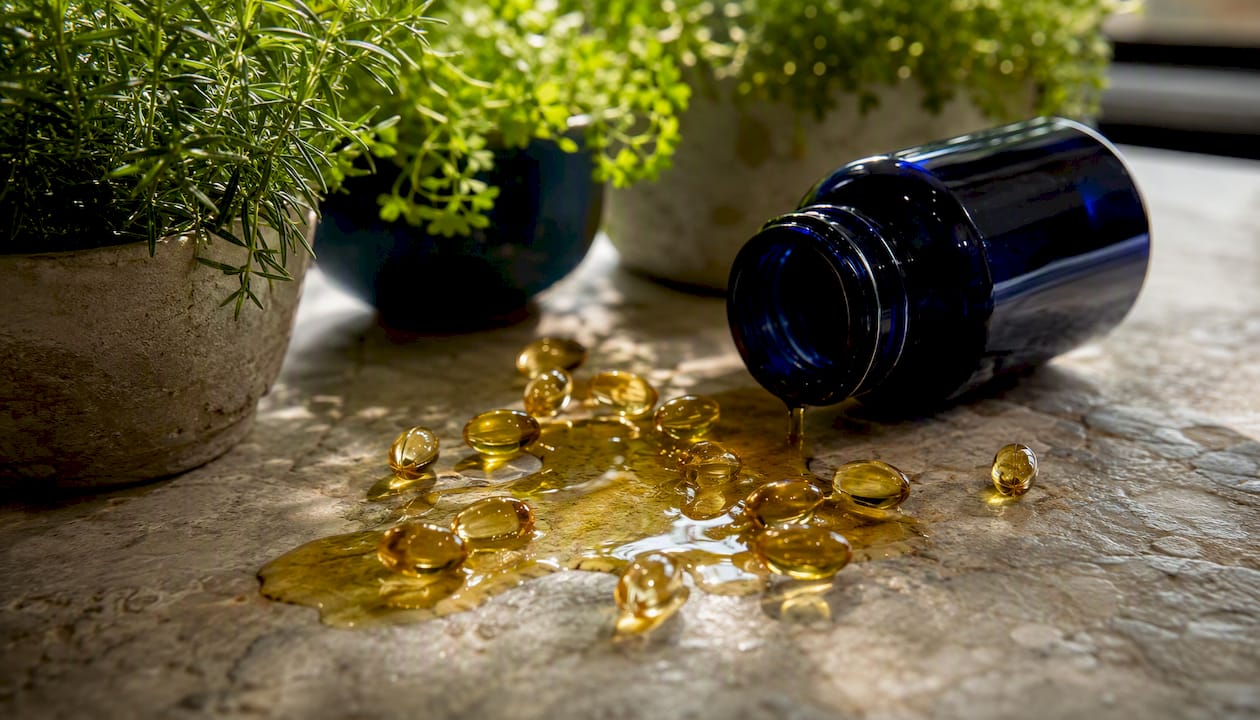
Oil-based softgels outperform dry powder capsules because CoQ10 is fat-soluble and needs a lipid carrier to cross the gut wall efficiently. Liposomal delivery, which encases CoQ10 in tiny fat-based spheres, showed measurable Cmax and AUC improvements over standard formulations in the Frontiers in Nutrition trial cited earlier. Crystal-free and microencapsulated formulations solve a different problem: raw CoQ10 crystallizes easily, and crystallized particles are harder for your gut to absorb. Breaking that crystal structure down before it reaches your stomach, as multiple formulation studies confirm, improves both single-dose absorption and steady-state blood levels.
Meal timing plays a bigger role than most people realize, too. Because CoQ10 requires fat for absorption, taking it on an empty stomach, regardless of form, can undercut even a premium formulation. Pairing your dose with breakfast eggs, dinner with olive oil, or any meal containing some fat gives your gut the lipid environment it needs to shuttle CoQ10 across the intestinal wall.
Here’s a quick formulation checklist to run through before you buy:
- Is it an oil-based softgel, or a dry powder capsule with no solubilization step?
- Does the label mention a specific delivery technology (liposomal, crystal-free, microencapsulated) rather than a vague “enhanced absorption” claim?
- Does the company disclose or link to any bioavailability data for that specific formulation, not just the ingredient in general?
- Is the recommended use paired with meal timing guidance?
Pro Tip: Before comparing ubiquinone to ubiquinol, compare formulations within each category first. A well-engineered ubiquinone softgel with verified delivery technology can outperform a poorly formulated ubiquinol capsule, even though ubiquinol has the theoretical absorption edge.
Dosage Ranges, Safety, and Drug Interactions to Know
Most published research on CoQ10 uses daily doses between 100 and 300 mg, split once or twice daily. Some pharmacokinetic studies test higher single doses to measure absorption curves, but that’s a research tool, not a recommended daily intake for general use.
A few interaction points deserve real attention, not a passing mention:
- Blood-thinning medications: CoQ10 has a chemical structure related to vitamin K and may interact with the effectiveness of anticoagulant therapy. Anyone on blood thinners should loop in their prescribing physician before starting CoQ10, in either form.
- Statin therapy: Statins are known to lower endogenous CoQ10 production, which is part of why some clinicians recommend supplementation alongside statin use. That interaction runs in the opposite direction from a safety concern, but it still warrants a conversation with your doctor rather than self-directed dosing.
- Blood pressure medications: CoQ10 may have a mild influence on blood pressure regulation in some people, so anyone on antihypertensive therapy should mention CoQ10 supplementation to their prescriber, per Drugs.
- Chemotherapy agents: Certain cancer treatment protocols advise against concurrent antioxidant supplementation without physician oversight. This isn’t a treatment claim about CoQ10 itself, just a standard caution that applies during active treatment for any condition.
Quick safety checklist: confirm your dose against product labeling (typically 100 to 300 mg daily), take it with a fat-containing meal, disclose any CoQ10 use to your pharmacist during medication reviews, and stop and consult a clinician if you notice any unusual symptoms after starting.
This article is general information, not personalized medical advice. Confirm dosing and interaction questions with a licensed clinician or pharmacist familiar with your full medication list.
How to Choose a CoQ10 Supplement Without Getting Fooled by Marketing
Here’s the step-by-step process worth running through before you check out, whether you’re standing in a pharmacy aisle or scrolling a product page.
- Identify the form on the label. Confirm whether it’s ubiquinone or ubiquinol, and don’t assume one is automatically better without checking formulation quality.
- Check for a named delivery technology. Look for terms like liposomal, crystal-free, or microencapsulated rather than vague “enhanced absorption” language with no specifics.
- Compare dose per capsule against the study range. Most research uses 100 to 300 mg daily; a product dosed far outside that range without explanation is a flag worth investigating.
- Calculate cost-per-effective-dose, not just price per bottle. A $40 bottle of 60 capsules at 100 mg costs about $0.67 per 100 mg dose. A $70 bottle of 30 capsules at 200 mg costs roughly $2.33 per 100 mg equivalent. The cheaper sticker price isn’t always the cheaper dose.
- Check storage and expiration guidance, especially for ubiquinol. Since ubiquinol oxidizes faster, a product with no storage instructions or an unusually long shelf claim deserves scrutiny.
- Look for third-party testing or a certificate of analysis. Independent verification of potency and purity matters more for a fat-soluble compound like CoQ10, where degradation isn’t always visible.
Red flags worth walking away from:
- Powder-filled capsules with no mention of solubilization or oil-based carrier.
- “Proprietary blend” language that hides the actual CoQ10 dose within a mix of other ingredients.
- Ubiquinol products with no storage or expiration guidance, given how much faster the reduced form degrades.
- Marketing copy that cites general CoQ10 research to imply a specific product’s superiority without disclosing which form or formulation was actually studied.
Why Delivery Technology Often Matters More Than the Form
Pulling the evidence together, a clear pattern emerges: the studies showing the biggest absorption gains almost always involve a delivery innovation, not simply a switch from ubiquinone to ubiquinol.
- Liposomal delivery improved Cmax by 31.3% and AUC by 22.6% over a standard formulation in a controlled trial, a bigger jump than most ubiquinone-to-ubiquinol comparisons produce.
- Crystal-free and microencapsulated formulations consistently beat crystalline and dry-powder versions across multiple comparative studies, independent of oxidation state.
- Individual variability in absorption is often larger than the average difference between forms, meaning formulation consistency and meal timing can matter more for you personally than which redox state you picked.
The biological reality that most circulating CoQ10 ends up as ubiquinol regardless of ingested form reinforces this. Your body is already doing conversion work in the background. What it can’t fix on its own is a poorly solubilized capsule that never gets absorbed in the first place.
The practical recommendation: prioritize formulation and delivery technology first. Pick a proven delivery method, oil-based softgel, liposomal, or crystal-free, and pair it with a fat-containing meal. Only after that should form (ubiquinone versus ubiquinol) become your tiebreaker, and mainly for older adults or those with absorption concerns and room in the budget.
Publisher Perspective: Choosing CoQ10 Ingredients for a Formulation
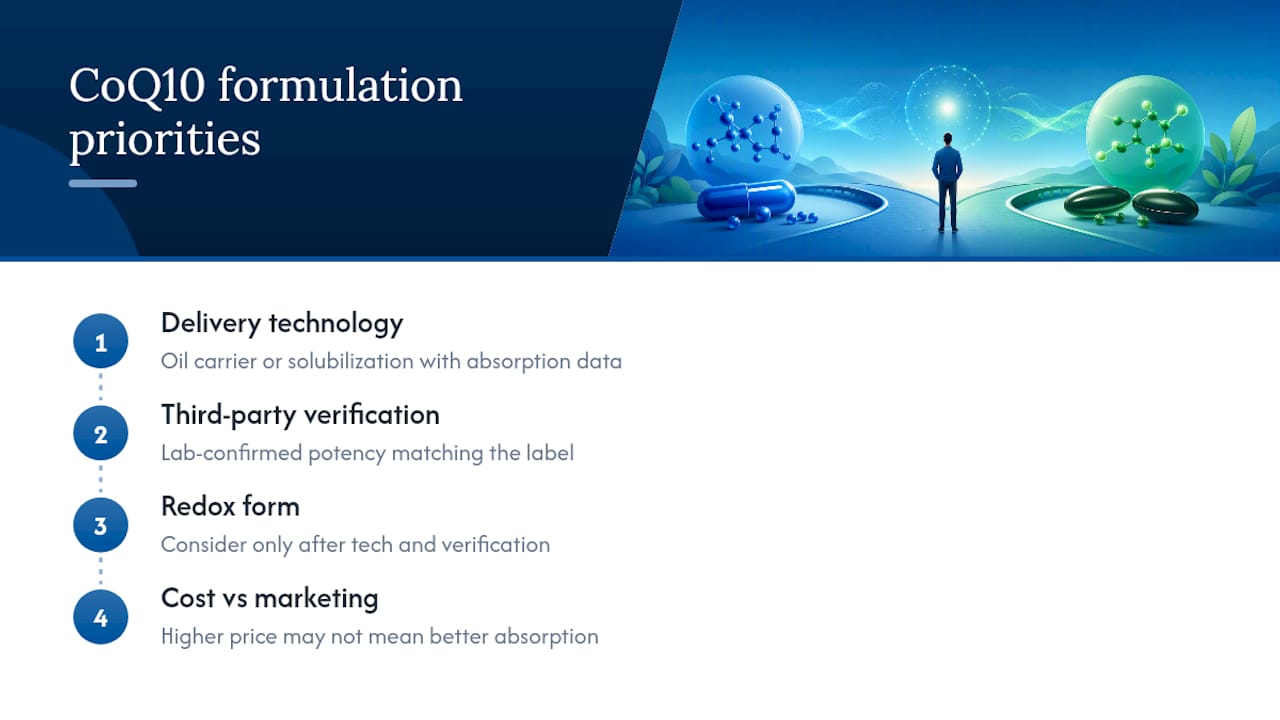
When Longevitypremier evaluates coenzyme Q10 for a formulation, the redox form is the third question we ask, not the first. The first question is delivery technology: does the ingredient supplier use an oil-based carrier or a solubilization process with actual absorption data behind it, or just a marketing claim? The second is verification: does a third-party lab confirm potency matches the label? Only after those two boxes are checked does the ubiquinone-versus-ubiquinol conversation become relevant, and even then, it’s weighed against cost-per-effective-dose rather than treated as an automatic upgrade.
This is where the industry’s obsession with ubiquinol as a premium ingredient sometimes works against the buyer. A supplement brand can charge more for ubiquinol while cutting corners on the oil base or skipping third-party testing entirely, and the result is a product that costs more but doesn’t necessarily absorb better than a well-made ubiquinone alternative. Formulation discipline is what actually moves the needle on blood levels, and that discipline has nothing to do with which redox form sits in the capsule. We think that’s the detail worth remembering before any purchase, not just from us, but from any brand making a coq10 vs ubiquinol pitch.
None of this constitutes a claim to treat, diagnose, or cure any condition. It’s a product-selection philosophy grounded in the absorption science, not a medical recommendation.
Where Longevitypremier Fits Into Your CoQ10 Decision
If you’ve read this far, you already know the real decision isn’t just ubiquinone or ubiquinol. It’s formulation quality, dose accuracy, and whether a brand backs its absorption claims with anything more substantial than a label buzzword.
Longevitypremier builds its formulations around that same principle: targeted, purposeful ingredient selection over generic wellness marketing, drawing on more than 30 years of healthcare practice experience behind the brand’s formulation decisions. While CoQ10 itself isn’t part of the current product lineup, the same rigor that this article recommends for evaluating a CoQ10 supplement, checking delivery technology, dose transparency, and third-party accountability, is exactly how Longevitypremier approaches its own cardiovascular and metabolic support formulas, including the Longevity Blood Pressure Formula bundle. If you’re building a broader supplement routine around cardiovascular and metabolic wellness goals, it’s worth seeing how those same formulation standards apply across the rest of your supplement shelf, not just your CoQ10 bottle. You can also grab the brand’s free wellness guide for a deeper look at how targeted formulation decisions get made before a product ever reaches the shelf.
One more note: if you’re taking blood thinners, statins, or blood pressure medication, or if you’re just deciding between ubiquinone and ubiquinol for your specific health picture, talk to a clinician or pharmacist before adding any new supplement to your routine.
Sources
- Comparison of Coenzyme Q10 (Ubiquinone) and Reduced Coenzyme Q10 (Ubiquinol) as Supplement to Prevent Cardiovascular Disease and Reduce Cardiovascular Mortality | Current Cardiology Reports
- Coenzyme Q10 (CoQ10) - Linus Pauling Institute (Oregon State University)