



![Longevity Complete Detox [BETA 21 Caps]: 7 Day Intensive Detox & Digestive Support](http://longevitypremier.com/cdn/shop/files/DetoxBeta-mid_100x100.png?v=1787365739)







Why 3–4 g/day of Omega 3s Lowers Triglycerides, and When It Won’t
Yes, omega-3 fatty acids lower triglycerides, and the effect is dose-dependent: at pharmacologic doses of EPA+DHA, most people see reductions of triglycerides, with larger reductions typically seen in very high triglycerides. Prescription EPA-only formulations carry the strongest outcome evidence for high-risk patients already on statins, while over-the-counter fish oil results vary widely by dose and form. Talk to a clinician before starting high-dose therapy, especially if you take blood thinners.
TL;DR:
- Prescription omega-3s at around 4 grams daily reliably lower triglycerides, especially in those with very high initial levels, while OTC doses vary widely.
- The cardiovascular benefits of omega-3s beyond triglyceride reduction are uncertain, with clear outcomes only shown for EPA-only formulations like REDUCE-IT.
- Formulation type and quality, such as re-esterified triglyceride form, significantly influence absorption and effectiveness, especially for OTC supplements.
- Achieving therapeutic doses with OTC fish oil often requires swallowing 10 or more capsules daily, which may be impractical for many users.
- High-dose omega-3 therapy must be managed with a healthcare provider to monitor side effects and interactions, particularly for blood thinners and liver health.
Table of Contents
- What the strongest evidence on omega 3 triglycerides actually shows
- How omega-3 fatty acids actually lower triglycerides
- Prescription omega-3s vs fish oil supplements: what actually differs
- TG, EE, and rTG: the label detail that changes how much you absorb
- How to dose omega-3s and know when it’s working
- Does lowering triglycerides actually prevent heart attacks?
- Safety, side effects, and drug interactions to know before you start
- What to look for when choosing a fish oil supplement
- About Longevity Premier’s approach to cardiovascular formulation
- EPA-only vs EPA+DHA: which lowers triglycerides better?
- Beyond triglycerides: what omega-3s do for inflammation and insulin sensitivity
- The gap between what the data shows and what supplement marketing promises
- A quality daily formula to support your cardiovascular routine
- Sources
What the strongest evidence on omega 3 triglycerides actually shows
The clinical consensus here is not ambiguous, but it does have edges. The American Heart Association’s science advisory lays out the clearest picture: prescription omega-3 fatty acids at doses commonly around 4 grams per day, providing clinically effective combined EPA and DHA, consistently lower triglycerides, with significant reductions documented in patients who start with very high triglycerides.
That dose-response relationship shows up across the research. A frequently cited mechanistic review in PMC reports substantial triglyceride reductions at pharmaceutical doses, while clinicians typically tell patients to expect moderate reductions in garden-variety hypertriglyceridemia. The gap between those numbers comes down to starting triglyceride level. People who start higher tend to see bigger absolute and percentage drops; people closer to normal see a smaller effect.
Where the evidence gets genuinely mixed is outcomes, not lipids. Nearly everyone agrees omega-3s lower triglycerides. Far fewer studies agree on whether that translates into fewer heart attacks. The REDUCE-IT trial, using icosapent ethyl (a purified, prescription EPA-only agent), found a significant reduction in major adverse cardiovascular events among statin-treated, high-risk patients, according to a cardiovascular outcomes review in PMC. Other outcome trials using combined EPA+DHA formulations have not replicated that benefit as cleanly.
A few things explain the split:
- Formulation differs. EPA-only and EPA+DHA blends behave differently in the bloodstream, and DHA in particular can nudge LDL cholesterol upward in some patients, an effect documented in the AHA advisory.
- Background therapy matters. REDUCE-IT enrolled patients already on statins, so the EPA effect was additive to existing LDL control, not a replacement for it.
- Comparator oil matters. Some trials used mineral oil placebos that may have slightly worsened the control group’s lipid profile, inflating the apparent benefit. Reviewers still debate how much this affected REDUCE-IT’s results.
- Population risk matters. Benefits concentrated in patients with elevated triglycerides and additional cardiovascular risk factors, not the general population taking fish oil for general health.
Quick fact: at prescription dosing of EPA+DHA, expect clinically meaningful triglyceride reductions for very high triglycerides. That is a guideline-backed assertion, not a supplement-marketing claim.
The takeaway for a health-conscious reader is straightforward. Triglyceride lowering with omega-3s is well established and dose-dependent. Whether that lowering prevents a heart attack depends heavily on which formulation you use, how high your risk was to begin with, and what else you’re already doing for your heart.
How omega-3 fatty acids actually lower triglycerides
The liver is the real battleground. Most of the triglyceride-lowering effect comes from a drop in hepatic VLDL-TG production, meaning your liver simply packages and releases less triglyceride-rich VLDL into the bloodstream in the first place. Tracer studies cited in the PMC mechanistic review show this is the dominant pathway, not a side effect.
A second mechanism reinforces the first: omega-3s appear to increase how quickly circulating triglycerides get cleared from the blood. This happens partly through enhanced activity of lipoprotein lipase, the enzyme that breaks down triglycerides in VLDL and chylomicrons so tissues can use the fatty acids for fuel, and partly through increased beta-oxidation, the process that burns fatty acids for energy inside cells.
Here’s the part most articles skip: your metabolic starting point changes how well this works.
- People with insulin resistance or obesity often have elevated free fatty acid (NEFA) flux from fat tissue into the liver, which keeps feeding the VLDL production machine even while omega-3s try to shut it down.
- That tug-of-war explains why triglyceride-lowering results are sometimes smaller in patients with poorly controlled diabetes or significant insulin resistance than in metabolically healthier people with isolated hypertriglyceridemia.
- It also explains why lifestyle changes (weight loss, reduced refined carbohydrate intake) tend to amplify what omega-3s can do rather than compete with them.
Think of the liver as a factory with two dials: an input dial (how much fat flows in from adipose tissue) and an output dial (how much triglyceride the liver decides to package and ship out). Omega-3s mostly turn down the output dial. If the input dial is cranked up by insulin resistance, the factory still has plenty of raw material to work with, and the net effect is smaller. This is one reason clinicians pair omega-3 therapy with metabolic management rather than treating it as a standalone fix.
Prescription omega-3s vs fish oil supplements: what actually differs
The FDA has approved several prescription omega-3 products specifically for adults with very high triglycerides (typically defined as 500 mg/dL or above), a use case detailed in the NCBI Bookshelf clinical reference. These include icosapent ethyl (a prescription EPA-only agent) and prescription EPA+DHA formulations. Both are dosed and monitored differently than a bottle of fish oil from a drugstore shelf.
| Factor | Prescription omega-3 agents | Over-the-counter fish oil |
|---|---|---|
| Typical dose | 4 g/day (icosapent ethyl or EPA+DHA prescription blend) | Highly variable, often 300 mg EPA+DHA per serving |
| Regulatory oversight | FDA-approved, standardized purity and potency | Regulated as a dietary supplement, not drug-grade |
| Indication | Very high triglycerides, sometimes as an adjunct to statins in high-risk patients | General wellness, mild triglyceride support |
| Outcome trial data | REDUCE-IT (EPA-only) showed cardiovascular event reduction | Outcome data inconsistent across studies |
| Pills needed for therapeutic dose | Typically 2 to 4 capsules/day at standardized concentration | Often 8 to 12+ capsules/day to approach the same EPA+DHA total |
The last row is the one people underestimate. Reaching a genuinely therapeutic 3 to 4 grams per day of combined EPA and DHA from a typical OTC capsule containing 300 mg total omega-3s means swallowing ten or more pills daily. That’s not a minor inconvenience. It’s a real barrier to actually hitting the dose that clinical trials used, a point the Mayo Clinic’s fish oil overview makes plainly when discussing why supplement outcomes trail prescription results.
A few practical distinctions worth knowing:
- Prescription products guarantee a fixed EPA/DHA content per capsule, verified by regulatory testing.
- OTC labels can understate oxidation or overstate potency if third-party testing wasn’t performed.
- Prescription therapy typically comes with lab monitoring built into the treatment plan; OTC use often doesn’t.
- If your triglycerides are above 500 mg/dL, this is a conversation for a doctor, not a supplement aisle decision.
TG, EE, and rTG: the label detail that changes how much you absorb
Fish oil comes in three chemical forms, and the difference is not cosmetic. Natural triglyceride (TG) form is how omega-3s exist in fish naturally, with fatty acids attached to a glycerol backbone. Ethyl ester (EE) form is a common concentration method where fatty acids are bound to ethanol instead, making it cheaper to produce at high potency. Re-esterified triglyceride (rTG) form takes concentrated EE oil and re-attaches the fatty acids back onto a glycerol backbone, mimicking the natural structure.
Why does this matter for triglyceride lowering? Absorption efficiency isn’t identical across forms. A randomized 16 week trial found that higher-percentage rTG preparations produced greater incorporation of EPA and DHA into red blood cell membranes compared with lower-percentage rTG products, according to research published in PMC. That same body of research notes that re-esterification isn’t always complete. Some products labeled rTG still contain meaningful amounts of residual ethyl esters or diglycerides, and the percent rTG figure, when a manufacturer discloses it, works as a rough chemoprofile marker for quality.
Practical label-reading points:
- If your capsule is ethyl ester form, take it with a fat-containing meal. Absorption depends more heavily on dietary fat with EE than with TG or rTG forms.
- TG and high-percent rTG forms are less meal-dependent, which matters if you’re on a low-fat diet or have digestive issues affecting fat absorption.
- Look for a disclosed percent rTG figure on rTG-labeled products. Higher percentages generally track with better bioincorporation.
- Oxidized fish oil smells and tastes rancid. Fresh product should be relatively neutral, not overtly “fishy.”
Pro Tip: If you’ve been taking fish oil for months without any lab movement in your triglycerides, check the form on the label before assuming the dose was wrong. An ethyl ester capsule taken on an empty stomach can underperform the same milligram dose taken with a fatty meal.
How to dose omega-3s and know when it’s working
Getting to a therapeutic dose starts with basic label math, and most people get it wrong the first time because they confuse “fish oil” milligrams with “EPA+DHA” milligrams.
- Check the Supplement Facts panel, not the front label. A capsule marketed as “1,000 mg fish oil” might contain only 300 mg of combined EPA and DHA. That distinction is everything.
- Add up your daily EPA+DHA total. If your goal, discussed with a clinician, is 3 to 4 grams per day, and each capsule provides 300 mg, you need 10 to 13 capsules daily to reach that range with a standard OTC product.
- Compare that pill burden to a prescription option. A prescription formulation delivering the same 3 to 4 grams in 2 to 4 capsules may be far more realistic for daily adherence.
- Give it time before judging results. Meaningful triglyceride changes typically show up within 4 to 12 weeks of consistent therapeutic dosing, not days.
- Recheck a fasting lipid panel at 8 to 12 weeks. This is the standard window clinicians use to evaluate whether a dose is working before adjusting it.
- Watch more than the triglyceride number. Ask for LDL, HDL, and non-HDL cholesterol on the same panel, since EPA+DHA combinations can shift LDL in some patients even as triglycerides fall.
- Add liver enzymes if you’re on a high dose long-term. This is standard practice for prescription omega-3 therapy and reasonable for sustained high-dose OTC use as well.
- Loop in a clinician before changing anything if you’re already on statins or blood thinners. Dose adjustments in either direction deserve medical input, not guesswork.
The timeline point trips people up most often. Triglycerides respond faster than LDL cholesterol typically does, so an 8 to 12 week recheck is usually enough to tell whether your current dose and formulation are doing their job.
Does lowering triglycerides actually prevent heart attacks?
This is where the science gets genuinely nuanced, and where marketing tends to blur a real distinction: lowering a lab number and preventing a cardiovascular event are not automatically the same thing.
The clearest outcome data comes from REDUCE-IT, which tested icosapent ethyl, a purified EPA-only prescription drug, in statin-treated patients with elevated triglycerides and additional cardiovascular risk factors. The trial found a roughly 25% reduction in major adverse cardiovascular events, a result summarized in the cardiovascular outcomes review in PMC. That is a genuinely large effect size for a lipid-focused intervention.
Trials using combined EPA+DHA formulations have generally not shown the same outcome benefit, even when triglycerides dropped comparably. Several explanations get debated in the literature:
- The comparator oil used as placebo differed across trials, which may have exaggerated or understated the apparent benefit depending on the study.
- DHA’s modest LDL-raising effect in some patients may partially offset triglyceride benefits at the cardiovascular event level.
- Patient populations varied in baseline risk, statin use, and triglyceride severity, making direct trial-to-trial comparisons unreliable.
The practical takeaway: prescription EPA-only therapy has real outcome trial support in a specific high-risk, statin-treated population. General OTC fish oil supplementation, while it reliably lowers triglycerides, has not shown that same consistency for hard cardiovascular outcomes, a nuance the Mayo Clinic makes explicit in its patient guidance. Lowering the number and lowering your risk of an event are related but not interchangeable goals.
Safety, side effects, and drug interactions to know before you start
Most people tolerate omega-3 fatty acids well, but “well tolerated” doesn’t mean risk-free, especially at the higher doses needed for triglyceride therapy.
- GI side effects are the most common complaint. Fishy aftertaste, mild nausea, and loose stools tend to improve when capsules are taken with food or split into two doses rather than one large dose.
- Bleeding risk is the interaction that matters most. Omega-3s have mild antiplatelet effects, and combining high doses with anticoagulants like warfarin or antiplatelet drugs can compound that risk. Anyone on blood thinners or scheduled for surgery should talk to a clinician before starting high-dose omega-3 therapy.
- Pregnancy needs individualized guidance, since dosing recommendations differ from general adult hypertriglyceridemia management.
- Fish or shellfish allergy is a real consideration for some fish-derived products, though purified prescription formulations are typically manufactured to remove allergenic proteins.
- Liver function deserves periodic checking with sustained high-dose use, particularly if you’re also taking other medications metabolized by the liver.
None of this makes omega-3 therapy dangerous for most people. It does mean high-dose, therapeutic-level use belongs in a conversation with a healthcare provider rather than a self-directed experiment, particularly if you take other medications.
What to look for when choosing a fish oil supplement
Not all bottles on the shelf are equal, and the differences show up in your bloodwork, not just the price tag.
- EPA+DHA per serving, not total fish oil milligrams. This is the number that determines whether you can realistically reach a therapeutic dose without swallowing a dozen capsules.
- Third-party testing seals such as USP, NSF, or IFOS indicate independent verification of potency and contaminant limits, since supplement labels aren’t always accurate on their own.
- Oxidation and freshness data, when a manufacturer discloses it (TOTOX values or similar), tell you whether the oil has degraded before it reached your medicine cabinet.
- Percent rTG, if the product claims re-esterified triglyceride form. Higher disclosed percentages track with better bioincorporation in randomized data.
- Cost per gram of actual EPA+DHA, calculated by dividing price by total EPA+DHA content across the bottle, not by capsule count.
Pro Tip: Do the math before you buy: divide the bottle price by the total grams of EPA+DHA it actually contains, not by the number of capsules. A cheaper bottle with low potency per capsule often costs more per therapeutic gram than a pricier, more concentrated product.
If you’re managing cardiovascular risk broadly rather than isolated triglycerides, a targeted cardiovascular support formula built around specific ingredient categories can complement dietary and supplement strategy, though it doesn’t replace prescription therapy when triglycerides are severely elevated.
About Longevity Premier’s approach to cardiovascular formulation
Longevity Premier develops targeted nutraceutical formulations informed by more than 30 years of healthcare practice experience, with a specific focus on cardiovascular, metabolic, and detoxification support. The brand’s approach centers on high-quality ingredient selection and purposeful formulation rather than broad, one-size-fits-all wellness products.
Product categories span blood pressure support, glucose and cholesterol metabolism, digestive health, and detoxification, reflecting a belief that targeted nutritional support serves health-conscious consumers better than generic supplementation…
EPA-only vs EPA+DHA: which lowers triglycerides better?
Both forms lower triglycerides. The difference shows up in the details, not the headline effect.
EPA-only formulations, most notably prescription icosapent ethyl, avoid the modest LDL-raising effect that some patients experience with combined EPA+DHA products, a nuance detailed in the AHA science advisory. That matters clinically because a patient whose triglycerides drop 30% but whose LDL rises even slightly hasn’t necessarily improved their overall cardiovascular risk profile. EPA-only sidesteps that tradeoff for many patients.
Combined EPA+DHA formulations still lower triglycerides effectively and remain the FDA-approved choice in several prescription products, but the LDL nuance is why some clinicians default to EPA-only agents for patients who are already borderline on LDL cholesterol. It’s also why REDUCE-IT’s outcome benefit, built on EPA-only therapy, hasn’t been fully replicated by trials using combined formulations.
For someone shopping OTC supplements, this translates into a real label question: does the product list EPA and DHA separately, and does the EPA-to-DHA ratio lean one way or another? A supplement with a much higher DHA ratio may behave differently for your LDL than one that’s predominantly EPA, even at similar total triglyceride-lowering doses. There’s no universal “better” here. It depends on your existing lipid profile and what your clinician is trying to balance.
Beyond triglycerides: what omega-3s do for inflammation and insulin sensitivity
Triglyceride lowering isn’t the only cardiovascular-relevant change omega-3 fatty acids produce, and this is where the story gets more interesting than a single lab number suggests.
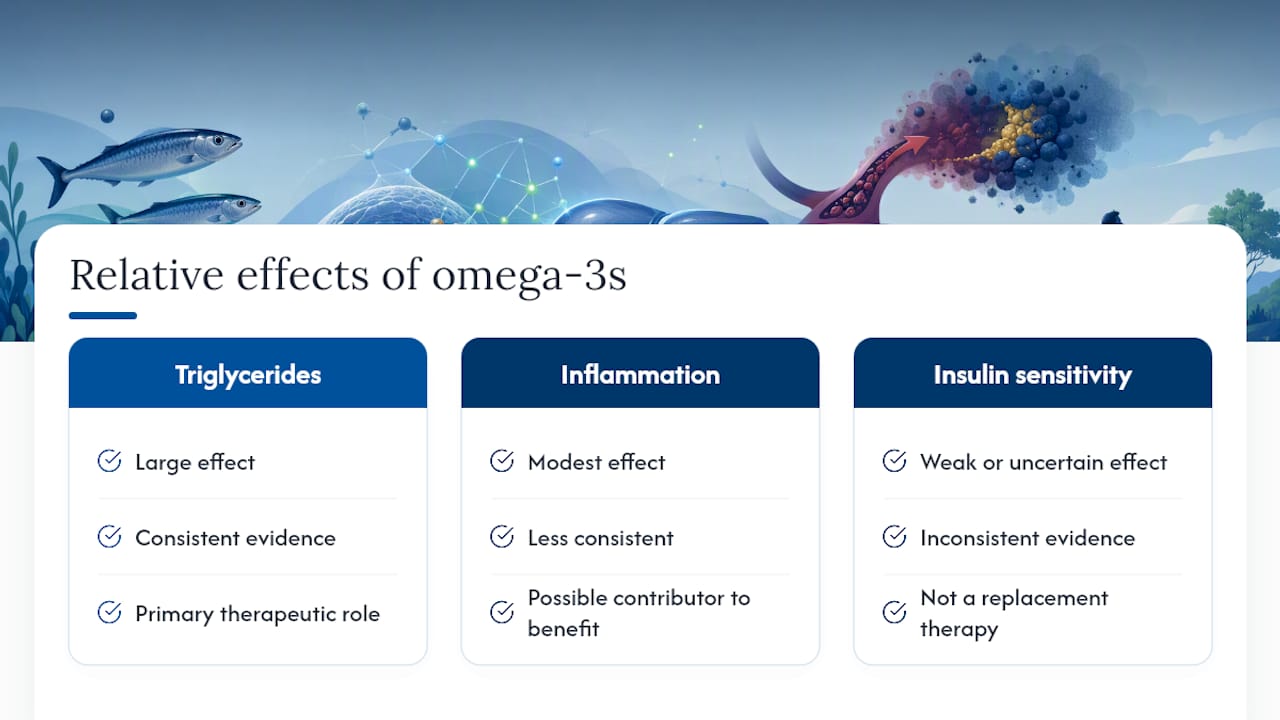
EPA and DHA are precursors to specialized lipid mediators involved in resolving inflammation, which is part of why omega-3 supplementation is frequently studied alongside inflammatory markers like C-reactive protein. The effect tends to be modest compared to the triglyceride response, but it’s a plausible contributor to cardiovascular benefit that operates independently of lipid numbers.
Insulin sensitivity is more contested territory. Some research suggests omega-3s may modestly improve how tissues respond to insulin, partly through reduced free fatty acid flux into the liver, the same NEFA pathway involved in triglyceride metabolism. Other studies show no meaningful change. The honest summary is that the insulin sensitivity signal is far weaker and less consistent than the triglyceride-lowering effect, and no one should start omega-3 therapy expecting it to meaningfully treat insulin resistance on its own.
What this means practically: omega-3s are a triglyceride tool first, with a secondary, more modest potential benefit for inflammatory markers, and a genuinely uncertain effect on insulin sensitivity. Readers managing metabolic syndrome broadly should treat omega-3 supplementation as one piece of a larger strategy that includes diet, activity, and, when indicated, medication for glucose control, not a substitute for any of those.
The gap between what the data shows and what supplement marketing promises
Here’s what the evidence actually supports, stripped of marketing gloss: omega-3s reliably lower triglycerides in a dose-dependent way, and that part of the story is genuinely solid. What’s overstated is the leap from “lowers a lab number” to “prevents your heart attack,” a leap that only holds up clearly for prescription EPA-only therapy in a specific high-risk population.
The conventional advice, “take fish oil for your heart,” undersells the dose problem. Most OTC bottles simply don’t contain enough EPA+DHA per capsule to get anywhere near the 3 to 4 grams per day that moved the needle in trials, and most people never do the label math to find out.
If you take one thing from this, do the arithmetic on your own supplement before assuming it’s working, and get a lipid panel to check. Formulation and percent rTG genuinely matter for absorption, but dose is the bigger lever most people never pull. Quality formulation, the kind Longevity Premier focuses on, is a reasonable adjunct once the dose question is settled, not a replacement for that math or for medical guidance when triglycerides are severely elevated.
*— Charles
A quality daily formula to support your cardiovascular routine
If you’ve read this far, you already know that supplements work best as one piece of a triglyceride and cardiovascular strategy, not a standalone fix, especially compared to prescription therapy when your numbers call for it. Longevity Premier’s formulations are built as an adjunct to that broader plan, not a replacement for medical care, using carefully selected ingredients aimed at cardiovascular and metabolic support.

The Longevity Blood Pressure Formula is designed for readers focused on cardiovascular wellness alongside lipid management, combining targeted botanical ingredients rather than a generic multivitamin approach. If prescription omega-3 therapy is already part of your plan, this kind of formulation fits alongside it, not in place of it.
Want the fuller picture on proactive cardiovascular support before you buy anything? Grab Longevity Premier’s free wellness ebook for a practical starting point, then visit the blood pressure formula page to see ingredient details and decide if it fits your routine.
Sources
- Fish oil – how does it reduce plasma triglycerides? - PMC
- Omega-3 Fatty Acids for the Management of Hypertriglyceridemia: A Science Advisory From the American Heart Association | Circulation
- Fish oil – Mayo Clinic